
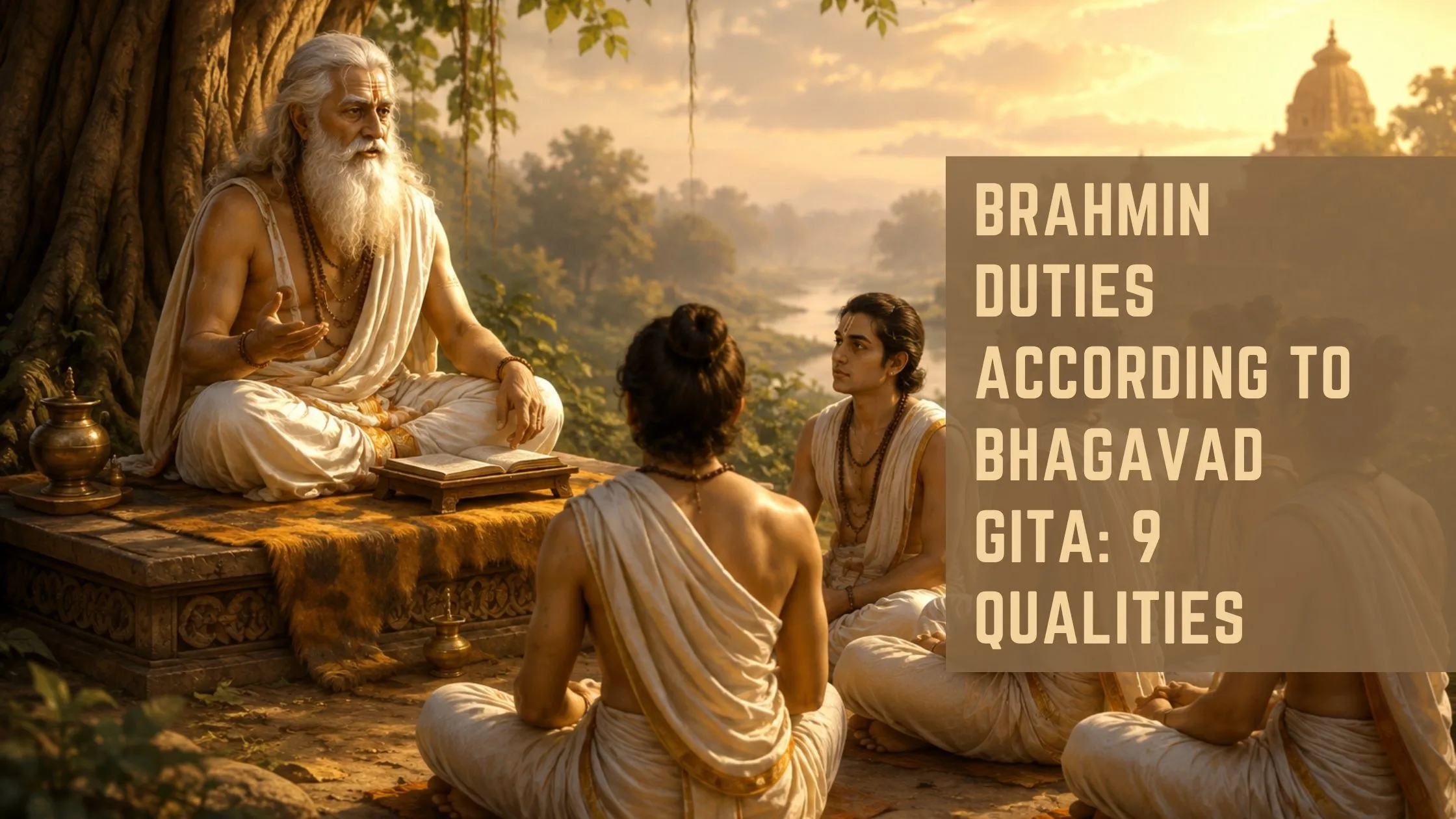
What makes a person a true Brahmin according to the Bhagavad Gita? Is it simply a social position, a profession, or something deeper?
In Chapter 18, Krishna gives a remarkably detailed answer. While discussing different forms of work and qualities, He describes the Brahmin duties through a group of inner virtues. Bhagavad Gita 18.42 lists peacefulness, self-control, austerity, purity, tolerance, straightforwardness, knowledge, wisdom, and faith as qualities associated with Brahmin nature.
This is important because the verse shifts attention from external status toward character and conduct.
The Sanskrit expression brahma-karma svabhava-jam is commonly translated as the duties or work of the Brahmanas arising from their nature. Different translations use slightly different words for example, “religiousness,” “faith,” or “belief in God” for āstikyam, and “wisdom,” “realisation,” or “special knowledge” for vijñānam.
Understanding these teachings can help us explore what spiritual discipline, learning, integrity, and self-mastery mean in everyday life.
Table of Contents
- Key Takeaways
- What Are Brahmin Duties According to the Bhagavad Gita?
- Brahmin Duties: Character Before Status
- Brahmin Duties vs Brahmin Profession
- Are Brahmin Duties Relevant Today?
- What Can We Learn From Brahmin Duties Today?
- Brahmin, Brahman, and Brahma: What Is the Difference?
- Why Bhagavad Gita 18.42 Matters
- Frequently Asked Questions
- Conclusion
Key Takeaways
- Brahmin duties are described in Bhagavad Gita 18.42 through nine qualities.
- These include peace, self-control, austerity, purity, tolerance, honesty, knowledge, wisdom, and faith.
- Krishna describes them as qualities arising from one's nature.
- Knowledge is paired with wisdom, suggesting that learning should become lived understanding.
- Self-control and purity are presented as essential parts of spiritual discipline.
- The teaching can be studied as a framework for character development and spiritual responsibility.
- Brahmin, meaning a member of the Brahmana varna in this context, should not be confused with Brahman, the term used in Indian philosophy for ultimate reality.

What Are Brahmin Duties According to the Bhagavad Gita?
The most direct answer appears in Bhagavad Gita 18.42:
शमो दमस्तपः शौचं क्षान्तिरार्जवमेव च ।
ज्ञानं विज्ञानमास्तिक्यं ब्रह्मकर्म स्वभावजम् ॥
The verse identifies nine qualities associated with Brahmin nature:
| Sanskrit quality | Common meaning | Practical expression |
|---|---|---|
| Shama | Peacefulness | Calmness of mind |
| Dama | Self-control | Regulation of the senses |
| Tapas | Austerity | Disciplined living |
| Shaucha | Purity | Cleanliness and inner integrity |
| Kshanti | Tolerance | Patience and forgiveness |
| Arjava | Straightforwardness | Honesty and sincerity |
| Jnana | Knowledge | Study and understanding |
| Vijnana | Wisdom/realisation | Applying knowledge deeply |
| Astikya | Faith | Spiritual conviction |
These nine qualities are explicitly connected with brahma-karma and svabhava-jam in the verse.
1. Peacefulness — Shama
The first of the Brahmin duties is shama, commonly translated as peacefulness or serenity.
This refers to the ability to cultivate a calm and disciplined mind. A person may face criticism, success, failure, temptation, or uncertainty, yet still strive to remain internally balanced.
Peace does not mean avoiding life's responsibilities. It means learning not to become completely controlled by every emotional reaction.
Modern lesson
Before reacting, pause.
Before speaking, reflect.
Before making an important decision, calm the mind.
This makes shama relevant far beyond ancient religious settings.
2. Self-Control — Dama
The second quality is dama, or self-control.
The Bhagavad Gita connects spiritual growth with mastery over the senses and mind. Traditional commentaries distinguish shama as control or quieting of the inner mind and dama as restraint of the external senses.
Self-control does not mean suppressing every desire. It means developing the ability to choose wisely rather than automatically following every impulse.
For example:
- Choosing discipline over procrastination
- Choosing thoughtful speech over angry words
- Choosing moderation over excess
- Choosing long-term purpose over short-term pleasure
This is one of the most practical Brahmin duties for modern life.
3. Austerity — Tapas
Tapas means austerity, disciplined effort, or voluntary self-restraint.
It is not necessarily about extreme physical hardship. Instead, it can be understood as the willingness to maintain discipline even when something is difficult.
A student who studies consistently, a teacher who continues learning, or a seeker who maintains spiritual practice despite distractions can all illustrate this principle.
The underlying lesson is simple:
Growth requires discipline.
4. Purity — Shaucha
Another important element of Brahmin duties is shaucha, or purity.
Purity can be understood on multiple levels:
- Physical cleanliness
- Purity of intention
- Integrity in action
- Clarity of thought
- Honesty in relationships
A person may appear disciplined externally while carrying jealousy, dishonesty, or harmful intentions internally. The deeper spiritual ideal is therefore not merely external cleanliness but inner refinement as well.
Some traditional commentaries distinguish external and internal forms of purity.
5. Tolerance and Forgiveness — Kshanti
The fifth quality is kshanti, often translated as tolerance, patience, or forgiveness.
This does not mean accepting injustice without thought. Rather, it points toward the ability to endure difficulties without allowing anger and resentment to completely dominate the mind.
Imagine someone insulting you.
The immediate reaction may be anger.
The disciplined response is to pause, understand the situation, and choose an appropriate action instead of reacting blindly.
This quality makes tolerance one of the most meaningful Brahmin duties for relationships and society.
6. Straightforwardness — Arjava
Arjava is associated with straightforwardness, honesty, sincerity, or uprightness.
It means reducing the gap between what one thinks, says, and does.
A spiritually disciplined person should not need deception to maintain an image.
Straightforwardness can appear in simple actions:
- Keeping promises
- Speaking honestly
- Avoiding manipulation
- Accepting mistakes
- Treating people fairly
In this sense, Brahmin duties are not merely about acquiring knowledge. They also require integrity.
7. Knowledge — Jnana
Jnana means knowledge.
For the Brahmin ideal described in the Gita, learning has an important role. Traditional interpretations associate this quality with knowledge gained through scriptural and philosophical study.
But knowledge should not become a reason for pride.
The purpose of genuine knowledge is to reduce ignorance.
A person who knows many scriptures but cannot control anger, ego, dishonesty, or selfishness has not necessarily transformed that knowledge into wisdom.
This leads to the next quality.
8. Wisdom and Realisation — Vijnana
The Gita places jnana and vijnana together.
This distinction is valuable.
Knowledge can mean understanding an idea intellectually.
Wisdom means allowing that understanding to become part of one's life.
For example, someone may know that attachment creates suffering. That is knowledge.
Learning to remain balanced when something is lost is closer to lived wisdom.
Traditional commentary on this verse similarly distinguishes knowledge from wisdom or realisation.
Therefore, the deeper Brahmin duties involve not only learning truth but living according to it.
9. Faith — Astikya
The final quality mentioned in Bhagavad Gita 18.42 is astikya, translated variously as faith, religiousness, or spiritual conviction.
Faith here can be understood as trust in spiritual truth and the path of higher knowledge.
For a seeker, faith provides the strength to continue studying, questioning, practicing, and growing even when immediate results are not visible.
Faith and knowledge therefore need not be opposites.
In the Gita's framework, sincere faith can support the pursuit of deeper understanding.
Brahmin Duties: Character Before Status
One of the most important ways to understand this teaching is to focus on the qualities Krishna actually lists.
The verse does not begin by describing wealth, political authority, social privilege, or material success. Instead, it describes inner qualities and disciplined conduct.
The central themes are:
Mind → Senses → Discipline → Purity → Patience → Integrity → Knowledge → Wisdom → Faith
This progression provides a useful framework for thinking about spiritual responsibility.
At the same time, the verse belongs to the Gita's discussion of varna and svabhava, so it should be understood within its historical and philosophical context rather than automatically treated as a modern occupational classification.
Brahmin Duties vs Brahmin Profession
It is also useful to distinguish between qualities and traditional occupations.
Some traditional interpretations associate Brahmanas with activities such as teaching, studying sacred knowledge, performing or guiding rituals, and offering spiritual counsel.
However, Bhagavad Gita 18.42 itself specifically highlights the nine qualities listed above.
| Inner quality | Possible expression |
|---|---|
| Peacefulness | Calm leadership |
| Self-control | Disciplined conduct |
| Austerity | Consistent practice |
| Purity | Ethical living |
| Tolerance | Forgiveness |
| Straightforwardness | Honesty |
| Knowledge | Study and teaching |
| Wisdom | Practical spiritual understanding |
| Faith | Devotion and conviction |
This distinction helps prevent the verse from being reduced to a simple list of occupations.
Are Brahmin Duties Relevant Today?
Yes, if approached as a framework for character, learning, discipline, and spiritual responsibility.
A modern person can apply these principles regardless of profession.
A teacher can practice patience.
A student can practice disciplined learning.
A businessperson can practice honesty.
A parent can practice self-control.
A spiritual seeker can cultivate purity and faith.
The practical lesson is that knowledge becomes meaningful when it transforms behavior.
What Can We Learn From Brahmin Duties Today?
The nine qualities can be converted into a simple daily practice:
- Calm the mind before reacting.
- Control impulses instead of being controlled by them.
- Maintain discipline even when motivation disappears.
- Keep intentions and actions pure.
- Practice patience during conflict.
- Speak honestly and avoid unnecessary manipulation.
- Keep learning throughout life.
- Turn information into wisdom through experience.
- Maintain faith in a meaningful spiritual path.
In this way, the ancient teaching becomes a practical guide for personal development.
Brahmin, Brahman, and Brahma: What Is the Difference?
These three terms are often confused.
Brahmin (ब्राह्मण) refers to the Brahmana category or social/spiritual class discussed in texts such as the Bhagavad Gita.
Brahman (ब्रह्मन्) is a philosophical term commonly used for ultimate reality in Hindu thought.
Brahma (ब्रह्मा) refers to the creator deity within the Hindu Trimurti.
Therefore, Brahmin duties and teachings about Brahman are not the same topic.
This distinction is particularly important when researching Bhagavad Gita terminology.
Why Bhagavad Gita 18.42 Matters
Bhagavad Gita 18.42 is one of the clearest verses for understanding the qualities associated with Brahmin nature.
Rather than presenting spirituality as merely an external identity, Krishna's description centers on:
- Inner peace
- Self-mastery
- Discipline
- Purity
- Patience
- Integrity
- Learning
- Wisdom
- Faith
Different translations use slightly different English terms, but the underlying Sanskrit list remains consistent across the sources consulted.
The verse therefore offers a powerful question for self-reflection:
Am I simply collecting spiritual knowledge, or am I allowing that knowledge to transform the way I live?
Frequently Asked Questions
1. What are the Brahmin duties according to Bhagavad Gita?
Bhagavad Gita 18.42 describes nine qualities associated with Brahmin duties: peacefulness, self-control, austerity, purity, tolerance, straightforwardness, knowledge, wisdom, and faith.
2. Which Bhagavad Gita verse describes Brahmin duties?
The primary verse is Bhagavad Gita 18.42, which explicitly uses the expression brahma-karma svabhava-jam and lists the qualities associated with Brahmana nature.
3. How many qualities of a Brahmin are mentioned in Bhagavad Gita 18.42?
Nine qualities are mentioned: shama, dama, tapas, shaucha, kshanti, arjava, jnana, vijnana, and astikya.
4. What does shama mean in Brahmin duties?
Shama generally refers to peacefulness, serenity, or control of the mind. It represents inner calm and mental discipline.
5. What does dama mean?
Dama means self-control or restraint of the senses. It teaches a person not to become a slave to every impulse.
6. Are Brahmin duties only about studying scriptures?
No. While knowledge and learning are important, Bhagavad Gita 18.42 also emphasizes peace, self-control, purity, patience, honesty, wisdom, and faith.
Conclusion
The Brahmin duties described in Bhagavad Gita 18.42 go far beyond a simple list of social responsibilities. Krishna presents a picture of a person committed to peacefulness, self-control, discipline, purity, tolerance, honesty, knowledge, wisdom, and faith.
These qualities remind us that spiritual development is not measured only by what we know, but also by how we live.
Knowledge should create humility.
Discipline should create strength.
Wisdom should create better decisions.
Faith should create perseverance.
And self-control should create inner freedom.
For anyone studying the Bhagavad Gita today, these teachings offer an enduring invitation: cultivate the qualities that lead the mind from confusion toward clarity and from knowledge toward wisdom.
Want to explore more teachings from the Bhagavad Gita? Read more Krishna teachings, Gita verses, spiritual lessons, and practical wisdom on TheGita.in and discover how ancient wisdom can guide modern life.