"If Krishna is an incarnation of Lord Vishnu, why does He declare Himself to be the Supreme Reality in the Bhagavad Gita?"
This profound question has intrigued saints, philosophers, scholars, and spiritual seekers for thousands of years. Across Hindu philosophy, the concept of Brahman refers to the eternal, infinite, and absolute reality—the source of everything that exists. Yet, in the Bhagavad Gita, Lord Krishna makes extraordinary declarations about His own divine nature, leading many to ask:
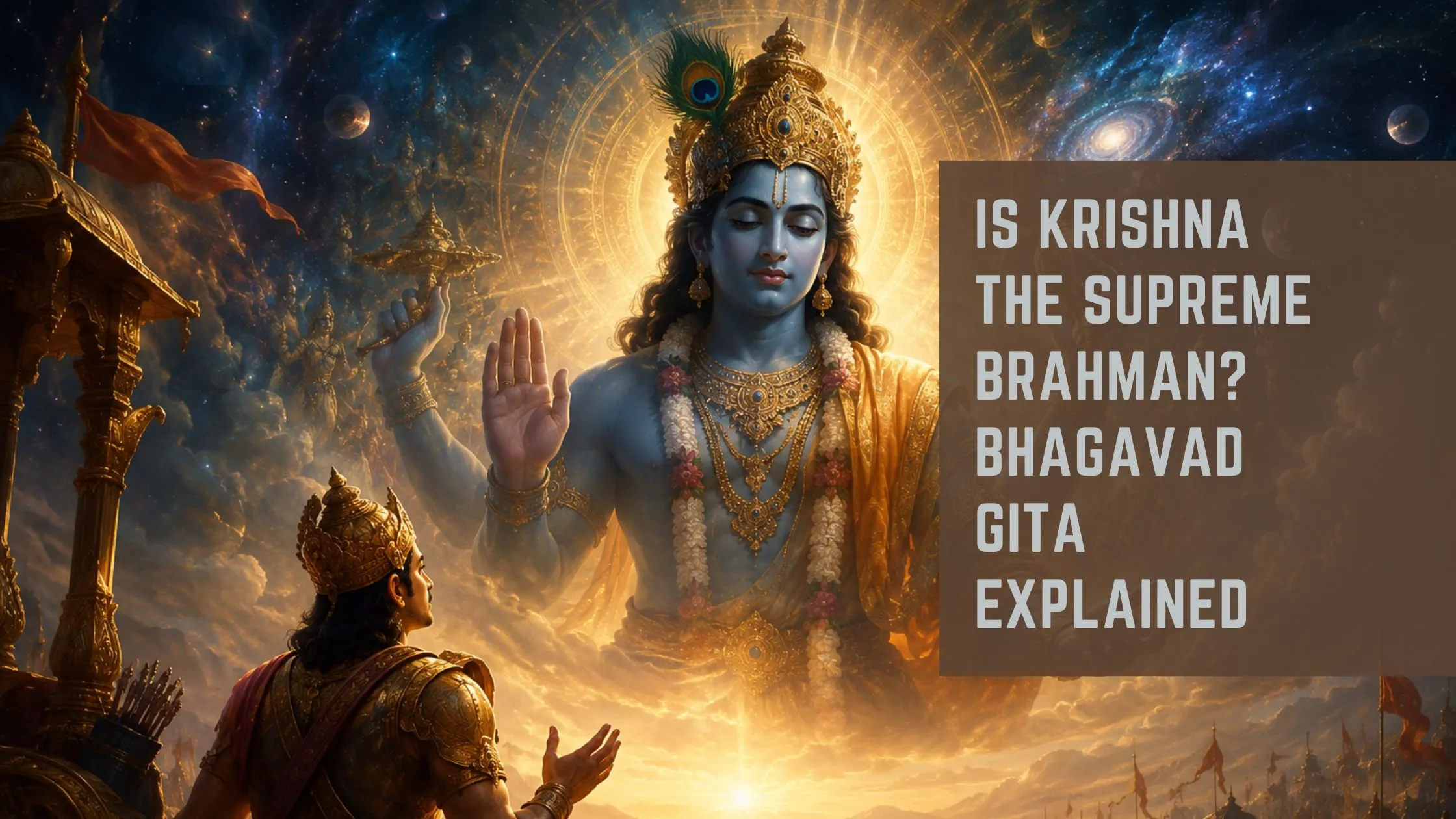
Is Krishna the Supreme Brahman?
The Bhagavad Gita does not merely present Krishna as a wise teacher or a heroic prince. It reveals Him as the ultimate source of creation, the indweller of every heart, and the Supreme Truth beyond time and space. Different Vedantic traditions explain this in unique ways, but they all agree that Krishna's teachings reveal the deepest truths about the Divine.
In this article, we'll explore what the Bhagavad Gita says, examine key verses, understand the concept of Brahman, compare philosophical viewpoints, and discover what Krishna's supreme nature means for our own spiritual journey.
Featured Snippet
Yes, according to the Bhagavad Gita, Lord Krishna is presented as the Supreme Brahman (Parabrahman)—the ultimate source of all creation, consciousness, and existence. While different schools of Vedanta interpret this relationship differently, the Gita repeatedly describes Krishna as the highest reality from whom everything originates and in whom everything ultimately rests.
Key Takeaways
- Krishna declares Himself the source of the entire universe.
- Brahman is the eternal, infinite, and absolute reality.
- The Bhagavad Gita identifies Krishna with the Supreme Reality.
- Different Vedanta schools interpret Krishna's relationship with Brahman differently.
- Realizing Krishna as the Supreme Brahman leads to devotion, wisdom, and liberation.
What Is Brahman?
In Hindu philosophy, Brahman is the highest, eternal, and infinite reality. It is neither born nor destroyed. Everything that exists originates from Brahman, exists within Brahman, and eventually returns to Brahman.
The Upanishads describe Brahman as:
- Eternal
- Infinite
- Omnipresent
- Omniscient
- Beyond birth and death
- The source of all existence
Unlike physical objects, Brahman is not limited by time, space, or form. It is the ultimate truth that exists beyond all appearances.
"Brahman is not something you create or discover; it is the eternal reality that has always existed."
Who Is Lord Krishna?
Lord Krishna is revered as one of Hinduism's most beloved deities. In the Mahabharata, He serves as Arjuna's charioteer, friend, philosopher, and spiritual guide. However, the Bhagavad Gita gradually reveals a much deeper identity.
Krishna is presented as:
- The creator of the universe
- The sustainer of all beings
- The supreme teacher of dharma
- The indwelling Self within every heart
- The ultimate refuge for humanity
Rather than merely teaching about God, Krishna speaks as the Divine Himself.
Why Do People Ask If Krishna Is the Supreme Brahman?
The question arises because Hindu scriptures describe Brahman as formless, eternal, and beyond human comprehension, while Krishna appears in a beautiful human form.
This naturally leads to questions such as:
- Is Krishna simply an avatar?
- Is Krishna identical with Brahman?
- Is Brahman greater than Krishna?
- Can the infinite take a personal form?
The Bhagavad Gita addresses these questions through Krishna's own declarations.
Bhagavad Gita Verses That Reveal Krishna's Supreme Nature
1. Bhagavad Gita 10.8
अहं सर्वस्य प्रभवो मत्तः सर्वं प्रवर्तते।
Translation
"I am the source of all spiritual and material worlds. Everything emanates from Me."
Meaning
This verse is one of the strongest declarations of Krishna's supreme position. Rather than being one among many gods, Krishna identifies Himself as the origin of everything.
If everything originates from Him, then He is understood as the Supreme Reality.
2. Bhagavad Gita 7.7
मत्तः परतरं नान्यत्किञ्चिदस्ति धनञ्जय।
Translation
"There is no truth superior to Me, O Arjuna."
Meaning
Krishna leaves little room for ambiguity. He clearly states that nothing exists above Him.
For many Vedantic scholars, this verse strongly supports the understanding of Krishna as the Supreme Brahman.
3. Bhagavad Gita 9.4
मया ततमिदं सर्वं जगदव्यक्तमूर्तिना।
Translation
"By My unmanifest form, I pervade this entire universe."
Meaning
Although Krishna appears in human form, He explains that His divine existence transcends physical limitations. His presence permeates the entire cosmos.
What Does "Supreme Brahman" Mean?
The word Parabrahman literally means "the Highest Brahman" or "the Supreme Absolute Reality."
Its characteristics include:
- Infinite knowledge
- Infinite power
- Eternal bliss
- Absolute truth
- Source of all existence
- Beyond birth and death
- Independent of everything else
The Bhagavad Gita attributes all of these qualities to Lord Krishna.
Is Krishna Different from Brahman?
The answer depends on the philosophical tradition.
| School | Understanding |
|---|---|
| Advaita Vedanta | Krishna is the manifestation of Nirguna Brahman for devotees. Ultimately Brahman alone exists. |
| Vishishtadvaita | Krishna is the personal Supreme Brahman possessing infinite auspicious qualities. |
| Dvaita Vedanta | Krishna is the Supreme Lord, eternally distinct from individual souls. |
| Gaudiya Vaishnavism | Krishna is the original Personality of Godhead and the source even of Vishnu's expansions. |
Although interpretations differ, Krishna's supreme status remains central across these traditions.
"Truth is one, but wise seekers explain it in different ways."
Krishna, Brahman, and Paramatma
Understanding these three concepts helps clarify the teachings of the Bhagavad Gita.
| Aspect | Brahman | Paramatma | Krishna |
| Nature | Absolute Reality | Supreme Soul within all beings | Supreme Personal God |
| Relationship | Impersonal aspect | Localized aspect | Complete manifestation of the Divine |
| Experience | Through knowledge | Through meditation | Through devotion, knowledge, and surrender |
Many Vaishnava traditions explain these as different realizations of the same Supreme Reality, with Krishna representing its fullest personal expression.
Why Krishna's Teachings Matter Today
Recognizing Krishna as the Supreme Brahman is not merely a theological idea. It transforms the way we view ourselves and the world.
When we see all beings as connected to the same divine source, we naturally cultivate compassion, humility, and responsibility. Krishna's teachings encourage us to perform our duties without attachment, remain steady in success and failure, and seek lasting peace through spiritual wisdom rather than temporary pleasures.
These lessons remain deeply relevant in today's fast-paced world, where stress, comparison, and uncertainty often dominate daily life.
"The one who sees the Divine in all beings and all beings in the Divine never feels separated from the truth."
Life Lessons from Krishna as the Supreme Brahman
Whether one follows Advaita, Vishishtadvaita, Dvaita, or another Vedantic tradition, the Bhagavad Gita teaches timeless principles that can transform everyday life. Understanding Krishna as the Supreme Brahman is not merely a philosophical concept—it is a guide to living with purpose, wisdom, and devotion.
1. Trust the Divine Plan
Krishna reminds Arjuna that the Supreme Reality governs the universe with perfect wisdom. Even when life appears uncertain, every experience can become an opportunity for growth.
Lesson: Have faith that challenges are temporary and that every action performed with sincerity has meaning.
2. Perform Your Duty Without Attachment
One of Krishna's central teachings is to focus on righteous action rather than becoming attached to results.
Lesson: Success and failure should not define your peace of mind. Dedicate your efforts to the highest purpose and let go of anxiety about outcomes.
"Peace begins when attachment to results ends."
3. See the Divine in Everyone
If Krishna is the Supreme Brahman and all beings exist within Him, then every person deserves respect, kindness, and compassion.
Lesson: Treat others with empathy, regardless of differences in status, beliefs, or background.
4. Seek Knowledge Alongside Devotion
The Bhagavad Gita beautifully balances wisdom (Jnana), action (Karma), and devotion (Bhakti). Understanding Krishna's divine nature deepens both faith and self-awareness.
Lesson: Spiritual growth comes through learning, reflection, and sincere practice.
5. Surrender Does Not Mean Weakness
Krishna encourages Arjuna to surrender—not by abandoning responsibility, but by placing complete trust in the Divine while continuing to fulfill his duty.
Lesson: True surrender is an expression of courage, humility, and confidence in God's guidance.
Modern Relevance: Why This Teaching Matters Today
The question "Is Krishna the Supreme Brahman?" is more than a theological debate. It has practical significance in the modern world.
For Students
Krishna's teachings inspire discipline, focus, and resilience during academic and personal challenges.
For Professionals
The principle of selfless action encourages ethical leadership, dedication, and balance in the workplace.
For Families
Recognizing the divine presence in every individual fosters love, forgiveness, and stronger relationships.
For Spiritual Seekers
Understanding Krishna as the Supreme Brahman encourages deeper meditation, devotion, and the pursuit of self-realization.
For Society
The Bhagavad Gita teaches that inner transformation is the foundation of outer harmony. A society rooted in compassion, truth, and selflessness naturally becomes more peaceful.
Common Misconceptions
Misconception 1: Krishna Is Only a Historical Figure
The Bhagavad Gita presents Krishna not only as a historical personality but also as the eternal Divine Reality that transcends time.
Misconception 2: Brahman Is Completely Separate from Krishna
Many Vedantic traditions explain that Krishna is the fullest manifestation of the Supreme Brahman, while others describe Him as Brahman appearing in a personal form. Understanding the philosophical context is essential.
Misconception 3: Realizing Brahman Is Only for Monks
Krishna teaches the Bhagavad Gita to Arjuna—a warrior engaged in worldly responsibilities. This demonstrates that spiritual realization is possible while fulfilling one's duties with sincerity and devotion.
Frequently Asked Questions (FAQs)
1. Is Krishna the Supreme Brahman according to the Bhagavad Gita?
Yes. The Bhagavad Gita contains several verses in which Krishna identifies Himself as the source of all creation, the highest reality, and the ultimate refuge. Many Vedantic traditions therefore recognize Him as the Supreme Brahman.
2. What does "Supreme Brahman" mean?
The Supreme Brahman (Parabrahman) refers to the highest, eternal, infinite, and absolute reality that is the source, sustainer, and ultimate goal of the universe.
3. Is Brahman different from God?
The answer depends on the philosophical tradition. In many schools of Hindu philosophy, Brahman is understood as the ultimate reality, while Krishna represents its complete personal manifestation.
4. Which Bhagavad Gita verses describe Krishna as the Supreme?
Some of the most significant verses include:
- Bhagavad Gita 7.7
- Bhagavad Gita 9.4
- Bhagavad Gita 10.8
- Bhagavad Gita 15.15
- Bhagavad Gita 18.66
These verses highlight Krishna's supreme position and His relationship with all existence.
5. What is the relationship between Krishna, Brahman, and Paramatma?
The Bhagavad Gita presents these as interconnected understandings of the Divine. Brahman is the all-pervading absolute reality, Paramatma is the Divine present in every heart, and Krishna reveals Himself as the Supreme Personality from whom everything originates.
Final Thoughts
The question "Is Krishna the Supreme Brahman?" has inspired centuries of spiritual reflection. While different Vedantic schools explain this relationship in distinct ways, the Bhagavad Gita consistently presents Krishna as the ultimate source of creation, the indwelling Lord of every heart, and the highest refuge for humanity.
More importantly, the Gita invites readers not merely to debate philosophy but to experience its truth through righteous living, selfless action, devotion, and inner realization. Whether one approaches Krishna through knowledge, meditation, or loving devotion, His teachings encourage a life rooted in wisdom, compassion, and unwavering faith.
As Krishna declares in the Bhagavad Gita, the ultimate purpose of spiritual life is not simply to understand the Divine intellectually but to cultivate a relationship with the Supreme Reality that transforms the heart and guides every action.
"When wisdom and devotion unite, the seeker discovers not only who Krishna is—but also their own eternal nature."
If you wish to deepen your understanding of the Bhagavad Gita, explore verse-by-verse explanations, timeless life lessons, and practical spiritual wisdom at TheGita.in.