What happens when hope is born in the darkest hour?
The birth of Lord Krishna is more than an ancient story of a divine child. It is a story of faith in the face of fear, courage in the face of oppression, and the triumph of dharma over adharma.
According to the traditional account in the Bhagavata Purana, Krishna was born in Mathura to Devaki and Vasudeva, at a time when the cruel King Kansa had created an atmosphere of fear. His birth is celebrated as Janmashtami, one of the most important festivals dedicated to Lord Krishna.
But why was Krishna born in a prison? Why did Kansa fear Devaki's eighth child? Why did Vasudeva carry the newborn Krishna across the Yamuna in the middle of the night?
And most importantly what does Krishna's birth teach us about our own lives?
Let's explore the complete Krishna birth story and the deeper meaning behind it.
Table of Contents
- Key Takeaways
- The Story Before Krishna's Birth
- Why Did Kansa Fear Krishna?
- Devaki and Vasudeva in Prison
- The Divine Birth of Lord Krishna
- Why Was Krishna Born in a Prison?
- Vasudeva Carries Krishna to Gokul
- Vasudeva and the Yamuna
- Krishna Arrives in Gokul
- Why Is Krishna's Birth Celebrated as Janmashtami?
- 7 Life Lessons From Krishna's Birth Story
- Krishna's Birth and the Bhagavad Gita
- The Deeper Meaning of Krishna's Birth
- Frequently Asked Questions
- Conclusion
Key Takeaways
- Krishna was born to Devaki and Vasudeva in Mathura.
- Kansa feared a prophecy that Devaki's eighth child would cause his downfall.
- Krishna's birth took place in the prison where Devaki and Vasudeva were confined.
- Vasudeva secretly carried Krishna to Gokul to protect him.
- Krishna's arrival symbolizes the restoration of dharma and hope.
- His birth story teaches us about faith, courage, surrender and righteousness.
- Krishna's appearance is closely connected with his later teachings in the Bhagavad Gita.
The Story Before Krishna's Birth
Devaki and Vasudeva's Marriage
Devaki, the daughter of Devaka, married Vasudeva, a respected member of the Yadu dynasty.
According to the traditional account, Devaki's cousin Kansa, the ruler of Mathura, personally drove the newly married couple's chariot.
Everything appeared joyful until a divine voice announced a terrifying prophecy:
Devaki's eighth child would become the cause of Kansa's downfall.
The prophecy transformed Kansa's happiness into fear. He wanted to kill Devaki immediately, but Vasudeva intervened and promised that he would surrender their children to Kansa.
The Bhagavata Purana describes how Kansa's fear gradually turned into tyranny, eventually leading to the imprisonment of Devaki and Vasudeva.
Why Did Kansa Fear Krishna?
Kansa's greatest weakness was fear.
Although he was powerful and ruled Mathura, the prophecy made him constantly afraid of losing his life and power.
Instead of changing his actions, Kansa attempted to destroy the future he feared.
This is one of the first lessons hidden within the Krishna birth story:
Fear can make even a powerful person powerless.
Kansa had a kingdom, authority and strength, but he could not control destiny.
His obsession with protecting himself ultimately became the very path toward his downfall.
Devaki and Vasudeva in Prison
Kansa imprisoned Devaki and Vasudeva and closely guarded them.
According to traditional accounts, Devaki gave birth to several children, and Kansa killed them because of his fear of the prophecy. The story describes the enormous suffering experienced by the parents before Krishna's birth.
Imagine the emotional weight of that situation.
A mother knows that her newborn child is in danger.
A father knows that the ruler of the kingdom may take the child away.
Yet, in the middle of this darkness, something extraordinary is about to happen.
Krishna is about to be born.
The Divine Birth of Lord Krishna
Krishna was born on the eighth day of the dark fortnight of the month of Bhadrapada, traditionally celebrated as Janmashtami.
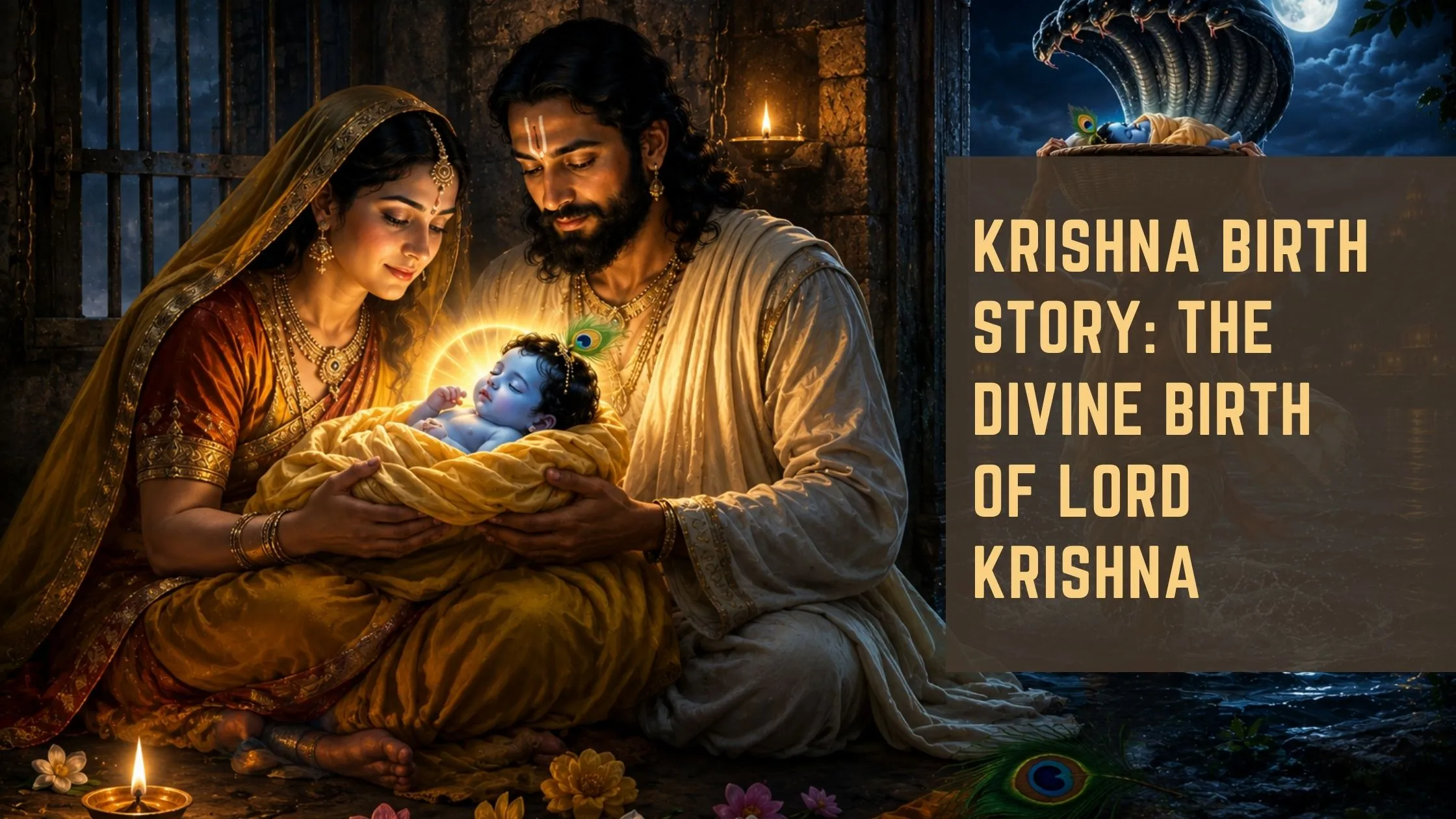
The traditional narrative places his birth at midnight in Mathura, while Devaki and Vasudeva were imprisoned.
His birth is described not simply as an ordinary human birth but as the divine appearance of the Supreme Being.
This connects directly with Krishna's own words in the Bhagavad Gita.
Bhagavad Gita 4.7
“यदा यदा हि धर्मस्य ग्लानिर्भवति भारत...”
The verse explains that whenever dharma declines and adharma rises, Krishna manifests Himself.
The following verse explains the purpose:
“परित्राणाय साधूनां विनाशाय च दुष्कृताम्।
धर्मसंस्थापनार्थाय सम्भवामि युगे युगे॥”
Meaning: Krishna manifests to protect the righteous, overcome wrongdoing and re-establish dharma.
This gives Krishna's birth a deeper meaning.
He does not appear merely to change one historical event. His appearance represents the restoration of righteousness.
Why Was Krishna Born in a Prison?
This is one of the most fascinating aspects of the Krishna birth story.
Krishna could have appeared in a palace surrounded by comfort and celebration.
Instead, tradition places his birth in a prison cell.
There is a profound spiritual message here.
Sometimes light appears exactly where darkness seems strongest.
Krishna's birth teaches us that difficult circumstances do not necessarily mean that hope has disappeared.
“जहाँ अंधकार सबसे गहरा होता है, वहीं प्रकाश के जन्म की संभावना सबसे अधिक होती है।”
The prison can therefore be understood not only as a physical place but also as a symbol of fear, oppression and limitation.
Krishna's arrival represents the possibility of freedom from all three.
Vasudeva Carries Krishna to Gokul
After Krishna's birth, Vasudeva was instructed to take the newborn child to Gokul, where Nanda and Yashoda lived.
According to the traditional story, the prison guards fell into a deep sleep, the chains were released, and the prison doors opened.
Vasudeva placed baby Krishna in a basket and began his journey through the night.
He had one mission:
Protect the child.
Vasudeva and the Yamuna
The journey led Vasudeva to the Yamuna River.
The river was flowing strongly, and carrying a newborn child across it seemed almost impossible.
Yet Vasudeva continued.
Traditional accounts describe Shesha Naga protecting Krishna from the rain with his hood as Vasudeva crossed the river.
This scene has become one of the most iconic images associated with Krishna Janmashtami.


The lesson?
Faith does not mean that the path will be easy.
It means continuing even when you cannot see the entire path ahead.
Vasudeva did not know everything that would happen next.
He simply took the next step.
Krishna Arrives in Gokul
Vasudeva eventually reached Gokul and found Nanda and Yashoda.
At that time, Yashoda had given birth to a child.
Vasudeva exchanged the newborns and returned to Mathura with the other baby.
When Kansa later came to the prison, he attempted to kill the child. The traditional narrative then describes the child revealing a divine form and warning Kansa that the one destined to defeat him was already elsewhere.
Krishna was therefore raised in Gokul under the loving care of Nanda and Yashoda.
And the divine child who had been born in a prison would soon become the beloved Makhan Chor, Gopala and Kanha of Vraja.
Why Is Krishna's Birth Celebrated as Janmashtami?
Janmashtami celebrates the appearance of Lord Krishna.
Devotees observe the occasion through:
- Fasting
- Bhajan and kirtan
- Krishna worship
- Reading or listening to Krishna's stories
- Decorating temples and homes
- Midnight celebrations
- Jhanki and Krishna's childhood scenes
- Chanting Krishna's names
But Janmashtami is more than a festival.
It invites us to ask:
Has Krishna's wisdom been born within us?
Because celebrating Krishna externally is meaningful, but understanding his teachings internally can transform our lives.
7 Life Lessons From Krishna's Birth Story
1. Hope Can Exist in Darkness
Krishna was born in a prison at midnight.
His story reminds us that difficult circumstances do not define the future.
Lesson: Never assume that today's darkness is permanent.
2. Fear Cannot Defeat Destiny
Kansa tried to escape the prophecy through violence.
Yet his fear only pushed him deeper into wrongdoing.
Lesson: Fear should not control our decisions.
3. Courage Means Taking the Next Step
Vasudeva had no guarantee that his journey would be easy.
Still, he carried Krishna across the Yamuna.
Lesson: When the entire path is unclear, focus on the next right action.
4. Dharma Requires Action
Krishna's appearance is associated with the restoration of dharma. The Bhagavad Gita explicitly connects his manifestation with the decline of righteousness and rise of adharma.
Lesson: Knowing what is right is not enough—we must act upon it.
5. Power Without Wisdom Leads to Destruction
Kansa possessed tremendous worldly power but was ruled by fear and ego.
Lesson: Real strength comes from self-control and wisdom, not domination.
6. Faith Gives Strength
Devaki and Vasudeva endured tremendous suffering while holding onto faith.
Lesson: Faith does not remove every difficulty, but it can give us the strength to endure it.
7. Light Eventually Overcomes Darkness
The central emotional movement of Krishna's birth story is from:
Fear → Hope
Darkness → Light
Adharma → Dharma
Imprisonment → Freedom
That is why Krishna's birth continues to resonate thousands of years later.
Krishna's Birth and the Bhagavad Gita
The Krishna birth story and the Bhagavad Gita are deeply connected.
The child born in Mathura eventually became Arjuna's charioteer and spiritual guide on the battlefield of Kurukshetra.
In the Gita, Krishna explains that his appearance is connected with the protection of righteousness and the restoration of dharma.
| Krishna's Birth Story | Spiritual Meaning |
|---|---|
| Prison | Inner limitations |
| Midnight | Darkness and uncertainty |
| Krishna's birth | Awakening of hope |
| Vasudeva's journey | Courage and faith |
| Yamuna | Obstacles in life |
| Gokul | Love and simplicity |
| Kansa | Fear, ego and tyranny |
| Krishna's mission | Restoration of dharma |
The Deeper Meaning of Krishna's Birth
Perhaps the most beautiful way to understand Janmashtami is this:
Krishna is not only born in Mathura. Krishna can also be born within us.
Whenever we choose truth over deception, courage over fear, compassion over hatred and dharma over selfishness, we allow Krishna's teachings to become alive in our own lives.
“कृष्ण का जन्म केवल मथुरा में नहीं हुआ था;
वे हर उस हृदय में जन्म लेते हैं जहाँ धर्म, प्रेम और सत्य जागते हैं।”
This is the deeper message behind the celebration.
Frequently Asked Questions
When was Lord Krishna born?
According to the traditional Hindu calendar, Krishna appeared on the eighth lunar day, Ashtami, of the dark fortnight of Bhadrapada. His birth is celebrated as Janmashtami.
Where was Lord Krishna born?
Krishna is traditionally believed to have been born in Mathura, in the prison where his parents Devaki and Vasudeva were confined.
Who were Krishna's parents?
Krishna's birth parents were Devaki and Vasudeva. He was later raised in Gokul by Nanda and Yashoda.
Why did Kansa want to kill Krishna?
A divine prophecy warned Kansa that Devaki's eighth child would be responsible for his downfall. His fear led him to commit cruel acts against Devaki's children.
Why did Vasudeva take Krishna to Gokul?
Vasudeva took the newborn Krishna to Gokul to protect him from Kansa and place him in the care of Nanda and Yashoda.
What is the main lesson of Krishna's birth?
One of the central lessons is that dharma and hope can emerge even in the darkest circumstances. Krishna's appearance is also connected in the Bhagavad Gita with restoring dharma when adharma rises.
What does Krishna's birth symbolize?
Krishna's birth can be understood as a symbol of hope, divine consciousness, courage, righteousness and the victory of dharma over adharma.
Conclusion
The Krishna birth story begins in a prison but does not end there.
It begins with fear but moves toward hope.
It begins under the rule of Kansa but ultimately leads toward the restoration of dharma.
And perhaps that is why Krishna's birth remains so meaningful today.
Janmashtami is not only a celebration of something that happened in the past. It can also become a reminder for the present:
When fear becomes powerful, choose courage.
When darkness surrounds you, protect the light.
When adharma rises, stand with what is right.
And when life feels uncertain, keep moving with faith.
Because the story of Krishna reminds us that even in the darkest night, a new light can be born.
Krishna's birth is not simply a story to remember it is a wisdom to live.
Explore the teachings of Lord Krishna and discover how the timeless wisdom of the Bhagavad Gita can bring clarity, courage and purpose to modern life.
Explore the timeless wisdom of Lord Krishna and discover how the teachings of the Bhagavad Gita can bring clarity, courage, and purpose to everyday life on TheGita.in.