
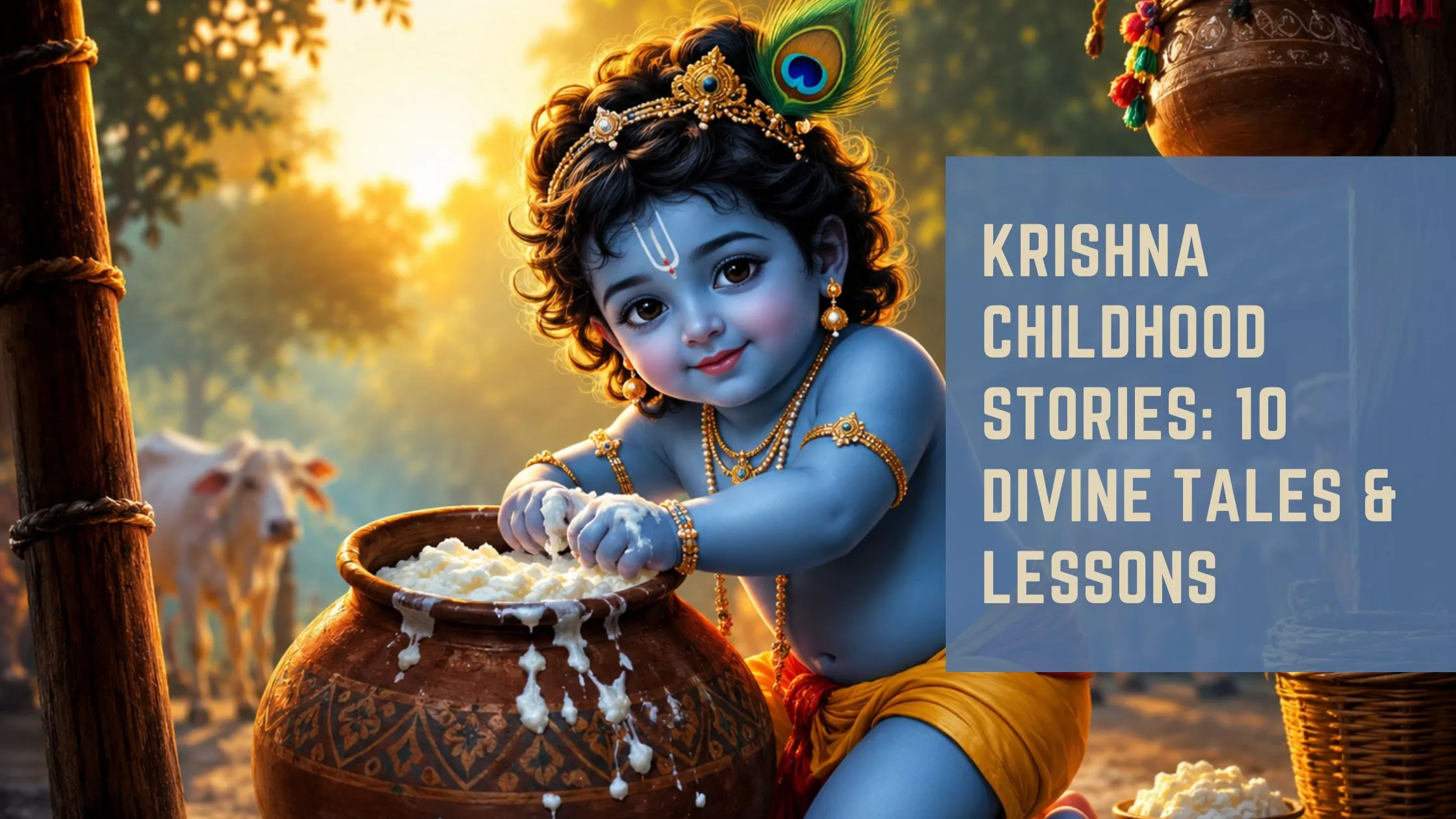
The Krishna childhood stories are among the most beloved tales in Hindu tradition. They portray Lord Krishna not only as a divine figure but also as a mischievous child who played with friends, stole butter, teased the residents of Gokul, and filled Vrindavan with joy.
These stories are especially memorable because they combine divine wisdom with childhood innocence. Krishna could perform extraordinary deeds while remaining playful, affectionate, and close to ordinary people.
Traditional accounts of Krishna’s childhood appear prominently in the Bhagavata Purana, particularly its Tenth Canto, along with other Vaishnava texts and devotional traditions.
For devotees, these stories represent more than miracles. Each episode carries a deeper message about dharma, bhakti, fearlessness, surrender, friendship, and the relationship between the individual soul and the Divine.
Table of Contents
- Key Takeaways
- Krishna Childhood Stories Every Devotee Should Know
- What Does Govardhan Hill Teach Us?
- Krishna Childhood Stories About Friendship
- Krishna and His Cowherd Friends
- Krishna and Kaliya: The Serpent in the Yamuna
- Krishna’s Childhood Stories and the Meaning of Play
- Why Krishna Childhood Stories Still Matter Today
- Lessons From Krishna Childhood Stories
- Krishna Childhood Stories: Historical and Scriptural Context
- Frequently Asked Questions
- Conclusion
Key Takeaways
- Krishna’s childhood is traditionally associated with Gokul, Nanda’s village, and Vrindavan.
- His butter-stealing stories symbolize the intimate love between Krishna and his devotees.
- The defeat of demons such as Putana represents the triumph of divine protection over destructive forces.
- The Govardhan story highlights faith, community, humility, and protection of nature.
- Krishna’s childhood friendships demonstrate affection without selfish expectations.
- These stories remain relevant because their lessons can be applied to modern relationships and everyday challenges.
- The Krishna childhood stories connect playful incidents with profound spiritual ideas.
Krishna Childhood Stories Every Devotee Should Know
1. Krishna’s Birth in Mathura
Although Krishna spent most of his early childhood in Gokul and Vrindavan, his story begins in Mathura.
According to tradition, Krishna was born to Devaki and Vasudeva while the kingdom was ruled by the cruel King Kamsa. A prophecy had warned Kamsa that Devaki’s eighth child would become the cause of his downfall.
To protect the newborn child, Vasudeva secretly carried Krishna across the Yamuna River to Gokul and placed him in the care of Nanda and Yashoda.
This beginning establishes one of the central themes of Krishna’s life: divine purpose can unfold even in the middle of fear and uncertainty.
2. Krishna and Mother Yashoda
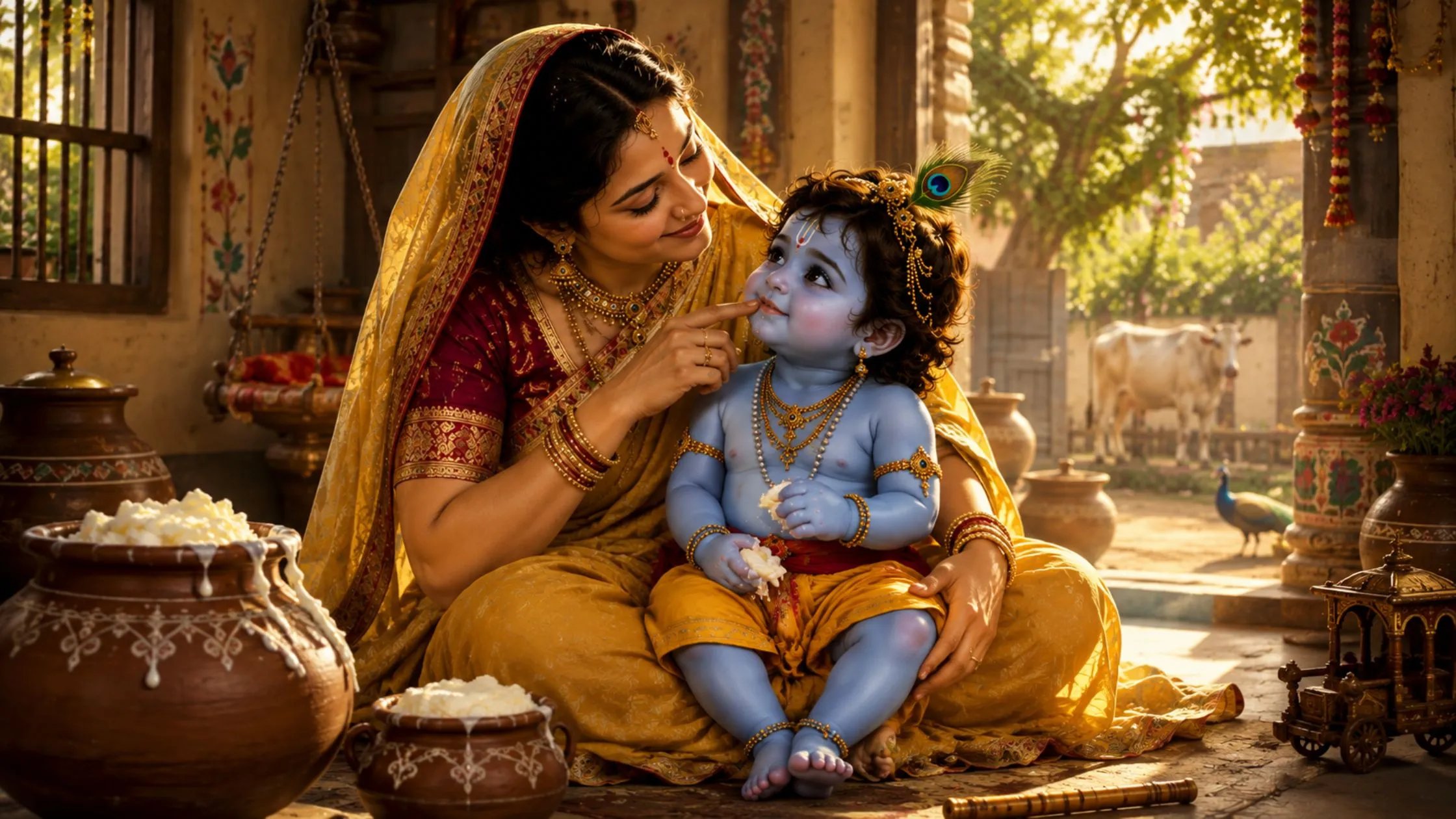
Among the most touching Krishna childhood stories are the stories of Krishna and Yashoda.
Yashoda loved Krishna as her own son and often had to deal with his mischievous behavior. Krishna’s relationship with her represents vatsalya bhava the devotional attitude of loving God as a child.
One famous episode occurs when Yashoda sees the entire universe inside Krishna’s mouth after hearing that he has eaten mud.
Instead of simply presenting Krishna as an all-powerful deity, the story shows the mystery of divine love: the infinite can become intimately close to the devotee.
3. Krishna’s Butter-Stealing Adventures
Perhaps no story captures Krishna’s playful personality better than his love for butter.
According to devotional traditions, Krishna and his friends would enter homes in Gokul and steal freshly prepared butter. The residents would complain to Yashoda, but Krishna’s charming behavior made it difficult to remain angry with him.
This is why Krishna is affectionately called Makhan Chor, or “the butter thief.”
But what does the butter symbolize?
Devotional interpretations often understand butter as representing the pure essence of the heart. Krishna “stealing butter” can therefore be understood metaphorically as Krishna winning the purified heart of his devotee.
The playful Krishna childhood stories surrounding butter remind us that spirituality does not always have to appear serious or distant.
4. Krishna and Putana
One of the darker episodes in Krishna’s childhood involves Putana.
According to the Bhagavata Purana, Putana approached Krishna while disguised as a woman who intended to harm him. She attempted to poison the infant Krishna, but Krishna survived and defeated her.
The story is traditionally interpreted as an example of divine protection and the triumph of good over harmful intentions.
It also demonstrates an important feature of Krishna’s childhood narratives: even when Krishna appears as a helpless infant, he is portrayed as possessing extraordinary divine power.
5. Krishna Lifts Govardhan Hill
The Govardhan Hill episode is one of the most famous Krishna childhood stories.
According to tradition, the residents of Vrindavan prepared to worship Indra, the deity associated with rain. Krishna encouraged them to honor Govardhan Hill, the land, cattle, forests, and natural resources that sustained their community.
Indra became angry and sent heavy rain upon Vrindavan.
Krishna then lifted Govardhan Hill and sheltered the residents and their cattle beneath it. The people remained protected until the storm passed.
What Does Govardhan Hill Teach Us?
The story offers several interpretations:
| Lesson | Meaning |
|---|---|
| Faith | Trust during difficult circumstances |
| Community | People supporting one another |
| Humility | Power should not become arrogance |
| Nature | Respect for the environment and resources |
| Leadership | A true leader protects others |
The story is especially relevant today because it can inspire reflection on environmental responsibility, community cooperation, and responsible leadership.
Krishna Childhood Stories About Friendship
Krishna’s childhood friendships are central to the emotional appeal of his early life.
He played with the cowherd boys, known as gopas, and shared countless adventures with them. Their relationship was based on affection, trust, laughter, and companionship.
Unlike relationships built around status or personal advantage, Krishna’s friendships are often portrayed as spontaneous and joyful.
Krishna and His Cowherd Friends
The boys of Vrindavan played games, explored the forests, shared food, and accompanied Krishna during their daily activities.
These stories remind us that true friendship does not require constant competition.
A good friend can make ordinary moments meaningful.
For children, these tales can teach sharing and cooperation. For adults, they can serve as a reminder to preserve genuine relationships despite the pressures of modern life.
Krishna and Kaliya: The Serpent in the Yamuna
Another dramatic story tells of the serpent Kaliya, who had polluted the waters of the Yamuna.
The residents of Vrindavan feared the dangerous serpent. Krishna entered the river and eventually subdued Kaliya by dancing upon his many heads.
The episode is commonly understood as a symbolic victory over destructive and poisonous forces.
The story can also be interpreted psychologically. The poisonous serpent may represent anger, ego, jealousy, or uncontrolled negativity forces that can contaminate an individual’s inner life.
The message is powerful: negative tendencies may appear intimidating, but courage and spiritual awareness can help overcome them.
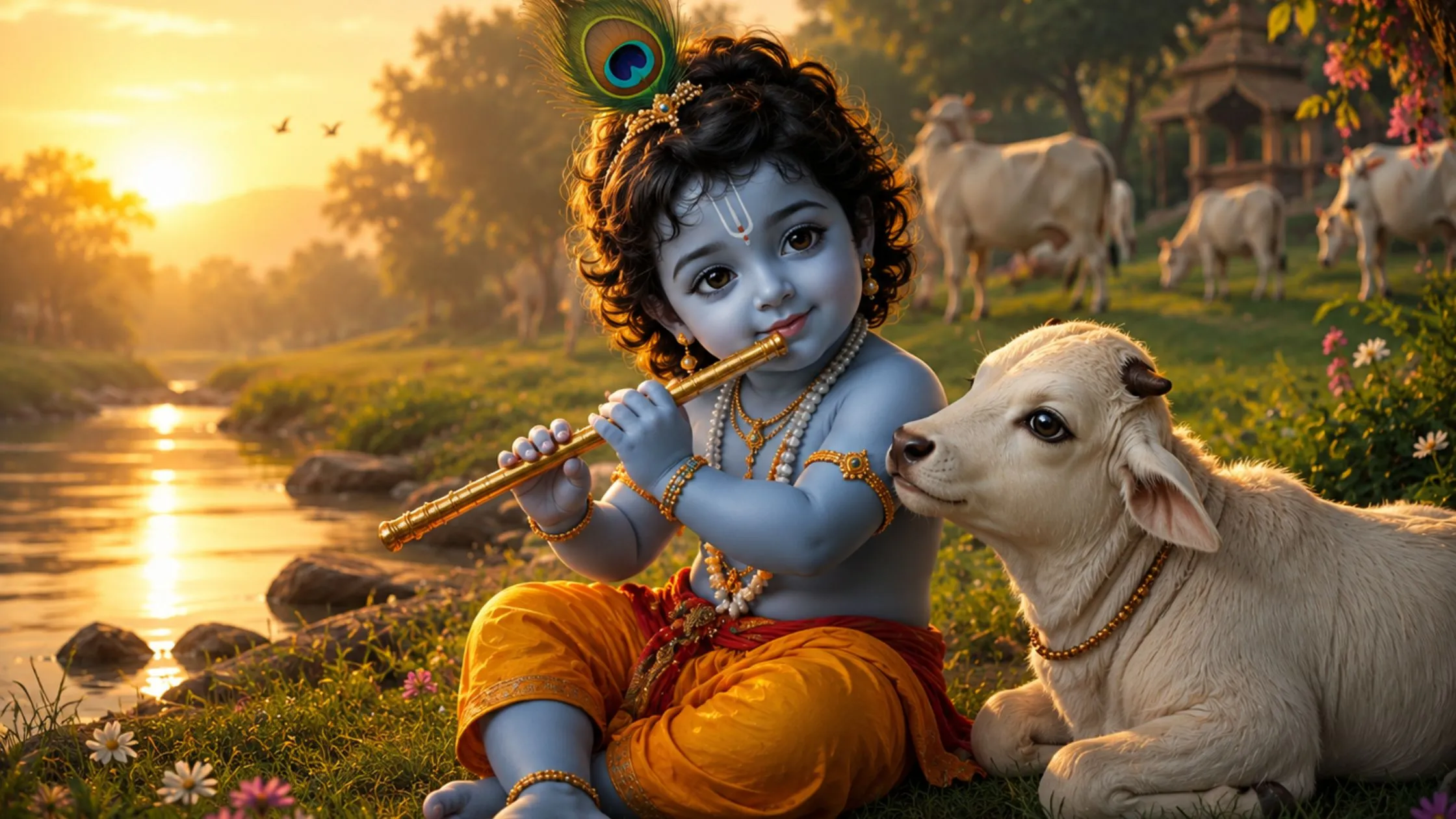
Krishna’s Childhood Stories and the Meaning of Play
Why are so many stories about Krishna filled with play?
Because Krishna’s childhood represents a devotional idea in which the Divine is not approached only through fear or formal worship.
The people of Vrindavan could laugh with Krishna, play with him, complain about him, feed him, and even scold him.
This intimate relationship is central to bhakti traditions.
The Krishna childhood stories therefore present spirituality as something that can involve affection, joy, friendship, family, and everyday experiences.
The Deeper Meaning of Krishna’s Mischief
Krishna’s mischief is not simply about breaking rules.
His playful behavior often creates opportunities for people to experience love and devotion.
From a spiritual perspective, the stories encourage us to look beyond appearances. Something that seems like ordinary childhood mischief can carry a deeper message about love, attachment, surrender, and divine play or lila.
Why Krishna Childhood Stories Still Matter Today
The popularity of Krishna childhood stories continues across generations because their themes remain universal.
A modern reader may not experience the stories exactly as an ancient devotee did, but the underlying questions remain relevant:
- How should we respond to fear?
- What makes a good friend?
- How can we control anger and ego?
- Why is humility important?
- How can communities protect one another?
- What does unconditional love look like?
- How can spirituality become part of everyday life?
For example, the Govardhan episode can encourage community thinking, while Krishna’s friendship stories can inspire healthier relationships.
Similarly, the story of Kaliya can encourage people to examine the “poison” of anger and negativity within themselves.
Lessons From Krishna Childhood Stories
Here are some practical lessons that can be drawn from these traditional narratives:
1. Face Fear With Courage
Krishna repeatedly confronts situations that frighten others. The stories encourage us not to allow fear to control our decisions.
2. Stay Connected to Others
Krishna’s relationships with his friends and family show the importance of affection, trust, and community.
3. Keep Humility Alongside Strength
The Govardhan story illustrates how arrogance can become destructive, while humility can create harmony.
4. Protect What Sustains Life
The Govardhan narrative encourages respect for nature, animals, land, water, and the wider community.
5. Look Beyond Appearances
Krishna may appear as a mischievous child, yet traditional stories repeatedly reveal his divine nature.
6. Make Joy Part of Life
The playful side of Krishna reminds us that spiritual living does not necessarily mean withdrawing from happiness, relationships, or everyday experiences.
Krishna Childhood Stories: Historical and Scriptural Context
It is important to distinguish between scriptural tradition, devotional interpretation, and modern retellings.
The Bhagavata Purana is one of the major Sanskrit sources for Krishna’s childhood narratives. Stories have also been transmitted through texts such as the Harivamsa and through centuries of regional devotional literature, poetry, music, theater, and oral traditions.
Consequently, individual versions of a story may contain details that differ between traditions.
For readers exploring Krishna’s life, comparing different versions can be valuable because it reveals how Indian devotional traditions have interpreted Krishna across centuries and cultures.
Frequently Asked Questions
1. What are the most famous Krishna childhood stories?
Some of the best-known stories include Krishna’s birth, his butter-stealing adventures, the Putana episode, the Govardhan Hill story, his childhood friendship with the gopas, and his encounter with Kaliya.
2. Where did Krishna spend his childhood?
According to traditional accounts, Krishna was raised in Gokul and later spent much of his youth in Vrindavan under the care of Nanda and Yashoda.
3. Why did Krishna steal butter?
In devotional traditions, Krishna’s butter stealing represents his playful nature and his ability to “steal” the pure hearts of his devotees. The stories also highlight the intimate relationship between Krishna and the people of Gokul.
4. Who was Krishna’s mother during his childhood?
Krishna was born to Devaki, but he was raised by Yashoda and Nanda in Gokul. Yashoda is therefore remembered as Krishna’s foster mother and one of the most important figures in his childhood.
5. What is the lesson of the Govardhan Hill story?
The story highlights faith, humility, community cooperation, responsible leadership, and respect for nature and the resources that sustain life.
6. Who was Kaliya in Krishna’s childhood story?
Kaliya was a powerful serpent associated with the Yamuna River. Krishna subdued him in a famous episode that is traditionally interpreted as the triumph of divine power over destructive forces.
7. What do Krishna’s childhood stories teach children?
They can teach children values such as courage, friendship, kindness, sharing, respect for parents, compassion toward animals, and standing against harmful behavior.
Conclusion
The Krishna childhood stories are much more than charming tales about a mischievous child. They create a world where divine wisdom appears through friendship, family affection, courage, humor, compassion, and devotion.
From stealing butter in Gokul to lifting Govardhan Hill and defeating Kaliya, Krishna’s childhood narratives continue to offer lessons that remain meaningful in modern life.
Their enduring message is simple: courage can overcome fear, love can deepen faith, humility can overcome ego, and even ordinary moments can carry extraordinary meaning.
If these stories inspired you to explore Krishna’s teachings further, discover more spiritual insights, life lessons, verse explanations, and practical wisdom at TheGita.in.