
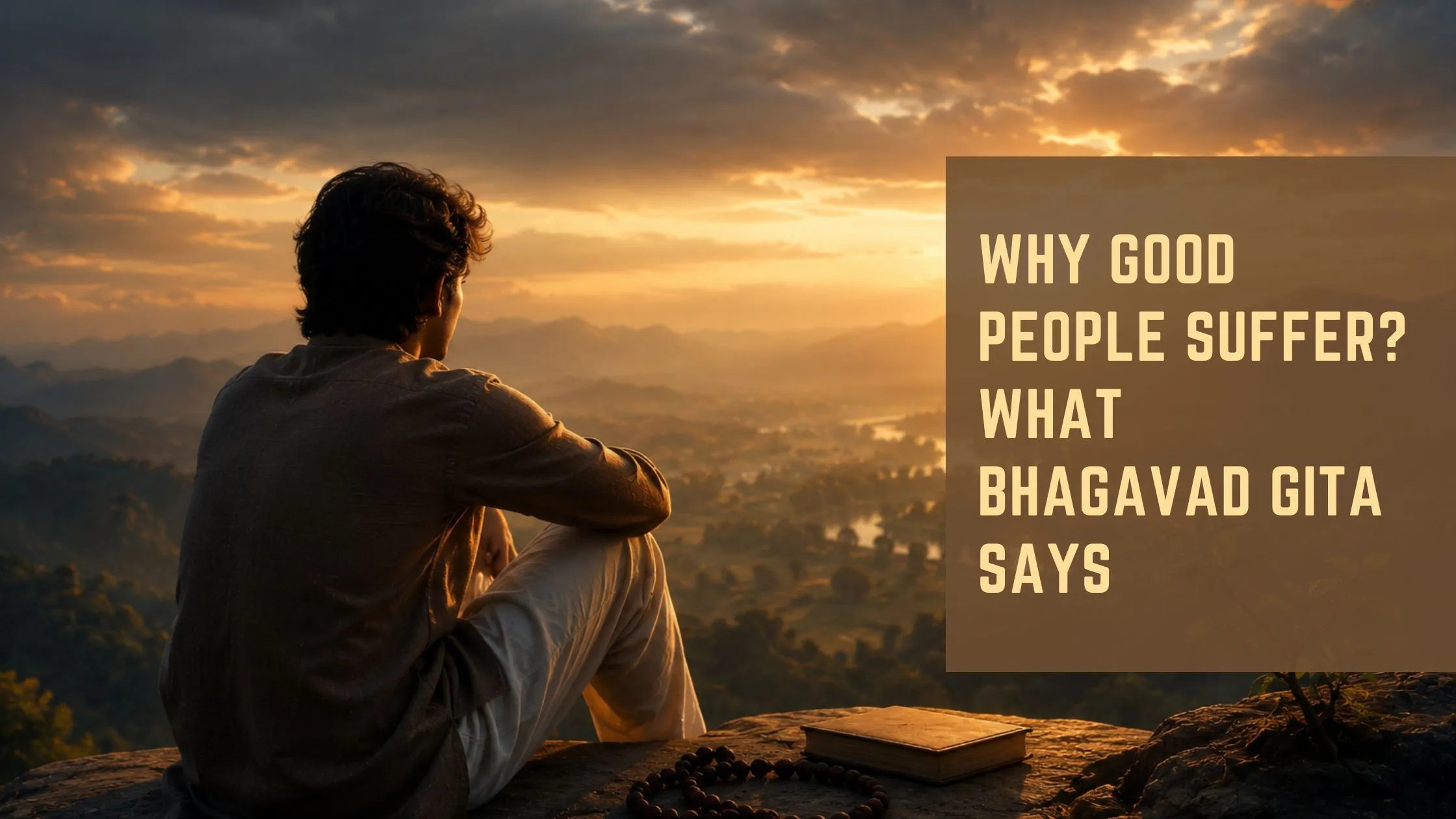
Why good people suffer is not answered by the Bhagavad Gita with the simple idea that suffering means someone is bad or being punished. The Gita explains suffering through karma, attachment, desire, changing circumstances, and the nature of the mind. It teaches us to focus on righteous action, reduce attachment to outcomes, develop inner strength, and understand that temporary suffering does not define a person's worth.
Table of Contents
- Key Takeaways
- Why Good People Suffer Even When They Do Everything Right
- Why Good People Suffer According to the Bhagavad Gita
- Why Good People Suffer When They Have Good Intentions
- The Difference Between Dharma and Reward
- Why Good People Suffer: Is It Because of Karma?
- Does Suffering Mean God Is Punishing You?
- What Krishna Teaches About Difficult Times
- Why Good People Suffer and What They Can Learn From It
- What Should You Do When Life Feels Unfair?
- The Deeper Answer: Life Is Not a Simple Reward System
- Frequently Asked Questions
- Conclusion
Key Takeaways
- Suffering does not necessarily mean punishment.
- Being a good person does not guarantee a life without difficulties.
- The Gita connects suffering with karma, attachment, desire, and the changing nature of life.
- We cannot control every event, but we can influence how we respond.
- Attachment to results can increase anxiety and disappointment.
- Difficult experiences can become opportunities for wisdom and inner growth.
- Dharma means acting according to what is right rather than simply chasing comfort.
- True peace comes from developing inner stability rather than expecting life to always go our way.
Why good people suffer? It is one of the most difficult questions we ask when life seems unfair.
You may have seen someone who is kind, honest, generous, and hardworking experience repeated difficulties while people who behave selfishly appear to succeed. At such moments, it is natural to wonder: If life has a moral order, why do good people suffer?
The Bhagavad Gita does not give a simplistic answer. Instead, Krishna presents a deeper way of looking at suffering, action, attachment, duty, and the mind.
The Gita was spoken to Arjuna at a moment when he was overwhelmed by grief, confusion, fear, and moral conflict. Krishna did not tell him that difficulty meant he was a bad person. Instead, He taught Arjuna how to understand his situation and act with wisdom.
This distinction is important.
Why Good People Suffer Even When They Do Everything Right
One reason this question is so painful is that we often expect fairness to work like a simple equation:
Good behavior = good results
But life does not always operate that way.
A person can work honestly and still lose an opportunity. Someone can love sincerely and still experience heartbreak. A compassionate person can become sick, lose a relationship, experience financial difficulty, or face betrayal.
The Bhagavad Gita asks us to look beyond this immediate equation.
Life contains circumstances that are not completely within our control. What we can control is our intention, our actions, our discipline, and our response.
This is one of the most important lessons of Krishna's teachings.

Why Good People Suffer According to the Bhagavad Gita
The Gita approaches suffering through several interconnected ideas rather than one explanation.
1. Life Naturally Contains Pleasure and Pain
In Bhagavad Gita 2.14, Krishna describes happiness and distress as temporary experiences, comparing their coming and going to seasonal changes.
The practical lesson is powerful:
No emotional or external condition remains exactly the same forever.
Just as winter changes into summer, difficult periods can change as well.
This does not mean suffering should be ignored. It means we should avoid believing that today's pain represents our entire future.
2. Karma Is More Complex Than “Good People Get Good Results”
Karma is often misunderstood as a simple reward-and-punishment system.
A more useful understanding is that actions have consequences and that our present circumstances cannot always be understood from one isolated moment.
This is why the question why good people suffer cannot always be answered by looking only at what someone is doing today.
The Gita places strong emphasis on action and responsibility. Instead of obsessing over every result, Krishna teaches Arjuna to perform his duty without becoming attached to the fruits of action.
This principle is especially relevant when life does not immediately reward our efforts.
3. Attachment Can Turn Pain Into Suffering
Pain and suffering are not always identical.
Pain can come from an event.
Suffering can become deeper when the mind repeatedly resists the event:
- “This should not have happened.”
- “Why me?”
- “My life is ruined.”
- “Things must happen exactly as I want.”
- “I cannot be happy unless this changes.”
The Bhagavad Gita repeatedly addresses attachment and desire because the mind becomes disturbed when it becomes dependent on specific outcomes.
A person may experience difficulty, but attachment can make that difficulty mentally overwhelming.
Why Good People Suffer When They Have Good Intentions
Good intentions matter, but intention does not give anyone complete control over circumstances.
Imagine two people starting the same business. Both work honestly. Both treat employees fairly. Both make sincere efforts.
One succeeds quickly.
The other faces losses.
Does that automatically mean the first person is morally superior?
Not necessarily.
External results are influenced by countless factors: timing, decisions, circumstances, other people's actions, opportunities, resources, and events beyond individual control.
The Gita therefore shifts attention from “What did I receive?” to “How should I act?”
This is a profound change in perspective.
The Difference Between Dharma and Reward
Dharma is often understood as righteous duty or the right way of living according to one's responsibilities.
The Gita teaches that action should not be performed only because we expect a particular reward.
That does not mean goals are meaningless.
It means your character should not depend entirely on whether the world gives you the outcome you wanted.
For example:
| Situation | Outcome-focused thinking | Gita-inspired approach |
|---|---|---|
| Career setback | “I failed.” | “What can I learn and do next?” |
| Betrayal | “Everyone is against me.” | “How should I respond wisely?” |
| Financial loss | “My life is over.” | “What action is possible now?” |
| Rejection | “I am not worthy.” | “This result does not define my value.” |
| Delayed success | “Life is unfair.” | “Continue doing the right work.” |
Why Good People Suffer: Is It Because of Karma?
This is one of the most frequently asked questions.
The concept of karma is central to many Indian philosophical traditions, but it should not be reduced to the statement:
“You are suffering because you were a bad person.”
That interpretation is too simplistic.
Karma involves action and its consequences, but spiritual traditions differ in how they interpret the precise relationship between past actions, present circumstances, free will, and divine order.
The Gita's emphasis is not on encouraging people to judge someone else's suffering.
Instead, its teachings encourage personal responsibility.
Rather than asking:
“What did this person do to deserve suffering?”
A more constructive question is:
“How should I act wisely in the circumstances I have?”
This distinction prevents spirituality from becoming a tool for blaming people for their pain.
Does Suffering Mean God Is Punishing You?
Not necessarily.
The Bhagavad Gita does not present every difficult event as evidence that God is angry with someone.
In fact, Krishna's conversation with Arjuna begins in the middle of an intensely painful situation. Arjuna is confused and distressed, yet Krishna continues to guide him rather than condemning him for experiencing emotional turmoil.
The message is important:
Difficulty can become the beginning of understanding.
A painful chapter does not automatically mean divine rejection.
What Krishna Teaches About Difficult Times
Krishna's teaching is ultimately about developing a mind that can remain steady amid changing circumstances.
This does not mean becoming emotionless.
It means learning not to become completely controlled by every rise and fall of life.
1. Focus on Your Actions
One of the best-known teachings of the Gita is the emphasis on action without attachment to results.
You may not control:
- how others behave,
- whether someone appreciates you,
- when success arrives,
- unexpected events,
- other people's decisions.
But you can influence:
- your effort,
- your choices,
- your integrity,
- your discipline,
- your response.
This is where personal power begins.
2. Stop Measuring Your Worth Through Outcomes
A failed exam does not make someone unintelligent.
A rejected application does not make someone worthless.
A failed relationship does not mean someone is incapable of love.
A business loss does not automatically make someone a failure.
Results are information—not always a definition of identity.
The Gita encourages us to separate our deeper sense of self from temporary circumstances.
3. Train the Mind
A restless mind can turn a small problem into a huge one.
The Gita places considerable importance on mastering the mind rather than allowing the mind to dominate us.
This has a direct modern relevance.
When you constantly replay the past, predict the future, compare yourself with others, and imagine every possible negative outcome, your external circumstances may remain unchanged while your internal suffering increases.
Spiritual practice, reflection, discipline, meditation, and self-awareness can help create distance between an event and your reaction to it.
Why Good People Suffer and What They Can Learn From It
Suffering should not automatically be romanticized.
Some experiences are genuinely painful, unjust, and devastating. Telling someone to “just learn a lesson” can sometimes minimize their experience.
The deeper Gita-inspired approach is different.
It asks:
Given that this has happened, what can I do now?
That question creates movement.
Suffering Can Teach Detachment
Sometimes difficulty reveals how strongly we have attached our happiness to one person, one achievement, one possession, or one expected future.
Suffering Can Reveal Inner Strength
You may discover that you are capable of handling more than you previously believed.
Suffering Can Change Priorities
A difficult experience can make a person reconsider what truly matters: relationships, health, purpose, character, spirituality, or peace of mind.
Suffering Can Deepen Compassion
Someone who has experienced hardship may develop greater empathy for others.
The goal is not to say that suffering is “good.”
The goal is to discover whether wisdom can emerge from something painful.
What Should You Do When Life Feels Unfair?
When you are struggling with the question why good people suffer, try these practical steps.
1. Accept the Reality of the Present Moment
Acceptance does not mean approval.
It simply means acknowledging:
“This is what is happening right now.”
Only then can you decide what to do next.
2. Separate What You Can Control
Make two lists.
Within my control:
- My actions
- My words
- My habits
- My effort
- My response
Outside my control:
- Other people's opinions
- Past events
- Unexpected circumstances
- Someone else's choices
- Exact future outcomes
Put your energy where it can make a difference.
3. Keep Doing What Is Right
Do not allow someone else's dishonesty to destroy your integrity.
Do not become cruel because someone treated you badly.
Do not abandon your values because life temporarily disappointed you.
Your character should not depend on how other people behave.
4. Give Yourself Time
Not every question has an immediate answer.
Sometimes spiritual growth begins by learning to live with uncertainty without losing your inner balance.
The Deeper Answer: Life Is Not a Simple Reward System
Perhaps the deepest answer to why good people suffer is that goodness should not be treated as a transaction.
If we are good only because we expect life to reward us, our goodness becomes conditional.
The Gita points toward something deeper: act according to dharma because it is right, not merely because it guarantees a particular result.
This is difficult.
But it is also liberating.
When your peace depends entirely on getting the result you want, you give the outside world control over your inner state.
When you focus on sincere action, wisdom, and character, you regain some of that control.
Krishna's final teaching to Arjuna is especially significant. After explaining his wisdom, Krishna tells Arjuna to reflect deeply and then choose what he wishes to do. Bhagavad Gita 18.63 emphasizes deliberation and freedom of choice.
That means spiritual wisdom is not simply about receiving answers.
It is about learning how to see clearly and then act consciously.
Frequently Asked Questions
1. Why good people suffer according to Bhagavad Gita?
The Gita does not say that suffering proves someone is bad. It discusses karma, attachment, desire, changing circumstances, and the mind. It teaches people to focus on righteous action rather than becoming consumed by outcomes.
2. Does karma mean good people should never suffer?
No. Karma should not be understood as a simplistic system where every good action immediately produces a pleasant result. The Gita emphasizes action, responsibility, detachment, and wisdom.
3. Does suffering mean God is punishing me?
Not necessarily. Difficult experiences are not automatically evidence of divine punishment. The Gita encourages people to respond to challenges with understanding, courage, and right action.
4. Why do bad people sometimes succeed?
External success and moral goodness are not identical. Wealth, status, popularity, or achievement do not automatically indicate spiritual or ethical superiority.
5. What does Krishna say about suffering?
Krishna teaches that happiness and distress are temporary and encourages Arjuna to remain steady while performing his responsibilities. Bhagavad Gita 2.14 is particularly relevant to this idea.
Conclusion
So, why good people suffer?
The Bhagavad Gita does not reduce the answer to punishment or reward. It offers a deeper perspective: life contains changing circumstances, actions have consequences, attachment can intensify suffering, and human beings do not control every outcome.
Being a good person does not mean you will never face pain.
It means that even when pain arrives, you have the opportunity to choose how you respond.
You can become bitter or wiser.
You can become consumed by the result or return to your duty.
For more practical lessons from the Bhagavad Gita, explore TheGita.in and discover timeless spiritual wisdom for modern life, relationships, challenges, and personal growth. Explore timeless wisdom for modern life, only on TheGita.in.