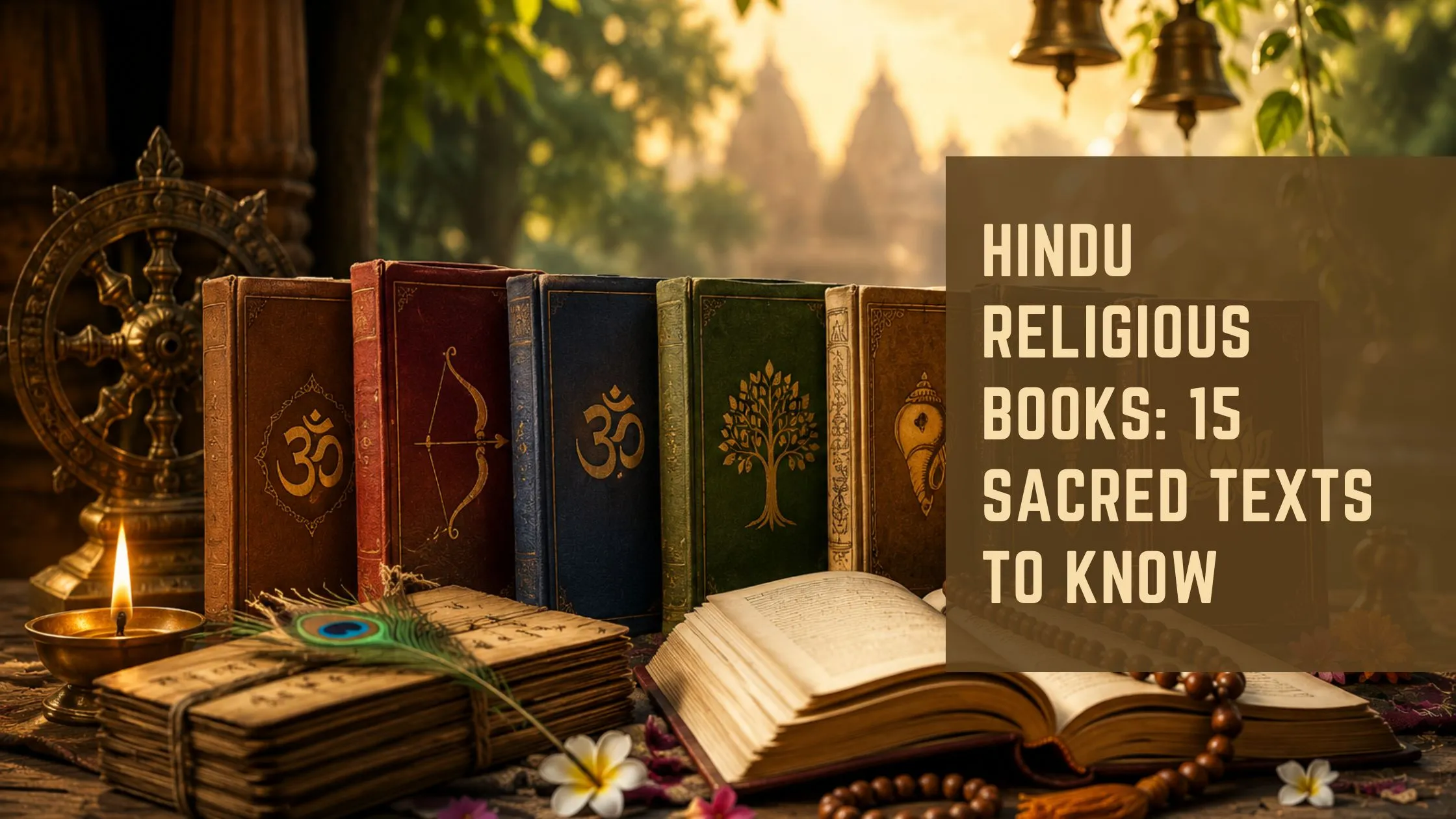
Hinduism does not have one single holy book that serves as its complete authority. Instead, its spiritual tradition has developed through thousands of years of scriptures, philosophical teachings, epic narratives, hymns, and devotional texts.
When people search for Hindu religious books, they may be looking for very different things. A beginner might want a simple introduction to Hindu philosophy, while another reader may be interested in Sanskrit scriptures, devotional stories, meditation, karma, or the teachings of Lord Krishna.
Understanding the different types of Hindu scriptures makes it easier to choose where to begin.
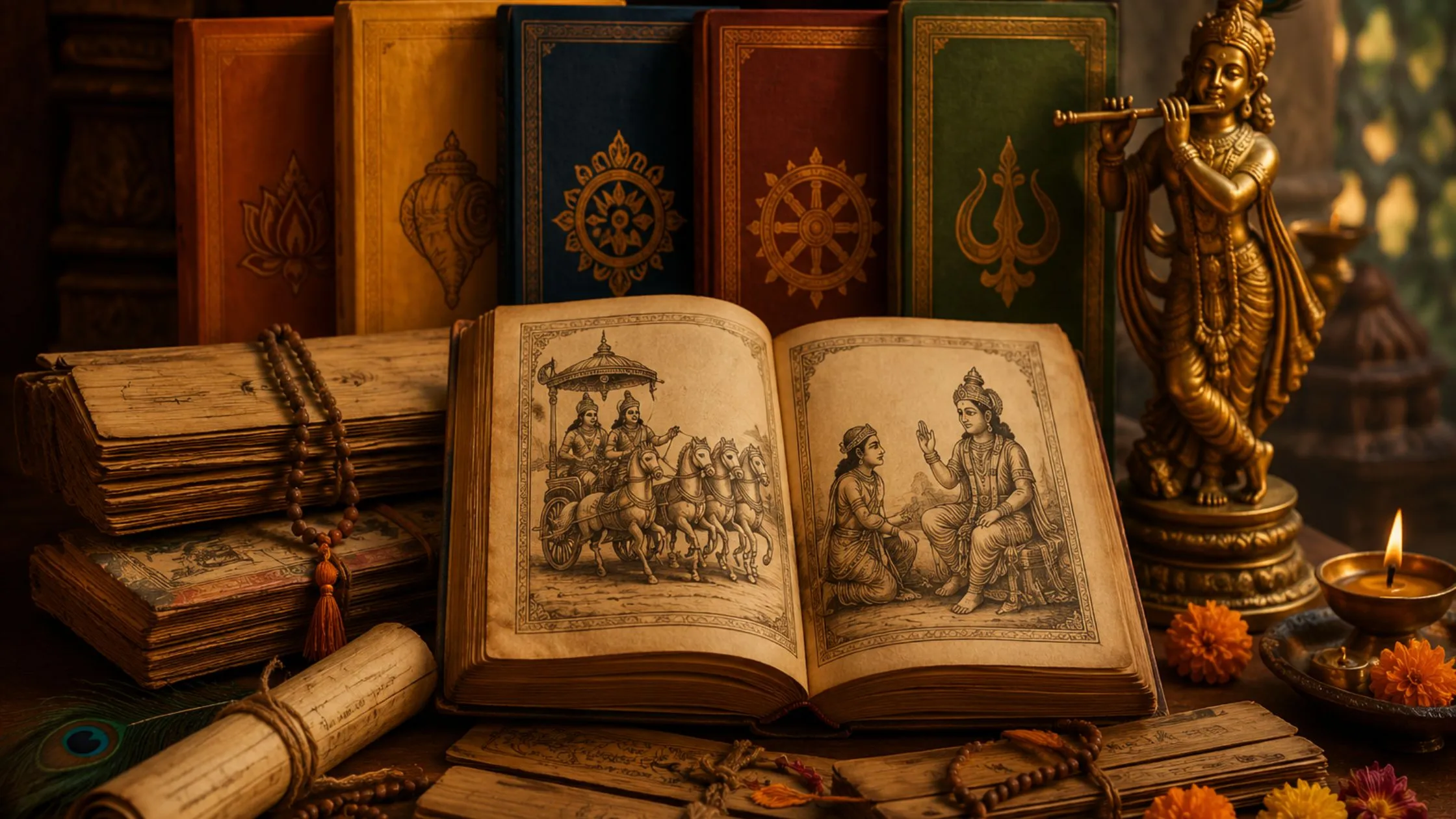
The Vedas contain ancient hymns and ritual knowledge. The Upanishads explore profound philosophical questions. The Bhagavad Gita presents spiritual wisdom through Krishna's dialogue with Arjuna. The Ramayana and Mahabharata communicate ethical and spiritual lessons through epic stories, while the Puranas preserve mythology, traditions, cosmology, and devotional teachings.
This guide explores the most important Hindu religious books, what they teach, and which texts may be suitable for different readers.
Table of Contents
- Key Takeaways
- What Are Hindu Religious Books?
- 1. The Vedas: Among the Oldest Hindu Scriptures
- 2. The Upanishads: Philosophy and Self-Knowledge
- 3. Bhagavad Gita: Spiritual Wisdom for Everyday Life
- 4. Ramayana: Dharma, Devotion, and Ideal Conduct
- 5. Mahabharata: The Epic of Dharma and Human Choices
- 6. The Puranas: Stories, Devotion, and Hindu Traditions
- 7. Agamas and Other Hindu Sacred Literature
- Which Hindu Religious Books Should Beginners Read First?
- Why Are Hindu Scriptures Still Relevant Today?
- How to Choose the Right Hindu Scripture
- Frequently Asked Questions
- Conclusion
Key Takeaways
- Hinduism has a large and diverse body of sacred literature rather than one single scripture.
- The Vedas are among the oldest foundational texts of the Hindu tradition.
- The Upanishads focus heavily on philosophy, consciousness, Atman, Brahman, and liberation.
- The Bhagavad Gita teaches practical spiritual wisdom through the conversation between Krishna and Arjuna.
- The Ramayana explores dharma, devotion, duty, courage, and ideal relationships.
- The Mahabharata examines dharma and human choices through a complex epic narrative.
- The Puranas contain stories, traditions, cosmology, genealogies, and devotional teachings.
- Beginners can start with accessible translations of the Bhagavad Gita before exploring longer scriptures.
What Are Hindu Religious Books?
Hindu religious books are a broad collection of sacred and traditional writings that preserve the spiritual, philosophical, ethical, ritual, and cultural knowledge of Hindu traditions.
They are not all the same type of literature. Some are collections of hymns, some are philosophical dialogues, some are epic stories, and others explain religious practices or devotional traditions.
Hindu sacred literature is often discussed through two broad categories:
| Category | Meaning | Examples |
|---|---|---|
| Shruti | “That which is heard” | Vedas, Upanishads |
| Smriti | “That which is remembered” | Bhagavad Gita, Ramayana, Mahabharata, Puranas |
This distinction is useful, but Hindu traditions are diverse, and individual schools may place different emphasis on particular scriptures.
1. The Vedas: Among the Oldest Hindu Scriptures
The Vedas form one of the foundational bodies of Hindu sacred literature. The word Veda is associated with knowledge.
There are four major Vedas:
- Rigveda – hymns and sacred verses
- Samaveda – chants and melodies associated with ritual
- Yajurveda – formulas and instructions connected with rituals
- Atharvaveda – hymns, prayers, and various forms of knowledge
The Vedic tradition was transmitted orally for generations before being preserved in written form.
What Do the Vedas Teach?
The Vedas contain hymns, rituals, prayers, philosophical ideas, and reflections on cosmic order.
They are particularly important for understanding the historical development of Hindu religious thought.
For beginners, however, reading the complete Vedic corpus can be challenging. A reliable introduction or translation can provide useful context.
2. The Upanishads: Philosophy and Self-Knowledge
Among the most influential Hindu religious books are the Upanishads, philosophical texts associated with the later portions of Vedic literature.
Rather than focusing primarily on ritual, many Upanishadic teachings explore questions such as:
- What is the self?
- What is ultimate reality?
- What is consciousness?
- What happens after death?
- Why do human beings experience suffering?
- How can a person attain liberation?
Important concepts include Atman, Brahman, karma, rebirth, and moksha.
Why Read the Upanishads?
The Upanishads can be especially meaningful for readers interested in meditation, consciousness, spirituality, and Indian philosophy.
They encourage deeper reflection rather than simply presenting religious rules.
3. Bhagavad Gita: Spiritual Wisdom for Everyday Life
The Bhagavad Gita is perhaps the most widely accessible starting point among Hindu religious books.
It appears within the Mahabharata and consists of a dialogue between Krishna and Arjuna on the battlefield of Kurukshetra.
Arjuna faces a profound moral crisis. Krishna responds by explaining duty, action, knowledge, devotion, meditation, the nature of the self, and liberation.
The Gita is traditionally divided into 18 chapters, each presenting different dimensions of spiritual practice and philosophy.
Major Teachings of the Bhagavad Gita
Some central themes include:
- Karma Yoga: acting without attachment to the fruits of action
- Jnana Yoga: pursuing spiritual knowledge
- Bhakti Yoga: developing devotion toward the Divine
- Dhyana: meditation and discipline of the mind
- Dharma: understanding and fulfilling one's responsibility
- Moksha: liberation from bondage
The Gita remains relevant because its questions are not limited to an ancient battlefield. People still struggle with uncertainty, responsibility, fear, ambition, attachment, and difficult decisions.
For someone searching for Hindu religious books for beginners, an accessible translation of the Bhagavad Gita is often a practical starting point.
4. Ramayana: Dharma, Devotion, and Ideal Conduct
The Ramayana, traditionally attributed to Valmiki, is one of India's great Sanskrit epics.
It tells the story of Rama, his exile, Sita, Lakshmana, Hanuman, and the conflict with Ravana.
Beyond its narrative, the Ramayana explores questions of:
- Dharma
- Loyalty
- Sacrifice
- Leadership
- Family responsibility
- Devotion
- Courage
- Truthfulness
Different versions and retellings of the Ramayana have developed across India and throughout Asia.
Why Is the Ramayana Still Relevant?
The epic continues to influence Indian literature, festivals, art, theatre, television, and popular culture.
Its characters also provide opportunities to discuss moral choices and the complexity of fulfilling one's responsibilities.
5. Mahabharata: The Epic of Dharma and Human Choices
The Mahabharata, traditionally attributed to Vyasa, is one of the world's great epic traditions.
It revolves around the conflict between the Pandavas and Kauravas, but its scope is much wider than the central war.
The epic examines politics, family relationships, morality, justice, ambition, duty, friendship, loyalty, and the consequences of human choices.
The Bhagavad Gita forms an important part of the Mahabharata.
What Can We Learn From the Mahabharata?
One of its strongest themes is that dharma can be difficult to understand in complicated circumstances.
Unlike simplistic stories where good and evil are always easy to identify, the Mahabharata frequently presents morally difficult situations.
That complexity makes it particularly relevant to modern readers.
6. The Puranas: Stories, Devotion, and Hindu Traditions
The Puranas are another major category of Hindu sacred literature.
Traditionally, Hindu tradition recognizes 18 Mahapuranas, although classifications and related texts vary across traditions.
Examples include:
- Bhagavata Purana
- Vishnu Purana
- Shiva Purana
- Markandeya Purana
- Skanda Purana
- Garuda Purana
- Matsya Purana
- Padma Purana
The Puranas contain stories about deities, cosmology, sacred geography, genealogies, traditions, festivals, and devotional practices.
Bhagavata Purana
The Bhagavata Purana is especially influential in Vaishnava traditions and is known for its devotional narratives involving Krishna.
Shiva Purana
The Shiva Purana focuses extensively on Lord Shiva, devotional practices, mythology, sacred places, and related traditions.
7. Agamas and Other Hindu Sacred Literature
Not all Hindu sacred literature fits neatly into the categories above.
Agamas are important scriptural traditions associated with temple worship, rituals, iconography, yoga, and spiritual practice. They are particularly significant in Shaiva, Vaishnava, and Shakta traditions.
There are also important devotional and philosophical works written in regional languages.
Examples include:
- Ramcharitmanas
- Tirukkural
- Yoga Vasistha
- Vivekachudamani
- devotional poetry of various saints
- works associated with Bhakti traditions
These texts demonstrate the enormous diversity of Hindu spiritual literature.
Which Hindu Religious Books Should Beginners Read First?
There is no single correct starting point. The best book depends on what you want to understand.
| If you want to learn about... | Good starting point |
| Karma and duty | Bhagavad Gita |
| Hindu philosophy | Upanishads |
| Rama and dharma | Ramayana |
| Epic stories and moral dilemmas | Mahabharata |
| Krishna devotion | Bhagavata Purana |
| Shiva traditions | Shiva Purana |
| Ancient Vedic tradition | Rigveda or an introduction to the Vedas |
| Temple traditions | Agamas |
| Practical spiritual reflection | Bhagavad Gita |
A Simple Reading Path
If you are completely new to Hindu philosophy, try this order:
Bhagavad Gita → Ramayana → selected Upanishads → Mahabharata → Puranas → Vedic literature
This approach begins with relatively accessible spiritual teachings before moving toward broader and more complex bodies of literature.
Why Are Hindu Scriptures Still Relevant Today?
The continuing relevance of Hindu religious books comes partly from the questions they explore.
Modern life may look very different from ancient India, but people still experience:
- Stress
- Uncertainty
- Attachment
- Fear of failure
- Relationship conflicts
- Questions about purpose
- Ethical dilemmas
- Desire for inner peace
The Bhagavad Gita's discussion of action and attachment, the Upanishads' exploration of consciousness, and the epics' treatment of duty and difficult choices can therefore be approached as sources of philosophical reflection.
Their value does not depend solely on treating them as historical documents. They can also be studied as living traditions whose ideas continue to influence spirituality, philosophy, literature, art, and culture.
How to Choose the Right Hindu Scripture
Before choosing from the many Hindu religious books available today, ask yourself what you want from your reading.
For Spiritual Guidance
Start with the Bhagavad Gita.
For Philosophy
Explore the Upanishads and introductory works on Vedanta.
For Stories and Values
Begin with the Ramayana or Mahabharata.
For Devotional Literature
Explore the Bhagavata Purana, Shiva Purana, and regional Bhakti literature according to your interests.
For Historical and Vedic Study
Begin with an introduction to the Vedas and the broader Vedic corpus.
When selecting an edition, consider the translator, commentary, Sanskrit text if relevant, and the tradition or philosophical school represented by the interpretation.
Frequently Asked Questions
1. What are the most important Hindu religious books?
The Vedas, Upanishads, Bhagavad Gita, Ramayana, Mahabharata, Puranas, and Agamas are among the major bodies of Hindu sacred literature.
2. What is the main holy book of Hinduism?
Hinduism does not have one universally designated holy book equivalent to a single central scripture. Instead, it has a large collection of sacred texts, with different traditions emphasizing different scriptures.
3. Which Hindu religious book should a beginner read first?
The Bhagavad Gita is often a practical starting point because it presents philosophical and spiritual ideas through a focused dialogue between Krishna and Arjuna.
4. Are the Vedas and Upanishads the same?
No. The Upanishads are associated with the Vedic corpus but focus strongly on philosophical and spiritual inquiry. The Vedas encompass a much broader body of ancient sacred literature.
5. Is the Bhagavad Gita part of the Mahabharata?
Yes. The Bhagavad Gita appears within the Mahabharata, in the Bhishma Parva section of the epic.
6. How many Vedas are there?
There are four traditionally recognized Vedas: Rigveda, Samaveda, Yajurveda, and Atharvaveda.
7. How many Puranas are there?
Hindu tradition commonly speaks of 18 Mahapuranas. There are also many Upapuranas and other related texts.
8. Which Hindu scripture teaches about karma?
The concept of karma appears across Hindu literature. The Bhagavad Gita gives especially detailed teachings about action, attachment, duty, and the consequences of action.
9. Which Hindu book is best for learning about Krishna?
The Bhagavad Gita is an excellent starting point for Krishna's philosophical teachings. The Bhagavata Purana is particularly important for Krishna-centered devotional traditions.
10. Can Hindu scriptures be read by non-Hindus?
Yes. Hindu scriptures are widely studied by people from different backgrounds for philosophical, historical, literary, cultural, and spiritual reasons. Reading them with reliable translations and contextual explanations can provide a more meaningful understanding.
Conclusion
Hindu religious books represent one of the world's richest and most diverse bodies of spiritual and philosophical literature. From the ancient Vedas and reflective Upanishads to the practical wisdom of the Bhagavad Gita, the stories of the Ramayana and Mahabharata, and the devotional traditions of the Puranas, each body of literature offers a different window into Hindu thought.
You do not need to read every scripture at once. Start with the subject that speaks to your current questions dharma, karma, devotion, meditation, self-knowledge, or the search for meaning.
The most important part is not simply finishing a book. It is reflecting on its teachings and considering how they can deepen your understanding of yourself and life.
Continue exploring the teachings of the Bhagavad Gita, Hindu philosophy, sacred scriptures, spiritual practices, and practical life lessons on TheGita.in.