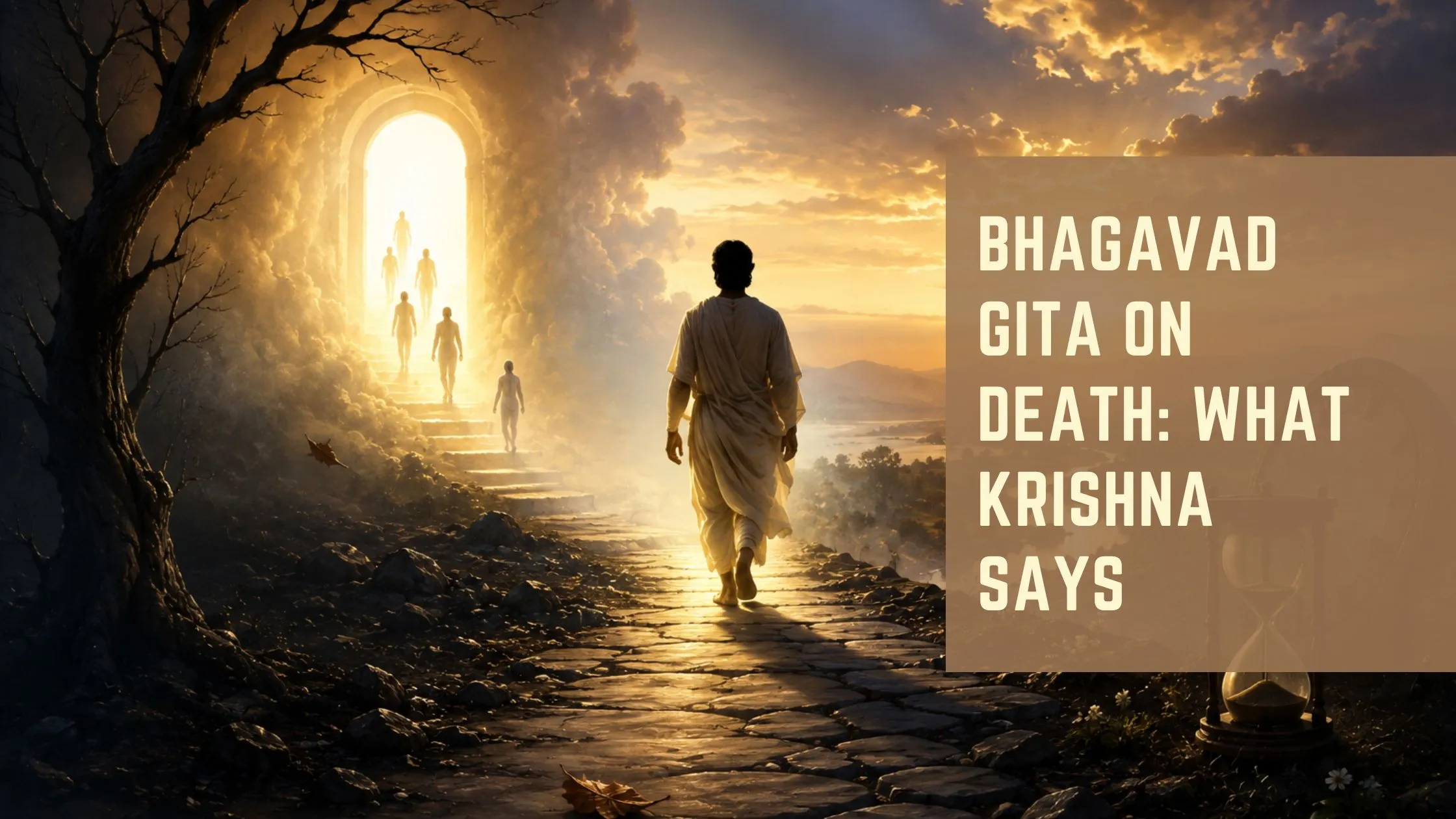
Death is one of the deepest mysteries of human life. No matter how successful, wealthy, powerful, or educated a person may be, everyone eventually has to face mortality. Yet the fear of death often comes from uncertainty: What happens after death? Does the soul die? Why must people we love leave us? How should we deal with grief?
Table of Contents
- Key Takeaways
- What Does the Bhagavad Gita Say About Death?
- Bhagavad Gita on Death: The Soul Never Dies
- Bhagavad Gita on Death and Rebirth
- Why Does Krishna Tell Arjuna Not to Fear Death?
- Bhagavad Gita on Death and Grief
- Bhagavad Gita on Death and the Nature of the Soul
- What Happens at the Time of Death According to the Bhagavad Gita?
- Bhagavad Gita on Death: How Should We Live?
- Modern Lessons From the Bhagavad Gita on Death
- Bhagavad Gita on Death vs. Common Fear of Death
- Frequently Asked Questions
- Conclusion
Key Takeaways
- The physical body is temporary, while the soul is eternal according to the Gita.
- Death is certain for every embodied being.
- Krishna compares bodily change to moving through childhood, youth, and old age.
- The Gita connects death with the cycle of birth and rebirth.
- Fear of death can lessen when we understand the distinction between body and soul.
- Grief is natural, but wisdom helps us understand it without becoming completely consumed by it.
- Krishna encourages people to focus on righteous action rather than being paralyzed by fear.
- Spiritual remembrance and devotion are important themes concerning the final moments of life.
Death is one of the deepest mysteries of human life. No matter how successful, wealthy, powerful, or educated a person may be, everyone eventually has to face mortality. Yet the fear of death often comes from uncertainty: What happens after death? Does the soul die? Why must people we love leave us? How should we deal with grief?
The Bhagavad Gita on death approaches these questions from a spiritual perspective.
Krishna's teachings to Arjuna begin in the middle of a crisis. Arjuna is overwhelmed by sorrow and confusion because he sees family members, teachers, and loved ones standing on the battlefield. His emotional struggle is not simply about war; it is also about death, attachment, grief, duty, and the meaning of existence.
Krishna gradually shifts Arjuna's understanding from the temporary body to the eternal self. In Bhagavad Gita 2.20, the soul is described as unborn and eternal and as not being destroyed when the body is destroyed.
This makes the Gita's teaching on mortality more than a discussion of what happens at the end of life. It is also a lesson about how to live while we are alive.
What Does the Bhagavad Gita Say About Death?
One of the central teachings of the Bhagavad Gita on death is that we should distinguish between the body and the self or soul.
The body changes continuously. A person begins as a child, becomes an adult, grows old, and eventually leaves the physical body.
Krishna explains this progression in Bhagavad Gita 2.13. The verse compares death to another transition: just as the embodied self passes through childhood, youth, and old age, it passes into another body.
This gives us an important perspective:
The body changes, but the deeper self is not defined by those physical changes.
From this perspective, death is not presented as the annihilation of the soul. Instead, it is understood as a transition involving the embodied self.
Body vs. Soul According to the Gita
| Physical Body | Soul / Self |
|---|---|
| Temporary | Eternal |
| Changes with age | Not destroyed by bodily change |
| Subject to birth and death | Described as unborn and undying |
| Material | Spiritual |
| Eventually perishes | Not destroyed when the body perishes |
This distinction is fundamental to understanding the Bhagavad Gita on death.

Bhagavad Gita on Death: The Soul Never Dies
Perhaps the most famous teaching about death appears in Bhagavad Gita 2.20.
Krishna tells Arjuna that the soul is not born and does not die. It is eternal and is not destroyed when the physical body is destroyed.
This does not mean that the Gita denies physical death. Rather, it distinguishes between physical death and spiritual existence.
The body can age, become ill, weaken, and eventually stop functioning. But according to Krishna's teaching, the soul is not subject to these same physical processes.
This idea changes the question from:
“Why does the soul die?”
to:
“What exactly is it that dies?”
The Gita's answer is that the physical body dies, while the eternal self is not destroyed.

Bhagavad Gita on Death and Rebirth
Another important aspect of the Bhagavad Gita on death is the concept of rebirth.
Krishna says in Bhagavad Gita 2.27 that for one who is born, death is certain, and after death, birth is certain.
This teaching places individual death within a larger cycle of existence.
The basic idea can be understood as:
Birth → Life → Death → Rebirth
The Gita does not encourage us to view this cycle as something to fear endlessly. Instead, it encourages spiritual understanding and liberation from attachment and ignorance.
The ultimate spiritual goal is not simply to experience another birth but to move beyond the cycle of repeated birth and death through realization of the true nature of the self and the Divine.
Why Does Krishna Tell Arjuna Not to Fear Death?
Arjuna's fear is deeply human.
He does not want to lose people he loves. He does not want to cause suffering. He is emotionally overwhelmed by the possibility of death.
Krishna does not simply tell him, “Do not feel anything.”
Instead, Krishna gives him a broader understanding of existence.
1. Death is unavoidable
The Gita acknowledges a simple reality: anything that is born will eventually die.
This truth applies to every human being. Accepting mortality does not mean becoming pessimistic. It means recognizing the temporary nature of physical existence.
2. The soul is eternal
Krishna teaches that the soul is not destroyed when the body is destroyed.
Understanding this distinction can transform our relationship with death.
3. Fear should not prevent righteous action
Arjuna's fear was preventing him from understanding his responsibility. Krishna therefore teaches him to act according to dharma, rather than allowing emotional confusion to completely control his decisions.
This principle has modern relevance too.
Sometimes fear of failure, loss, rejection, or uncertainty prevents us from doing what we know is right.
Bhagavad Gita on Death and Grief
One of the most difficult questions is:
If the soul is eternal, why do we still feel grief when someone dies?
The Gita does not suggest that human emotions are meaningless.
Arjuna himself is grieving.
The deeper lesson is that grief should be accompanied by wisdom.
When someone we love dies, the emotional pain can be overwhelming. The teachings of the Gita offer a spiritual framework through which grief can be understood without believing that existence has simply disappeared into nothingness.
This perspective can encourage:
- acceptance of life's impermanence
- gratitude for the time shared with someone
- spiritual reflection
- compassion
- detachment from excessive fear
- remembrance of the Divine
The goal is not to become emotionless. It is to develop inner steadiness while experiencing emotion.
Bhagavad Gita on Death and the Nature of the Soul
Krishna uses powerful ideas to explain why the soul should not be equated with the physical body.
The body undergoes constant transformation. A person's appearance, abilities, thoughts, and physical condition can change dramatically over a lifetime.
Yet there is also a sense of continuity in one's identity.
The Gita uses this observation to help Arjuna understand that bodily transformation does not necessarily mean destruction of the self.
The famous analogy of changing clothes
Another well-known teaching in the Gita compares changing bodies to changing clothes.
The idea is simple:
Old clothes are discarded and new clothes are taken; similarly, the embodied soul leaves one body and takes another.
The analogy emphasizes the temporary nature of the body and the continuity attributed to the soul.
It is one of the most memorable ways the Bhagavad Gita on death explains rebirth.
What Happens at the Time of Death According to the Bhagavad Gita?
Chapter 8 of the Gita gives particular attention to the final moments of life.
Bhagavad Gita 8.5 states that one who leaves the body while remembering Krishna attains His state.
This teaching highlights the importance of spiritual practice during life, rather than waiting until the final moment.
If a person spends an entire lifetime cultivating remembrance, devotion, self-control, and spiritual awareness, those tendencies can shape the consciousness with which they approach death.
Therefore, the Gita's message is not simply:
“Remember God when you are dying.”
It is closer to:
“Live your life in remembrance of the Divine.”
Bhagavad Gita on Death: How Should We Live?
The Gita's teachings about mortality ultimately bring us back to life.
If life is temporary, how should we spend it?
Krishna repeatedly emphasizes duty, disciplined action, devotion, knowledge, and freedom from attachment to results.
This creates several practical lessons.
1. Do your duty sincerely
Do not allow fear of the future to stop you from doing what is right today.
2. Understand impermanence
Relationships, possessions, status, youth, and physical strength are temporary.
Recognizing this can help us appreciate them without becoming completely dependent on them.
3. Reduce unnecessary attachment
Attachment can turn ordinary change into unbearable suffering.
The Gita encourages a form of detachment in which we care deeply but do not forget the eternal dimension of existence.
4. Cultivate spiritual awareness
Meditation, self-reflection, prayer, devotion, and study can help a person develop a deeper understanding of life and death.
5. Live meaningfully
Knowing that life is limited should encourage purposeful living—not fear.
Modern Lessons From the Bhagavad Gita on Death
The teaching remains relevant even outside its original battlefield setting.
Consider someone constantly worried about losing their job.
Another person may be terrified of losing social status.
Someone else may spend years worrying about aging.
The Gita's broader lesson is that change and loss are unavoidable parts of embodied life.
Instead of attempting to control everything, we can focus on what is within our control:
- our actions
- our intentions
- our discipline
- our response to circumstances
- our spiritual development
This is one reason the Bhagavad Gita on death can also be understood as a teaching about living without constant fear.
Bhagavad Gita on Death vs. Common Fear of Death
| Common Fear | Gita's Perspective |
|---|---|
| Death means complete destruction | The soul is described as eternal |
| Everything ends with the body | The self is distinguished from the body |
| Death is completely avoidable | Death is a natural certainty of embodied life |
| Loss should destroy our peace | Wisdom can help us process grief |
| Fear should control our decisions | Dharma and right action should guide us |
| Life has no deeper continuity | The Gita teaches rebirth and spiritual continuity |
This does not mean that death should be treated casually. Rather, it encourages us to approach mortality with clarity instead of ignorance.
Frequently Asked Questions
1. What does the Bhagavad Gita say about death?
The Bhagavad Gita teaches that physical death is inevitable, but the eternal soul is not destroyed. Krishna distinguishes the temporary body from the enduring self.
2. Does the Bhagavad Gita say the soul dies?
No. Bhagavad Gita 2.20 describes the soul as unborn, eternal, and not destroyed when the body is destroyed.
3. What does the Gita say happens after death?
The Gita describes the embodied soul as moving to another body and presents death within the larger cycle of birth and rebirth. Bhagavad Gita 2.13 is central to this teaching.
4. What does Bhagavad Gita 2.27 say about death?
It teaches that death is certain for one who is born and that birth follows death, placing mortality within the cycle of birth and rebirth.
5. Does the Bhagavad Gita say we should not grieve?
The Gita teaches wisdom and steadiness rather than uncontrolled lamentation. It does not simply deny human emotions; instead, Krishna helps Arjuna understand grief through knowledge of the eternal self.
Conclusion
The Bhagavad Gita on death offers a profound perspective on one of humanity's greatest fears.
Krishna does not deny that the body dies. Instead, He asks Arjuna to look beyond the temporary physical form and understand the eternal nature of the self. Bhagavad Gita 2.20 presents the soul as unborn and undying, while 2.13 describes the transition from one body to another.
The message is ultimately not about becoming indifferent to death.
It is about becoming wiser about life.
Explore more timeless teachings of the Bhagavad Gita at TheGita.in and discover practical spiritual wisdom for dealing with fear, attachment, relationships, purpose, and the challenges of modern life.