Have you ever wondered whether you should continue working hard when the results are not in your control? Why do some people remain peaceful despite difficulties, while others constantly struggle with expectations?
The answer to these questions lies in Bhagavad Gita Chapter 3, known as Karma Yoga (The Yoga of Action).
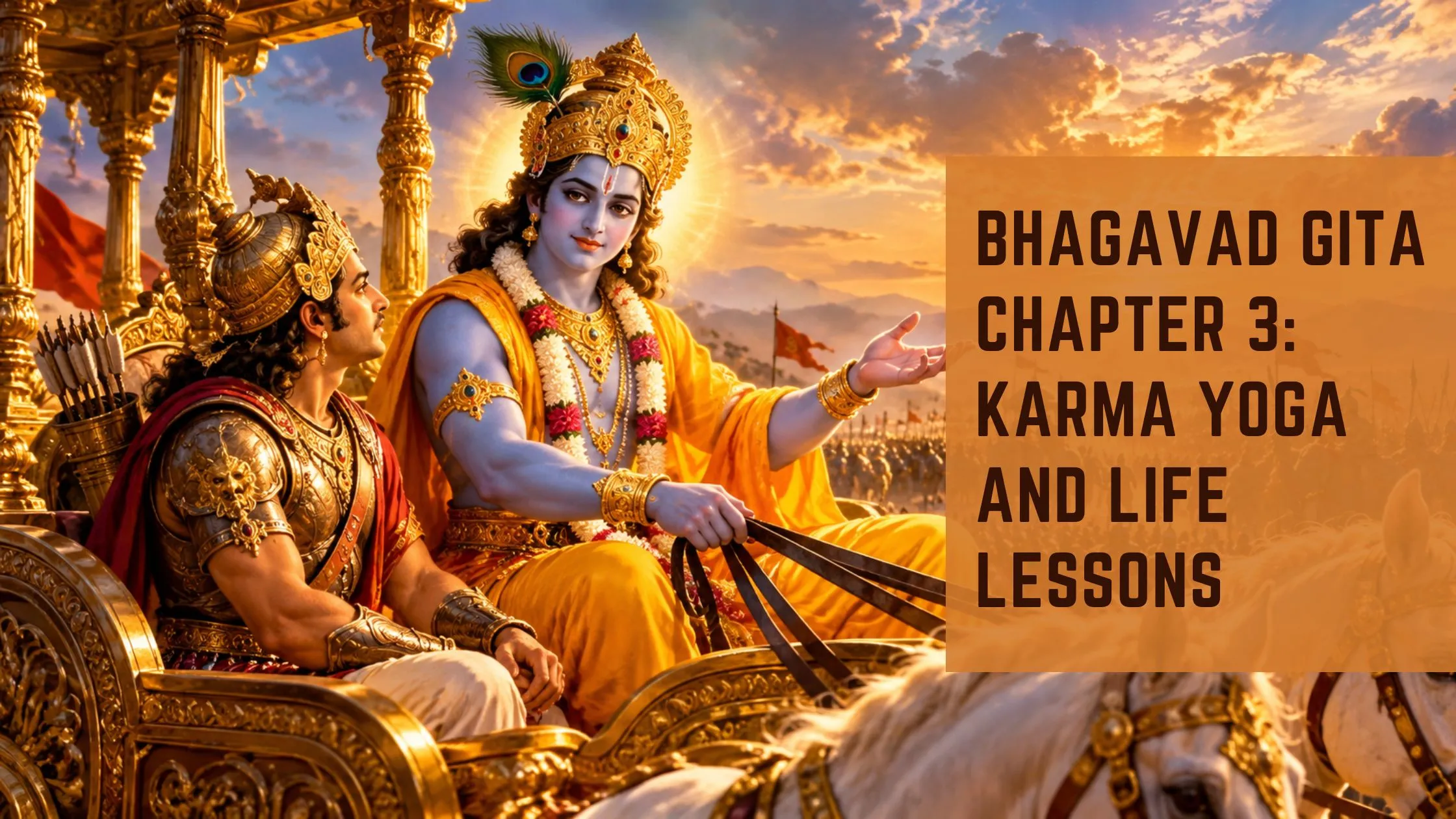
In this chapter, Lord Krishna explains to Arjuna that no human being can live without performing actions. Whether we realise it or not, our thoughts, decisions and activities continuously shape our lives.
Krishna teaches that the secret of a meaningful life is not escaping responsibilities but performing them with sincerity, without becoming attached to their results.
Chapter 3 contains 43 verses that explain duty, selfless action, sacrifice, desire, anger and the importance of working for the welfare of the world.
Table of Contents
- Key Takeaways
- 1. What Is Bhagavad Gita Chapter 3 About?
- 2. Why Did Arjuna Question Krishna? (Verses 1–2)
- 3. Nobody Can Live Without Karma (Verses 3–8)
- 4. The Importance of Yajna and Selfless Action (Verses 9–16)
- 5. Work Without Attachment to Results (Verses 17–26)
- 6. Why Should We Follow Our Own Dharma? (Verses 27–35)
- 7. What Is the Biggest Enemy of Human Beings? (Verses 36–43)
- 8. Important Bhagavad Gita Chapter 3 Shlokas and Their Meanings
- 9. How to Apply Karma Yoga in Daily Life
- 10. Beautiful Quotes Inspired by Bhagavad Gita Chapter 3
- Frequently Asked Questions (FAQs)
- Conclusion
Key Takeaways
No person can remain without performing action.
Perform your duties without attachment to their results.
Selfless action leads to spiritual growth.
Work for the welfare of society, not only personal benefit.
Control desire and anger because they disturb wisdom.
Follow your Dharma instead of blindly imitating others.
Discipline your senses and mind to achieve inner peace.

1. What Is Bhagavad Gita Chapter 3 About?
Bhagavad Gita Chapter 3 is called Karma Yoga, meaning the path of selfless action.
It begins with Arjuna's confusion about knowledge and action. He wonders why Krishna encourages him to fight if spiritual wisdom is considered superior to action.
Krishna explains that there are different paths to spiritual realisation, but nobody can achieve freedom simply by avoiding work.
He teaches that every individual has responsibilities and should fulfil them with honesty, dedication and a spirit of service.
The central message is simple:
Do your work sincerely, but do not allow the desire for rewards to control your mind.
2. Why Did Arjuna Question Krishna? (Verses 1–2)
Arjuna becomes confused by Krishna's teachings. If knowledge is greater than action, why should he engage in the difficult duty of fighting?
He asks Krishna to explain clearly which path is best for him.
Krishna responds by explaining that both the path of knowledge (Jnana Yoga) and the path of selfless action (Karma Yoga) can lead towards spiritual realisation.
However, simply abandoning responsibilities does not make a person spiritually wise.
Life Lesson: Do not confuse avoiding responsibilities with achieving spiritual peace. True wisdom teaches us how to fulfil our duties with the right attitude.
3. Nobody Can Live Without Karma (Verses 3–8)
One of the most important teachings of Chapter 3 is that nobody can remain completely inactive.
Even when someone sits silently, the mind continues to think, desire and make decisions.
Krishna explains that simply giving up physical activities does not lead to liberation. What matters is controlling the mind and performing actions without selfish attachment.
He encourages Arjuna to perform his prescribed duties because responsible action is better than escaping them.
Important Shloka – Bhagavad Gita 3.8
"नियतं कुरु कर्म त्वं कर्म ज्यायो ह्यकर्मणः।"
Meaning: Perform your prescribed duties because action is superior to inaction.
Life Lesson: Progress comes through responsible action. Waiting for the perfect moment or avoiding difficult situations will not solve life's problems.
4. The Importance of Yajna and Selfless Action (Verses 9–16)
Krishna explains that actions performed only for personal enjoyment create attachment, while actions performed as an offering to the Divine become a path of spiritual growth.
He introduces the concept of Yajna, which means sacrifice or sacred offering.
Yajna is not limited to religious rituals. It also represents selfless contribution, gratitude and working for the greater good.
Krishna explains that the world functions through mutual cooperation and interconnected responsibilities.
For example:
Farmers work to provide food.
Teachers share knowledge.
Parents care for their children.
Individuals contribute to society through their professions.
Life Lesson: A meaningful life is not measured only by what we receive but also by what we contribute.
5. Work Without Attachment to Results (Verses 17–26)
Krishna explains that a spiritually wise person performs actions without selfish expectations.
One of the most powerful ideas in this section is that great individuals should act responsibly because others learn by observing their behaviour.
Krishna himself explains that although he has nothing to gain personally, he continues performing actions for the welfare of the world.
This principle is known as Loka-Sangraha, meaning the welfare, stability and well-being of society.
Important Shloka – Bhagavad Gita 3.21
"यद्यदाचरति श्रेष्ठस्तत्तदेवेतरो जनः।"
Meaning: Whatever actions great people perform, others follow. Their behaviour becomes an example for society.
Life Lesson: Your actions influence others. Be responsible, honest and compassionate because your behaviour can inspire people around you.
6. Why Should We Follow Our Own Dharma? (Verses 27–35)
Krishna explains that all actions are influenced by the three Gunas of material nature: Sattva, Rajas and Tamas.
These qualities influence human behaviour, decisions and attitudes.
He teaches Arjuna not to become confused by external influences but to understand his responsibilities.
Important Shloka – Bhagavad Gita 3.35
"श्रेयान्स्वधर्मो विगुणः परधर्मात्स्वनुष्ठितात्।"
Meaning: It is better to perform one's own Dharma imperfectly than to follow another person's Dharma perfectly.
This verse teaches the importance of living according to one's responsibilities and nature.
Life Lesson: Do not constantly compare your journey with others. Focus on your own responsibilities, values and personal growth.
7. What Is the Biggest Enemy of Human Beings? (Verses 36–43)
Arjuna asks an important question: Why do people sometimes perform wrong actions even when they know what is right?
Krishna identifies desire (Kama) and anger (Krodha) as powerful forces that cloud human understanding.
Uncontrolled desires create dissatisfaction. When desires remain unfulfilled, frustration and anger can arise.
Krishna explains that desire covers knowledge like smoke covers fire, making it difficult for individuals to recognise the truth.
Important Shloka – Bhagavad Gita 3.37
"काम एष क्रोध एष रजोगुणसमुद्भवः।"
Meaning: It is desire and anger, born from the quality of Rajas, that become powerful enemies of human beings.
Krishna advises Arjuna to control the senses, strengthen the mind and develop spiritual understanding.
Life Lesson: Your greatest victory is not defeating others but gaining control over your own desires, anger and thoughts.
8. Important Bhagavad Gita Chapter 3 Shlokas and Their Meanings
| Verse | Main teaching | Life lesson |
|---|---|---|
| 3.5 | Nobody can remain without action | Keep fulfilling your responsibilities |
| 3.8 | Action is better than inaction | Do your duty |
| 3.9 | Work as an offering | Serve without selfishness |
| 3.21 | Great people influence others | Lead by example |
| 3.27 | Actions are influenced by the Gunas | Develop self-awareness |
| 3.30 | Surrender actions to Krishna | Work with faith |
| 3.35 | Follow your own Dharma | Avoid unhealthy comparison |
| 3.37 | Desire and anger are enemies | Control your inner impulses |
| 3.42 | Understand the hierarchy of senses, mind and intellect | Strengthen your wisdom |
9. How to Apply Karma Yoga in Daily Life
The teachings of Chapter 3 are not limited to ancient times. They are equally meaningful in modern life.
Here are seven practical ways to follow Karma Yoga:
At work: Give your best effort instead of worrying constantly about promotions and recognition.
In studies: Focus on learning rather than being obsessed with examination results.
In relationships: Help others without expecting something in return every time.
During difficulties: Accept challenges and take responsible action instead of giving up.
With anger: Pause before reacting and allow wisdom to guide your decisions.
In society: Contribute positively through kindness, honesty and service.
In spiritual life: Dedicate your actions to God with faith and humility.
10. Beautiful Quotes Inspired by Bhagavad Gita Chapter 3
"Your duty is to act with sincerity, not to become a prisoner of results."
"True success begins when action becomes service rather than selfish ambition."
"Control your desires before they begin controlling your life."
"Do not escape your responsibilities in search of peace; discover peace while fulfilling them."
"The greatest victory is mastering your own mind."
These are original inspirational reflections based on Chapter 3, not direct Sanskrit translations.
Frequently Asked Questions (FAQs)
Q1. What is Bhagavad Gita Chapter 3 called?
Bhagavad Gita Chapter 3 is called Karma Yoga, which teaches the importance of selfless action and performing one's duties without attachment to results.
Q2. How many verses are there in Bhagavad Gita Chapter 3?
There are 43 verses in Chapter 3 of the Bhagavad Gita.
Q3. What is the main message of Chapter 3?
Its main message is to perform your responsibilities sincerely without becoming attached to personal rewards or outcomes.
Q4. What does Krishna teach about karma?
Krishna teaches that action is unavoidable. Instead of escaping responsibilities, individuals should perform their duties with dedication and without selfish attachment.
Q5. What is Karma Yoga in simple words?
Karma Yoga is the practice of performing actions selflessly, with dedication and without excessive attachment to their results.
Q6. What does Bhagavad Gita 3.35 teach us?
It teaches that following one's own Dharma, even imperfectly, is better than imitating another person's path.
Q7. According to Chapter 3, what are the biggest enemies of human beings?
Krishna identifies uncontrolled desire and anger as major enemies because they cloud wisdom and influence human behaviour.
Conclusion
Bhagavad Gita Chapter 3 teaches us that spirituality is not about escaping the world or abandoning responsibilities. It is about transforming the way we live, work and think.
Krishna reminds Arjuna that every individual has duties to fulfil. When actions are performed with sincerity, selflessness and devotion, even ordinary responsibilities can become a path towards spiritual growth.
The chapter also reminds us that desire and anger can disturb our inner peace, while discipline, wisdom and selfless service help us move towards a better life.
The greatest lesson of Karma Yoga is this: Do your duty with your whole heart, surrender the results to God and never allow expectations to steal your peace.
Let your actions become your offering, your duty become your devotion and your life become a journey towards wisdom.
Read more spiritual teachings and timeless wisdom from the Bhagavad Gita at thegita.in.