
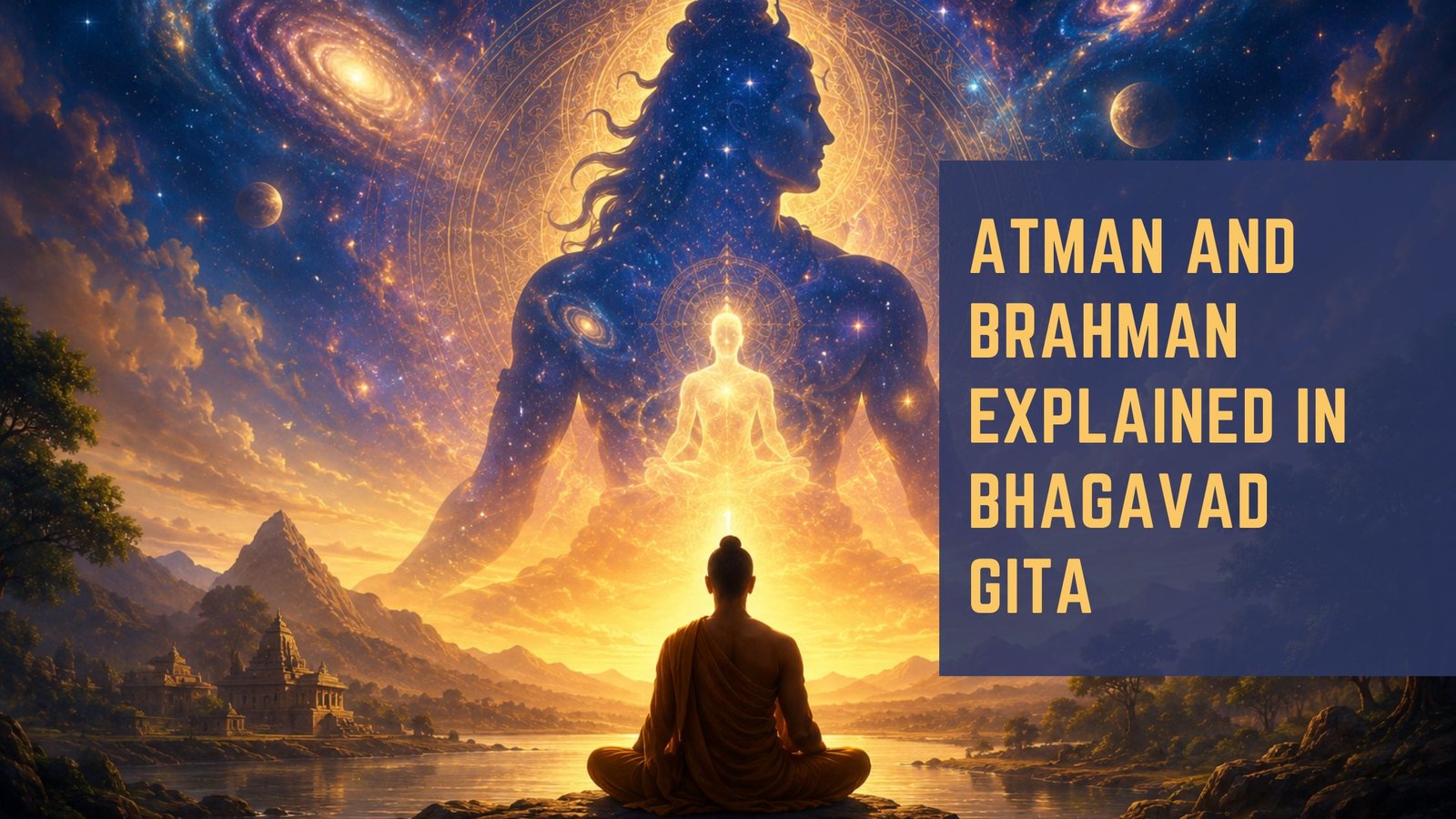
What if the stranger you passed on the street this morning has existed for thousands of years?
What if you, beneath your name, profession, emotions, and memories, are not merely a temporary human being—but an eternal consciousness that has traveled through countless lifetimes?
The ancient sages of India asked these questions long before modern philosophy and psychology began exploring the mystery of identity. In the sacred wisdom of the Bhagavad Gita, Upanishads, and Vedanta, two profound concepts emerge at the heart of existence: Atman and Brahman.
These are not merely philosophical words. They are the foundation of Hindu spirituality. They attempt to answer humanity’s deepest questions:
- Who am I?
- Why do I suffer?
- What happens after death?
- Is there a higher reality behind this universe?
The sages declared something astonishing: the soul within you, called Atman, is not separate from the supreme cosmic reality known as Brahman. The wave and the ocean are ultimately one.
Understanding Atman and Brahman is not only a spiritual journey—it is a transformation of how you see life, death, success, pain, and purpose.
Table of Contents
Key Takeaways
- Understand the true meaning of Atman and Brahman in Hindu philosophy.
- Discover how the Bhagavad Gita explains the eternal soul and universal consciousness.
- Learn practical spiritual lessons that can transform modern life, anxiety, fear, and relationships.
The Master Table
| Name | Key Symbol/Weapon | Reason | Spiritual Meaning |
|---|---|---|---|
| Atman | Eternal Light | Represents the individual soul | Pure consciousness beyond body and mind |
| Brahman | Infinite Cosmos | Represents ultimate reality | Source of all existence |
| Lord Krishna | Sudarshan Chakra | Teacher of eternal truth | Reveals unity of Atman and Brahman |
| Arjuna | Bow Gandiva | Symbol of the confused human mind | Seeker of spiritual knowledge |
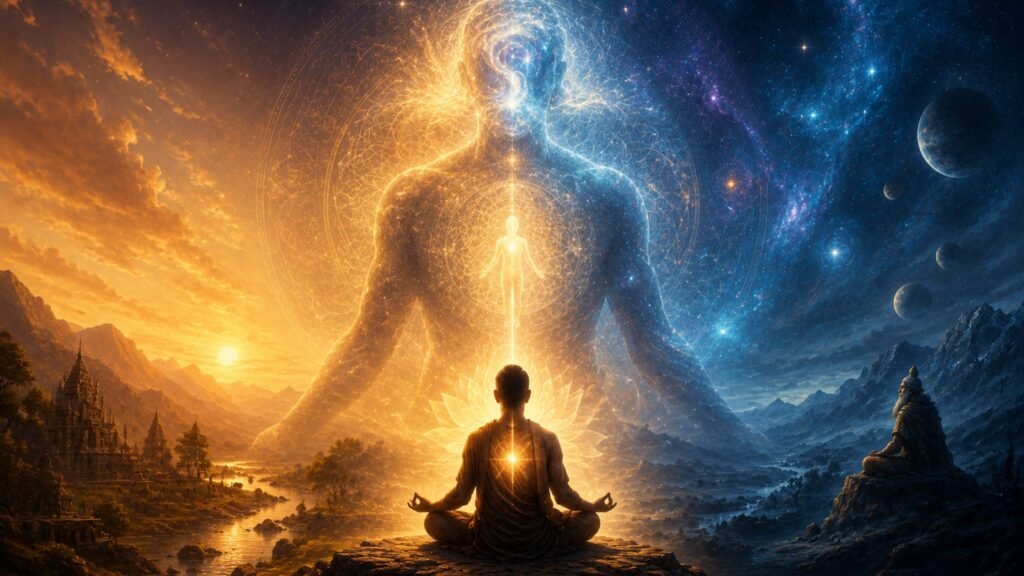
Understanding Atman: The Eternal Self
The Legend: Atman in the Bhagavad Gita
The concept of Atman becomes most powerful during the battlefield dialogue between Lord Krishna and Arjuna in the Bhagavad Gita.
As Arjuna trembles before the war of Kurukshetra, he becomes emotionally shattered. He fears death, loss, guilt, and destruction. Krishna then reveals a truth beyond worldly emotions: the soul can never die.
Krishna teaches that the body changes, ages, and disappears, but the Atman remains eternal.
“Na jāyate mriyate vā kadācin
Nāyaṁ bhūtvā bhavitā vā na bhūyaḥ”“The soul is never born, nor does it ever die.”
— Bhagavad Gita 2.20
This teaching changed the spiritual direction of humanity forever.
The Story: The Soul Beyond the Body
Imagine wearing different clothes throughout your life. Childhood clothes no longer fit adulthood. Similarly, according to Hindu wisdom, the soul changes bodies through reincarnation.
The body is temporary. The Atman is eternal.
Krishna explains this beautifully:
“Vāsāṁsi jīrṇāni yathā vihāya
Navāni gṛhṇāti naro ’parāṇi”“As a person changes worn-out garments and wears new ones, the soul similarly accepts new material bodies.”
— Bhagavad Gita 2.22
The Atman cannot be burned by fire, cut by weapons, drowned by water, or destroyed by time.
This idea gave ancient warriors courage, saints peace, and seekers spiritual freedom.
The Modern Lesson: Why Atman Matters Today
Modern life constantly attaches identity to external things:
- Career
- Appearance
- Wealth
- Social media validation
- Relationships
But when these collapse, people feel empty because they mistake temporary roles for their true self.
The wisdom of Atman teaches:
- You are not your anxiety.
- You are not your failures.
- You are not your physical appearance.
- You are eternal awareness experiencing temporary events.
This realization reduces fear, attachment, jealousy, and insecurity.
In today’s stressful world, the concept of Atman offers emotional stability and spiritual clarity.
Key Quote
“Aham Brahmasmi”
“I am Brahman.”
— Brihadaranyaka Upanishad
This statement does not mean the ego becomes God. It means the deepest essence of the soul is divine consciousness itself.
Understanding Brahman: The Infinite Reality
The Legend: Brahman in the Upanishads
The ancient sages meditated in forests for years seeking the ultimate truth behind creation.
They asked:
What is the source of stars, planets, time, life, and consciousness?
Their answer was Brahman—the infinite, formless, eternal reality beyond human imagination.
Brahman is not limited by religion, gender, shape, or language. It is existence itself.
The Upanishads describe Brahman as:
- Infinite
- Eternal
- Beyond thought
- Present everywhere
- Pure consciousness
Unlike gods with forms and personalities, Brahman is the supreme cosmic truth behind all forms.
The Story: The Ocean and the Wave
One of the most beautiful explanations of Brahman compares existence to the ocean.
Every wave appears separate for a short time. Some waves are large, some small, some calm, some violent. Yet all waves are made from the same ocean.
Similarly:
- Humans
- Animals
- Nature
- Stars
- Galaxies
All emerge from Brahman.
Individual identity is temporary, but the underlying essence remains one.
This realization destroys separation and awakens compassion.
The Modern Lesson: The End of Isolation
Modern society creates division everywhere:
- Religion against religion
- Nation against nation
- Human against nature
- Ego against ego
The understanding of Brahman teaches unity.
If all beings arise from the same divine consciousness, hatred loses meaning.
This philosophy encourages:
- Compassion
- Environmental respect
- Spiritual equality
- Inner peace
- Universal love
The wisdom of Brahman is deeply relevant in an age of loneliness and conflict.
Key Quote
“Sarvam Khalvidam Brahma”
“All this is truly Brahman.”
— Chandogya Upanishad
This means the divine is not distant. It exists within all creation.
The Relationship Between Atman and Brahman
The Greatest Spiritual Discovery
The central teaching of Advaita Vedanta is revolutionary:
Atman and Brahman are ultimately one.
The soul within you is not separate from ultimate reality.
This realization is called self-realization or enlightenment.
Adi Shankaracharya explained that ignorance creates the illusion of separation, just as darkness makes a rope appear like a snake.
When spiritual knowledge arises, illusion disappears.
The Story of Salt in Water
Ancient teachers often explained this truth through simple examples.
A guru once dissolved salt into water and asked his student to retrieve it.
The student could not see the salt.
But when he tasted the water, salt was everywhere.
Similarly, Brahman cannot always be seen through the eyes, but it pervades existence completely.
The Modern Lesson: Healing the Inner Void
People constantly search outside themselves for completeness:
- More money
- More fame
- More validation
- More possessions
Yet emptiness remains.
The realization of Atman and Brahman teaches that fulfillment already exists within.
Spiritual awakening is not becoming something new—it is remembering what you truly are.
This understanding brings freedom from endless craving.
Key Quote
“Tat Tvam Asi”
“You are That.”
— Chandogya Upanishad
This is among the most powerful spiritual declarations ever spoken.
Atman and Brahman in the Bhagavad Gita
Krishna’s Divine Revelation
In the Bhagavad Gita, Krishna reveals himself not merely as a deity but as the cosmic reality itself.
During the Vishwaroopa Darshan, Arjuna witnesses the universal form of Krishna containing galaxies, time, creation, and destruction.
This moment symbolizes Brahman expressing itself through divine form.
Krishna declares:
“I am the source of all spiritual and material worlds.”
— Bhagavad Gita 10.8
The Gita harmonizes devotion, action, meditation, and wisdom into one path toward realizing Brahman.
The Role of Karma and Dharma
Understanding Atman and Brahman changes how one performs action.
A spiritually awakened person:
- Acts without ego
- Serves without attachment
- Loves without selfishness
- Faces loss without despair
This is Karma Yoga.
Krishna teaches Arjuna to fulfill his duty while remaining spiritually centered.
The Modern Lesson: Spirituality Without Escapism
The Bhagavad Gita does not ask people to abandon life.
Instead, it teaches balance:
- Live fully.
- Perform responsibilities.
- Pursue excellence.
- But remember your eternal nature.
This wisdom allows spirituality to coexist with modern careers, relationships, and society.
Comparison Between Atman and Brahman
Key Differences and Similarities
Atman
- Individual soul
- Exists within each being
- Experiences karma and rebirth
- Appears separate due to ignorance
- Realized through self-awareness
Brahman
- Universal consciousness
- Infinite and eternal
- Source of all existence
- Beyond individuality
- Realized through enlightenment
Their Ultimate Unity
- Atman is like a drop
- Brahman is like the ocean
- Essence remains the same
- Separation is temporary illusion
Why Ancient Rishis Considered This Knowledge Supreme
The sages believed worldly achievements alone cannot remove suffering.
Even kings experience:
- Fear
- Aging
- Death
- Loss
- Anxiety
But realization of Atman and Brahman destroys existential fear.
This is why Hindu scriptures describe self-knowledge as the highest wisdom.
The journey inward becomes more important than external conquest.
The Spiritual Psychology of Atman and Brahman
Modern psychology studies the mind.
Ancient Hindu philosophy went deeper—it studied consciousness itself.
The sages observed:
- Thoughts constantly change.
- Emotions rise and fall.
- Bodies age.
- Personalities evolve.
Yet something silently witnesses all these changes.
That witnessing awareness is Atman.
Meditation helps individuals move beyond surface identity and reconnect with pure consciousness.
This is why meditation remains central in Hindu spiritual traditions.
Atman and Brahman in Daily Life
Spiritual wisdom becomes meaningful only when applied practically.
The teachings of Atman and Brahman can transform everyday living:
During Stress
Remember that problems are temporary experiences, not your eternal identity.
During Success
Remain humble because material achievements are temporary.
During Conflict
Recognize the same divine consciousness in others.
During Loss
Understand that the soul continues beyond physical death.
During Meditation
Observe thoughts without attachment and reconnect with inner stillness.
These teachings bring emotional maturity and spiritual resilience.
Common Misunderstandings About Atman and Brahman
“Atman Means Ego”
False.
Atman is not personality or ego. Ego is temporary identity. Atman is eternal consciousness.
“Brahman Is Just Another God”
Not exactly.
Brahman is the ultimate reality behind all forms of divinity.
“This Philosophy Rejects the World”
No.
The Bhagavad Gita teaches participation in life with spiritual awareness.
Frequently Asked Questions
What is the difference between Atman and Brahman?
Atman is the individual soul, while Brahman is the universal cosmic consciousness. Hindu philosophy teaches that both are ultimately one.
Is Atman immortal?
Yes. According to the Bhagavad Gita, the Atman is eternal and cannot be destroyed.
What does Brahman mean in Hinduism?
Brahman refers to the infinite, eternal, and ultimate reality that exists beyond all forms and limitations.
How can someone realize Atman and Brahman?
Through meditation, selfless action, devotion, spiritual discipline, and self-inquiry.
Which Hindu scripture explains Atman and Brahman best?
The Bhagavad Gita and the Upanishads provide the clearest explanations of these concepts.
Conclusion
Human beings spend their lives searching outside themselves for identity, love, peace, and meaning.
Yet the ancient sages whispered a truth capable of transforming existence itself:
What you seek externally already exists within you.
The journey of understanding Atman and Brahman is ultimately the journey from illusion to awakening.
It is the realization that beneath fear, ambition, suffering, and temporary identity lies an eternal consciousness untouched by time.
The Bhagavad Gita does not merely offer philosophy—it offers liberation.
When a person understands the eternal nature of the soul and its unity with the infinite Brahman, life itself changes. thegita.in Discover Timeless Wisdom, Awaken the Eternal Self.