
Who are you beyond your name?
Before surnames, before family titles, before kingdoms and social identities, there was Gotra an ancient spiritual lineage connecting a person to a Vedic sage.
Many people ask:
- What is Brahman ke gotra?
- Why do Brahmins have different gotras?
- Is gotra related to caste or ancestry?
- Why is gotra important in marriage?
- Does gotra still matter today?
These questions carry deep cultural and spiritual curiosity.
The word Gotra does not merely indicate family origin. It represents a sacred stream of wisdom passed from Rishis (Vedic seers) to generations. In many ways, your gotra is not just bloodline it is your spiritual inheritance.
If your surname tells society who you are, your gotra tells tradition where you came from.
This guide explores the origins, meanings, lists, spiritual lessons, and modern relevance of Brahman ke gotra in complete detail.
Table of Contents
Key Takeaways
- Gotra refers to lineage descending from ancient Vedic sages.
- Most Brahman gotras trace back to the Saptarishis (Seven Great Sages).
- Gotra has significance in rituals, identity, and traditional marriage rules.
- It is different from caste, surname, and family title.
- Knowing your gotra can deepen cultural and spiritual self-awareness.
- Ancient gotra wisdom carries modern lessons about roots, discipline, and dharma.
What Does Brahman Ke Gotra “Gotra” Mean?
The Sanskrit word Gotra (गोत्र) has layered meanings.
Etymologically:
- Go = cow, earth, senses, knowledge
- Tra = protection or enclosure
Originally, it meant a cattle enclosure or protected lineage.
Later in Vedic tradition, it came to mean:
A lineage descending from a common Rishi (sage).
Thus, Brahman ke gotra refers to the ancestral spiritual line associated with a Vedic seer.
Simple Definition
A gotra is:
- A lineage marker
- A ritual identity
- A spiritual ancestry
- A genealogical tradition
It is not merely biological—it is sacred memory.
Ancient Quote
“ऋषयो मूलं कुलस्य।”
Rishayo moolam kulasya.
“The sages are the roots of a lineage.”
Origin of Brahman Ke Gotra
The roots of Brahman gotras lie in the Vedas and Grihya Sutras.
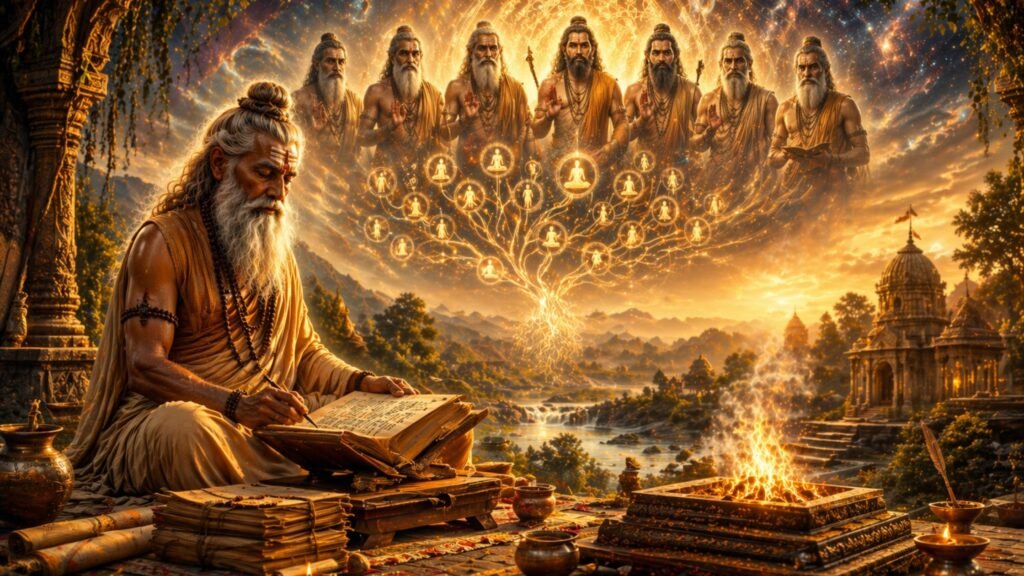
Ancient tradition traces many gotras to the Saptarishis.
The Seven Great Sages (Saptarishis)
- Vashistha
- Vishwamitra
- Atri
- Bharadwaja
- Gautama
- Jamadagni
- Kashyapa
Most Brahman gotras are linked to these or their branches.
Over time:
- Disciples formed sub-lineages
- Family branches expanded
- Pravara traditions developed
- Regional gotra variations emerged
This created the vast gotra system seen today.
Major Brahman Ke Gotra List and Meanings
Table of Common Brahman Gotras
| Gotra | Associated Rishi | Meaning/Association |
|---|---|---|
| Bharadwaja | Bharadwaja | Knowledge, scholarship |
| Kashyapa | Kashyapa | Creation, diversity |
| Vashistha | Vashistha | Wisdom and tapas |
| Gautama | Gautama | Discipline and dharma |
| Atri | Atri | Illumination |
| Agastya | Agastya | Balance and power |
| Shandilya | Shandilya | Devotion and philosophy |
| Kaushika | Vishwamitra | Spiritual transformation |
| Parashara | Parashara | Scriptural wisdom |
| Jamadagni | Jamadagni | Austerity and strength |
Bharadwaja Gotra
Associated with sage Bharadwaja.
Known for:
- Learning
- Vedic scholarship
- Discipline
- Teaching tradition
Lesson:
Knowledge becomes sacred when passed to others.
Kashyapa Gotra
Associated with sage Kashyapa.
Linked with:
- Creation
- Universal ancestry
- Diversity of beings
Lesson:
All life shares one source.
Vashistha Gotra
Linked to Vashistha.
Represents:
- Inner wisdom
- Tapasya
- Dharma
Lesson:
True power lies in self-mastery.
What Is Pravara in Gotra?
Many confuse gotra and pravara.
They differ.
Gotra
Primary lineage from a Rishi.
Pravara
List of prominent sages invoked within that lineage.
Example:
A person may belong to:
- Bharadwaja Gotra
- With Angirasa, Barhaspatya, Bharadwaja Pravara
This gives more specific ancestral identity.
Is Gotra Same as Caste?
No.
This is a common misunderstanding.
Gotra ≠ Caste
| Concept | Meaning |
|---|---|
| Caste (Jati) | Social community |
| Varna | Philosophical classification |
| Surname | Family name |
| Gotra | Sage lineage |
A person may share caste but have different gotras.
A person may share gotra but have different surnames.
Why Is Gotra Important in Marriage?
This is one of the most discussed aspects.
Traditionally, marriage within same gotra is often avoided.
Why?
Because people of same gotra are viewed as descending from one ancestral line.
It is treated symbolically like sibling ancestry.
Traditional Reasons
- Prevent close lineage unions
- Preserve exogamy
- Maintain ancestral distinctions
- Follow dharmic customs
Ancient Principle
“सगोत्र विवाह वर्जितः”
Sagotra vivaha varjitah.
“Marriage within same gotra is traditionally prohibited.”
Modern Note
Interpretations vary by:
- Region
- Community
- Family customs
- Legal/social outlook
Some traditions follow it strictly.
Others are more flexible.
Why Do Brahmins Ask Gotra in Rituals?
During puja or sankalpa, priests often ask:
- Name
- Father’s name
- Gotra
- Pravara
Why?
Because rituals invoke ancestral continuity.
It places the individual within a sacred chain.
Not as ego—
But as lineage remembrance.
Spiritual Meaning of Brahman Ke Gotra
The deepest meaning of gotra is often forgotten.
It is not merely:
- “Which group do I belong to?”
It is also:
- “Which wisdom stream do I inherit?”
Your gotra can be viewed as:
- A responsibility
- A discipline
- A spiritual identity
English Quote
“Lineage is not pride in ancestors, but responsibility toward their wisdom.”
Hindi Quote
“कुल का गौरव जन्म से नहीं, आचरण से बनता है।”
“The honor of lineage comes not from birth, but conduct.”
Do Surnames Indicate Gotra?
Sometimes yes.
Often no.
Example:
People with same surname may have different gotras.
Likewise:
Different surnames may share same gotra.
Therefore surname alone cannot confirm gotra.
One should verify through:
- Family elders
- Kul records
- Priests
- Traditional genealogy
- Family rituals
How to Know Your Brahman Gotra
If you do not know your gotra:
Try these methods.
Ask Elders
Often grandparents know.
Check Wedding Records
Traditional marriage records often mention gotra.
Consult Family Priest
Many maintain lineage records.
Review Sankalpa Traditions
Gotra is often recited during rituals.
Famous Rishis Behind Brahman Gotras
Sage Kashyapa
Kashyapa is often called a progenitor sage.
Associated with:
- Cosmic creation
- Universal fatherhood
- Balance
Sage Bharadwaja
Bharadwaja symbolizes scholarship.
Tradition associates him with:
- Knowledge
- Vedic sciences
- Teaching
Sage Vishwamitra
Vishwamitra represents transformation.
A king became a sage.
Lesson:
Your spiritual rise is greater than your birth.
Spiritual Lessons from Brahman Gotras
1. Remember Your Roots
A tree survives because of roots.
Humans too.
2. Wisdom Is Inherited and Earned
Birth gives lineage.
Character gives worth.
3. Identity Should Lead to Humility
Gotra was never meant for superiority.
It was meant for responsibility.
4. Tradition Carries Memory
Without memory, civilizations collapse.
5. Dharma Is Greater Than Lineage
Even the greatest sages valued conduct over pride.
Sanskrit Quote
“न कुलं वृत्तहीनस्य प्रमाणमिति मे मतिः।”
“Lineage has no value without noble conduct.”
Common Misconceptions About Brahman Ke Gotra
Myth 1:
Gotra means caste.
False.
Myth 2:
Gotra determines superiority.
False.
Ancient sages taught humility.
Myth 3:
Same surname means same gotra.
False.
Myth 4:
Gotra has no modern relevance.
Incomplete.
It still matters in:
- Rituals
- Genealogy
- Identity
- Cultural continuity
Regional Variations in Brahman Gotras
Different regions preserve variations.
North India
Common:
- Bharadwaj
- Gautam
- Kashyap
- Vashistha
South India
Common:
- Harita
- Kaushika
- Shandilya
- Vatsa
Eastern Traditions
Distinct pravara systems often emphasized.
Western India
Regional branches and sub-lineages preserved.
Brahman Ke Gotra in Scriptures
References appear in:
- Rigveda
- Manusmriti
- Mahabharata
- Grihya Sutras
These texts preserve lineage traditions.
Does Gotra Matter Spiritually Today?
Yes—if understood correctly.
Not as social ego.
But as:
- Remembering ancestral wisdom
- Preserving sacred identity
- Honoring dharma
- Connecting with roots
In modern life, people search for identity.
Gotra reminds us:
Identity can be spiritual, not only social.
Practical Importance of Knowing Your Gotra
Knowing your gotra helps in:
- Marriage discussions
- Rituals
- Ancestral understanding
- Cultural continuity
- Personal identity
A Deeper Philosophical Interpretation
Some scholars see gotra as symbolic.
Each Rishi represents qualities.
For example:
- Kashyapa → expansiveness
- Bharadwaja → knowledge
- Vashistha → wisdom
- Vishwamitra → transformation
Then asking “What is your gotra?”
also asks:
“What qualities are you meant to embody?”
That is profound.
Powerful Reflection Quote
“You do not honor your ancestors by repeating their names, but by living their values.”
FAQs
What is Brahman ke gotra?
Brahman ke gotra refers to ancestral lineage traced to an ancient Vedic sage or Rishi.
How many Brahman gotras are there?
There are many gotras and sub-branches. Many trace to major Rishi lineages such as the Saptarishis.
Why is same gotra marriage avoided?
Traditionally because same-gotra individuals are seen as sharing ancestral lineage.
Is gotra different from surname?
Yes. Surname is family name. Gotra is sage lineage.
How can I find my gotra?
Ask family elders, check ritual records, or consult a family priest.
Does gotra matter today?
Yes, especially in rituals, genealogy, and cultural identity.
Is Bharadwaj a gotra?
Yes, Bharadwaj (Bharadwaja) is a major Brahman gotra.
Conclusion
Understanding Brahman ke gotra is more than learning about ancestral names—it is discovering a deeper connection to Vedic wisdom, family heritage, and spiritual identity. Rooted in the lineages of ancient sages, the gotra system has long served as a guide for tradition, rituals, and social harmony. While many know gotra mainly through marriage customs, its true meaning goes beyond rules; it reflects remembrance of one’s roots and responsibility toward inherited values.
Explore timeless wisdom, spiritual heritage, and Vedic knowledge with TheGita where ancient truths guide modern life.