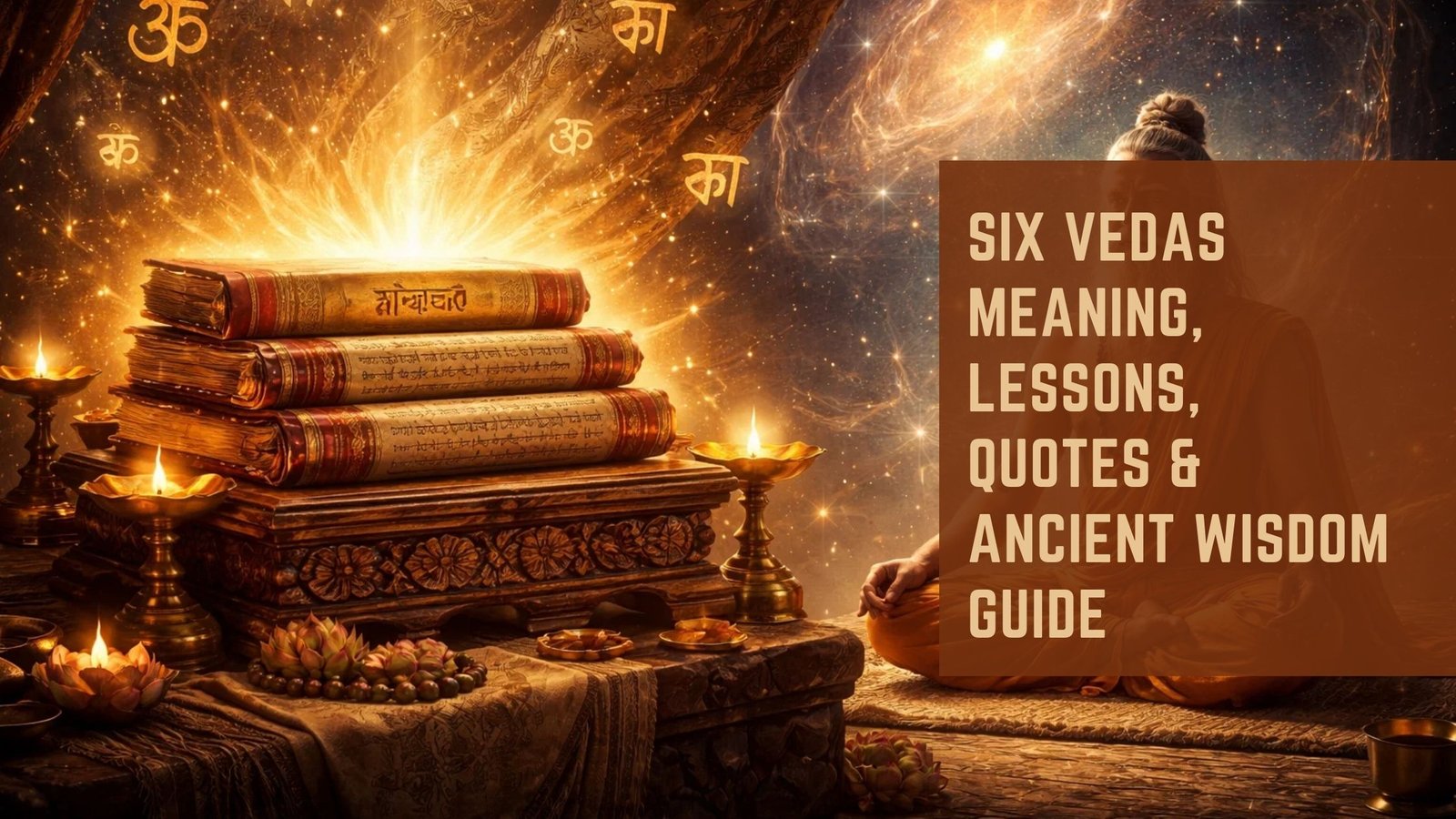
Thousands of years ago, long before modern science, philosophy, and organized education systems emerged, humanity already possessed a vast ocean of knowledge known as the Vedas. These sacred texts were not simply religious scriptures; they were guides to understanding life, nature, consciousness, and the universe.
The wisdom of the Vedas shaped spirituality, ethics, medicine, astronomy, and philosophy. They provided answers to questions humans still ask today:
- Who am I?
- Why do we exist?
- What is the purpose of life?
- How can humans live in harmony with the universe?
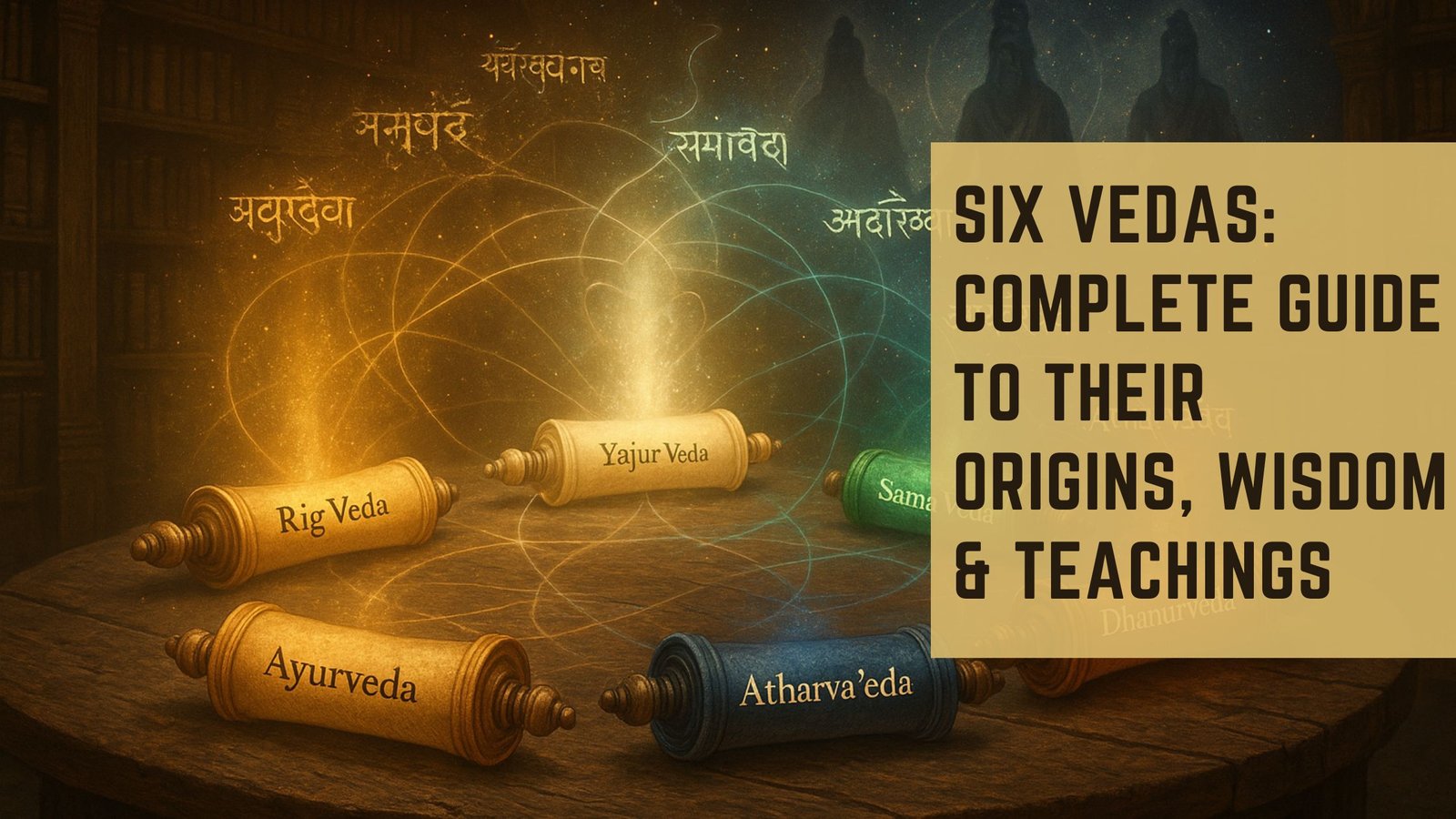
The ancient sages believed that knowledge is sacred and eternal. The Vedic tradition therefore preserved this wisdom in a structured system consisting of the four primary Vedas and the six Vedangas (often referred to as the “Six Vedas” in extended interpretation) that help understand them.
These six branches of knowledge serve as tools to properly study, interpret, and apply the wisdom of the Vedas.
The Vedic tradition teaches that true knowledge does not merely inform the mind; it transforms the soul.
A famous Vedic idea reminds us:
“Knowledge is the light that removes the darkness of ignorance.”
Understanding the Six Vedas therefore means exploring the foundation of human spiritual and intellectual evolution.
Table of Contents
Key Takeaways
- The Vedas are the oldest sacred knowledge texts in human history.
- There are four main Vedas: Rigveda, Yajurveda, Samaveda, and Atharvaveda.
- The Six Vedangas act as supporting sciences that explain and preserve the Vedas.
- These six are: Shiksha, Vyakarana, Chandas, Nirukta, Kalpa, and Jyotisha.
- Together they form the intellectual framework of ancient Vedic education.
- Their teachings include language, grammar, ritual science, astronomy, poetry, and philosophy.
What Are the Six Vedas?
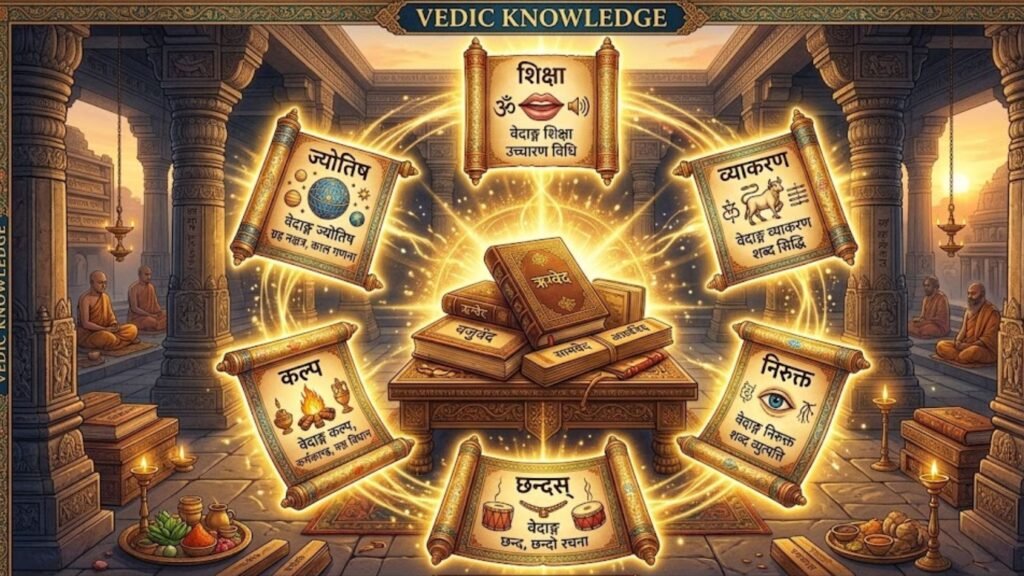
In traditional Vedic scholarship, the phrase “Six Vedas” commonly refers to the Six Vedangas, the disciplines that support and explain the Vedas.
The word Vedanga means “limb of the Veda.”
Just as the human body requires many limbs to function, the Vedas require these six disciplines to be properly understood.
These six are:
- Shiksha (phonetics)
- Vyakarana (grammar)
- Chandas (poetic meter)
- Nirukta (etymology)
- Kalpa (ritual procedures)
- Jyotisha (astronomy and time calculation)
Together they form the intellectual system that preserved Vedic wisdom for thousands of years.
The Six Vedangas (Six Vedas)
1. Shiksha The Science of Pronunciation
Shiksha focuses on correct pronunciation and sound patterns of Vedic chants.
In the Vedic tradition, sound was believed to have immense power. Even a small mistake in pronunciation could change the meaning or spiritual effect of a mantra.
Shiksha teaches:
- correct articulation
- pitch and tone
- rhythm of chanting
- phonetic precision
The ancient sages preserved the Vedas orally for centuries, and Shiksha ensured their accuracy.
Lesson from Shiksha
Words carry energy. The way we speak can heal, inspire, or harm.
Quote
“Speech that is truthful and kind becomes a bridge between souls.”
2. Vyakarana The Science of Grammar
Vyakarana is the study of Sanskrit grammar.
The greatest grammarian associated with this field is the sage Panini, whose work structured the Sanskrit language with remarkable scientific precision.
Vyakarana helps scholars:
- understand the meaning of Vedic texts
- interpret sacred verses accurately
- preserve linguistic clarity
Without grammar, sacred texts could easily be misinterpreted.
Lesson from Vyakarana
Language shapes thought. Clear language creates clear thinking.
Quote
“Grammar protects knowledge from distortion.”
3. Chandas The Science of Vedic Meter
Chandas studies the poetic structure and rhythm of Vedic hymns.
The Vedas were composed in carefully structured meters such as:
- Gayatri
- Anushtubh
- Trishtubh
- Jagati
These rhythmic patterns helped:
- memorization of sacred texts
- preservation of chants
- creation of spiritual vibrations
Lesson from Chandas
Harmony in rhythm reflects harmony in life.
Quote
“The universe itself moves in rhythm the Vedas simply echo it.”
4. Nirukta The Science of Word Meaning
Nirukta deals with etymology and interpretation of difficult Vedic words.
The ancient scholar Yaska wrote the famous work Nirukta, which explains obscure terms found in Vedic literature.
This discipline answers questions like:
- What does a particular Vedic word mean?
- What is its deeper symbolic meaning?
- How should it be interpreted?
Lesson from Nirukta
Understanding the origin of words leads to understanding the origin of ideas.
Quote
“When the meaning of words is known, the wisdom of the Vedas shines clearly.”
5. Kalpa The Science of Ritual Practice
Kalpa explains how Vedic rituals should be performed.
It provides guidelines for ceremonies such as:
- sacrifices (yajnas)
- religious rituals
- social duties
- life-cycle ceremonies
Kalpa texts include:
- Shrauta Sutras
- Grihya Sutras
- Dharma Sutras
These texts guided daily life and spiritual practices in ancient society.
Lesson from Kalpa
Spiritual knowledge must be practiced, not only studied.
Quote
“Wisdom becomes sacred when it is lived.”
6. Jyotisha The Science of Astronomy and Time
Jyotisha deals with astronomy, astrology, and time calculation.
Ancient Vedic scholars studied:
- planetary movements
- seasons
- lunar cycles
- auspicious timing for rituals
Jyotisha helped determine the correct timing for Vedic ceremonies.
It also laid the foundation for early Indian astronomy.
Lesson from Jyotisha
Human life is connected to the rhythms of the cosmos.
Quote
“The stars remind us that the universe and human life are deeply connected.”
Wisdom from the Vedic Tradition
| Theme | Quote | Meaning |
|---|---|---|
| Knowledge | “From ignorance lead me to truth.” | Knowledge liberates the soul |
| Truth | “Truth alone triumphs.” | Truth is eternal |
| Unity | “The world is one family.” | Humanity is interconnected |
| Wisdom | “Let noble thoughts come from every side.” | Remain open to knowledge |
| Harmony | “Peace within brings peace to the world.” | Inner transformation creates global harmony |
Spiritual Lessons from the Six Vedas
The teachings of the Six Vedas extend far beyond rituals or linguistic studies. They reveal universal life lessons.
1. Knowledge is Sacred
The Vedic tradition places knowledge above material wealth.
True wisdom leads to freedom.
2. Discipline Preserves Wisdom
The six Vedangas show that knowledge must be preserved with precision and discipline.
3. Language Shapes Reality
Words influence thoughts and actions.
The Vedic sages therefore treated language as sacred.
4. Life Is Connected to the Cosmos
The study of Jyotisha teaches that human life is part of a larger cosmic order.
5. Practice Is Essential
Knowledge without practice remains incomplete.
Kalpa reminds us that wisdom must guide action.
Why the Six Vedas Still Matter Today
Although written thousands of years ago, Vedic knowledge remains deeply relevant.
Modern scholars recognize that Vedic studies contributed to:
- linguistics
- mathematics
- astronomy
- philosophy
- medicine
- ethics
The Vedas encourage humanity to pursue both material progress and spiritual growth.
Their central message is timeless:
Balance knowledge, action, and inner awareness.
FAQ
What are the Six Vedas?
The Six Vedas generally refer to the Six Vedangas, the disciplines that support the study of the Vedas.
What are the names of the Six Vedangas?
The six Vedangas are:
Shiksha
Vyakarana
Chandas
Nirukta
Kalpa
Jyotisha
How many main Vedas exist?
There are four primary Vedas:
Rigveda
Yajurveda
Samaveda
Atharvaveda
Why are Vedangas important?
Vedangas help scholars properly understand pronunciation, grammar, meaning, ritual practice, and timing within Vedic studies.
Are Vedas religious or philosophical?
They are both. The Vedas combine spirituality, philosophy, science, and ethical teachings.
Conclusion
The Six Vedas represent an extraordinary intellectual and spiritual achievement of ancient humanity.
They demonstrate that knowledge is not merely about facts. It is about understanding life, the universe, and our place within it.
Through phonetics, grammar, poetry, interpretation, ritual science, and astronomy, the ancient sages created a system that preserved sacred knowledge for thousands of years.
Even today, their message remains powerful:
Seek truth.
Respect knowledge.
Live with harmony.
Stay connected to the universe.
As one ancient Vedic prayer beautifully says:
“Lead me from darkness to light, from ignorance to wisdom, and from mortality to eternal truth.”
The wisdom of the Six Vedas continues to illuminate the path for anyone searching for deeper understanding, purpose, and inner peace. Explore timeless wisdom with TheGita and transform your perspective on life