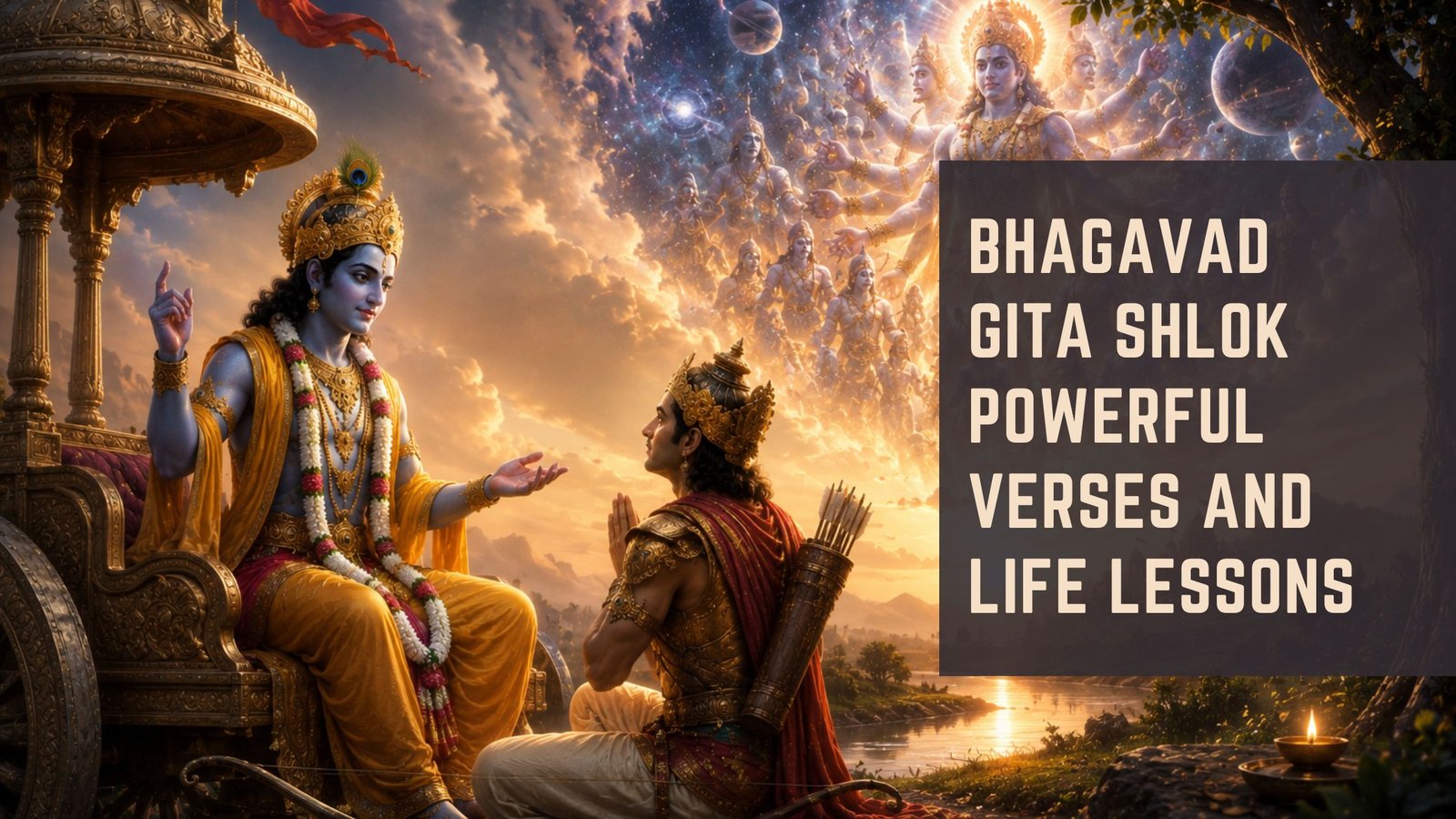
What if a single conversation spoken thousands of years ago could still solve the confusion, fear, anxiety, and emotional battles of modern humanity? Imagine standing in the middle of a battlefield—not of weapons, but of decisions, heartbreak, stress, ambition, and uncertainty. That battlefield is life itself. And hidden within the sacred dialogue of Bhagavad Gita lies wisdom powerful enough to guide every soul through darkness.
The Bhagavad Gita is not merely a religious text. It is a spiritual map for humanity. Spoken by Lord Krishna to Arjuna during the great war of the Mahabharata, every Bhagavad Gita Shlok carries timeless truth. These verses speak about duty, love, fear, attachment, discipline, devotion, karma, and liberation. Whether someone seeks success, peace, emotional healing, or spiritual awakening, the Bhagavad Gita Shlok offer answers that feel strangely personal.
Even after thousands of years, these sacred teachings continue to inspire leaders, saints, thinkers, students, warriors, and ordinary people across the world. The beauty of every Bhagavad Gita Shlok is that it speaks differently to every person depending on the stage of life they are experiencing.
Table of Contents
Key Takeaways
- Learn the deeper meaning behind powerful Bhagavad Gita Shlok and how they apply to modern life.
- Discover spiritual lessons about karma, discipline, inner peace, and devotion.
- Understand why the Bhagavad Gita continues to guide humanity beyond time.
The Master Table of Timeless Bhagavad Gita Wisdom
| Name | Key Symbol/Weapon | Reason They Matter |
|---|---|---|
| Lord Krishna | Sudarshan Chakra | Divine guide who revealed eternal truth |
| Arjuna | Gandiva Bow | Represents human confusion and awakening |
| Karna | Celestial Armor | Symbol of loyalty, pain, and destiny |
| Bhishma | Spear and Vows | Embodiment of discipline and sacrifice |
| Hanuman | Mace | Symbol of devotion and strength |
| Draupadi | Faith | Represents dignity, suffering, and surrender |
The Eternal Dialogue Between Krishna and Arjuna
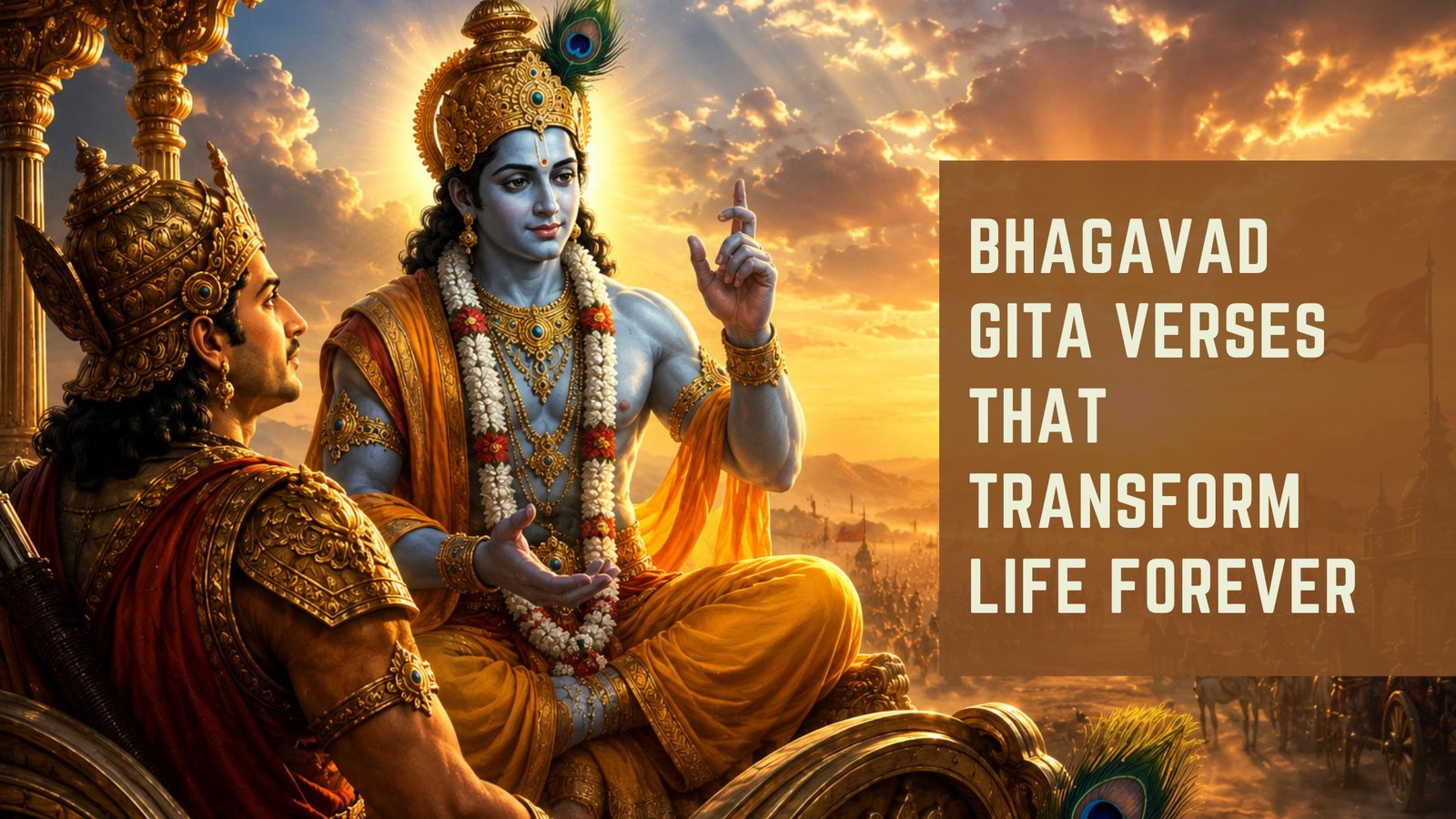
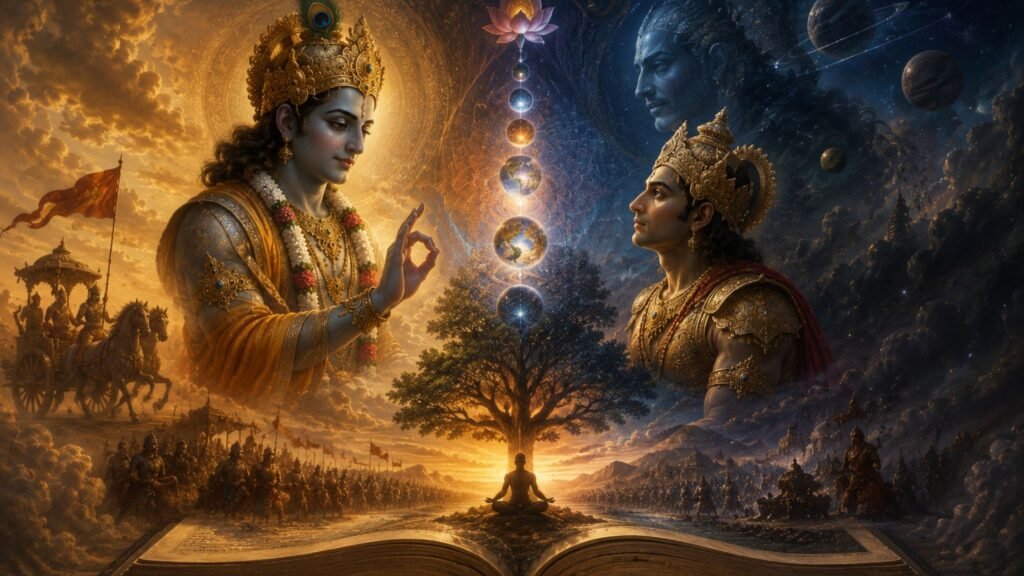
The Bhagavad Gita begins in a moment of emotional collapse. Arjuna, the greatest warrior of his era, suddenly refuses to fight. Standing before teachers, relatives, and loved ones on the battlefield of Kurukshetra, he becomes overwhelmed by grief and confusion.
At that moment, Lord Krishna delivers teachings that transcend religion and time. The Bhagavad Gita Shlok are not only about war; they are about the inner war every human experiences.
The Legend
In the Mahabharata, the Kurukshetra war symbolized the battle between righteousness and injustice. Krishna chose not to wield weapons but instead became Arjuna’s charioteer and spiritual guide.
The Story
Arjuna’s mind became clouded by fear and attachment. He questioned morality, duty, and life itself. Krishna responded with divine wisdom explaining karma, dharma, self-realization, and devotion.
The Modern Lesson
Today, people face emotional battles every day—career confusion, family pressure, anxiety, loneliness, and fear of failure. The Bhagavad Gita teaches that clarity comes when action aligns with purpose and spiritual awareness.
Key Quote
“कर्मण्येवाधिकारस्ते मा फलेषु कदाचन”
“You have the right to perform your duty, but not to the fruits of your actions.”
This Bhagavad Gita Shlok is perhaps the most quoted spiritual teaching in the world. It teaches detached action—work sincerely without becoming enslaved by outcomes.
Bhagavad Gita Shlok on Karma and Action
One of the most transformative teachings in the Bhagavad Gita concerns karma. Many misunderstand karma as fate, but Krishna explains it as conscious action.
The Legend
Krishna repeatedly emphasizes that inactivity is not wisdom. Every individual must perform their dharma with sincerity.
The Story
Arjuna wanted to escape responsibility because emotional pain clouded his judgment. Krishna reminded him that avoiding duty creates greater suffering.
The Modern Lesson
In modern life, people often delay action due to fear of failure. The Bhagavad Gita Shlok teach that sincere effort matters more than guaranteed success.
Key Quote
“योगः कर्मसु कौशलम्”
“Yoga is excellence in action.”
This Bhagavad Gita Shlok reveals that spirituality is not separate from work. True spirituality means performing every action with awareness and integrity.
Bhagavad Gita Shlok on the Mind
The human mind can become either a prison or a path toward liberation. Krishna explains that self-control is essential for peace.
The Legend
Arjuna admits that controlling the mind feels harder than controlling the wind itself.
The Story
Krishna teaches meditation, discipline, and detachment as tools to master the restless mind.
The Modern Lesson
In the age of social media, distractions, and anxiety, the teachings of the Bhagavad Gita Shlok feel more relevant than ever. Inner peace cannot be found externally.
Key Quote
“उद्धरेदात्मनात्मानं”
“Elevate yourself through your own mind, not degrade yourself.”
This verse teaches personal responsibility and self-awareness.
Bhagavad Gita Shlok on Fear and Courage
Fear often arises from attachment and uncertainty. Krishna repeatedly encourages Arjuna to rise above fear.
The Legend
Before the war began, Arjuna trembled emotionally and physically. He lost confidence in his purpose.
The Story
Krishna reminded him that the soul is eternal and cannot be destroyed.
The Modern Lesson
Fear of rejection, failure, loss, or death controls many people today. The Bhagavad Gita Shlok teach that spiritual understanding removes fear.
Key Quote
“न जायते म्रियते वा कदाचित्”
“The soul is never born and never dies.”
This timeless Bhagavad Gita Shlok comforts countless people facing grief and uncertainty.
Bhagavad Gita Shlok on Devotion
Devotion in the Gita is not blind ritual. It is complete trust in the Divine.
The Legend
Krishna reveals that pure devotion transcends social status, wealth, and intellectual pride.
The Story
Arjuna slowly moves from confusion toward surrender and trust.
The Modern Lesson
Modern life often creates emotional emptiness despite material success. Devotion reconnects the human heart with meaning.
Key Quote
“पत्रं पुष्पं फलं तोयं यो मे भक्त्या प्रयच्छति”
“Whoever offers Me a leaf, flower, fruit, or water with devotion, I accept it.”
This Bhagavad Gita Shlok teaches that sincerity matters more than external display.
Bhagavad Gita Shlok on Discipline
Without discipline, knowledge remains powerless.
The Legend
Warriors, sages, and kings in ancient India followed strict discipline to master themselves.
The Story
Krishna explains moderation in food, sleep, speech, and habits.
The Modern Lesson
Many people seek motivation but ignore discipline. The Bhagavad Gita teaches that inner mastery creates lasting success.
Key Quote
“युक्ताहारविहारस्य”
“For one who is balanced in eating, recreation, work, and sleep, yoga destroys suffering.”
Balance is presented as the foundation of peace.
Bhagavad Gita Shlok on Detachment
Detachment does not mean abandoning love or responsibility. It means freedom from unhealthy attachment.
The Legend
Arjuna’s suffering emerged because he became emotionally attached to outcomes.
The Story
Krishna explains that attachment creates fear, anger, and sorrow.
The Modern Lesson
Modern relationships and careers often become sources of anxiety because people attach their identity to temporary things.
Key Quote
“ध्यायतो विषयान्पुंसः सङ्गस्तेषूपजायते”
“Attachment develops from constant contemplation of desires.”
This Bhagavad Gita Shlok explains the psychological chain leading to suffering.
Bhagavad Gita Shlok on Leadership
The Gita also contains profound lessons for leaders.
The Legend
Krishna explains that society follows the example of great individuals.
The Story
Arjuna’s choices would influence the future of an entire civilization.
The Modern Lesson
Parents, teachers, entrepreneurs, and leaders shape society through their conduct.
Key Quote
“यद्यदाचरति श्रेष्ठः”
“Whatever a great person does, others follow.”
This Bhagavad Gita Shlok highlights the responsibility of influence.
Bhagavad Gita Shlok on Inner Peace
Peace cannot be purchased, borrowed, or forced.
The Legend
Krishna teaches that desires create endless agitation.
The Story
Arjuna learns that peace arises from self-realization and surrender.
The Modern Lesson
Despite technological progress, humanity struggles with stress and emotional emptiness. The Bhagavad Gita Shlok guide individuals toward inner stillness.
Key Quote
“अशान्तस्य कुतः सुखम्”
“How can there be happiness without peace?”
This profound verse exposes the root of human dissatisfaction.
Comparison Section: Timeless Lessons from the Gita
Krishna vs Arjuna
- Krishna represents divine wisdom and clarity.
- Arjuna represents human confusion and emotional struggle.
- Krishna guides through truth.
- Arjuna learns through questioning.
Karma vs Attachment
- Karma focuses on sincere action.
- Attachment focuses on desired outcomes.
- Karma creates growth.
- Attachment creates fear and anxiety.
Knowledge vs Wisdom
- Knowledge gathers information.
- Wisdom transforms life.
- Knowledge can create ego.
- Wisdom creates humility.
Why Bhagavad Gita Shlok Still Matter Today
The Bhagavad Gita survives because it addresses universal human struggles. Every generation faces fear, ambition, grief, anger, and uncertainty. The verses remain relevant because human emotions remain unchanged.
Students find guidance during confusion. Leaders discover responsibility. Spiritual seekers gain clarity. People experiencing heartbreak find comfort. Even those unfamiliar with Hindu philosophy often feel deeply moved by the teachings.
Unlike ordinary motivational quotes, Bhagavad Gita Shlok contain layered meaning. A single verse can inspire someone differently at different stages of life.
The text also balances spirituality with practicality. Krishna never asks Arjuna to abandon life. Instead, he teaches him how to live consciously within it.
Frequently Asked Questions
How many shlokas are in the Bhagavad Gita?
The Bhagavad Gita contains 700 shlokas spread across 18 chapters.
Who wrote the Bhagavad Gita?
The Bhagavad Gita is part of the Mahabharata, traditionally attributed to Vyasa.
Why is the Bhagavad Gita important?
It offers timeless wisdom about life, purpose, discipline, devotion, and self-realization.
Can non-Hindus read the Bhagavad Gita?
Yes. The teachings are universal and focus on human consciousness, ethics, and spiritual growth.
Which Bhagavad Gita Shlok helps with anxiety?
Many people find comfort in verses teaching surrender, detachment, and the eternal nature of the soul.
Conclusion
The Bhagavad Gita is more than scripture—it is a timeless mirror reflecting the human condition. Every Bhagavad Gita Shlok carries spiritual depth capable of transforming fear into courage, confusion into clarity, and suffering into wisdom. Across centuries, these sacred verses continue to guide humanity because they address truths beyond culture, geography, and time itself.
In a world overwhelmed by distraction and uncertainty, the Bhagavad Gita reminds humanity to act with integrity, live with awareness, and surrender with faith. Whether someone seeks success, peace, healing, or enlightenment, the answers hidden within these divine verses remain eternally relevant. Explore more timeless wisdom and spiritual insights at thegita.in.