
What if the answers to fear, confusion, duty, attachment, success, failure, and inner peace were already contained in an ancient conversation?
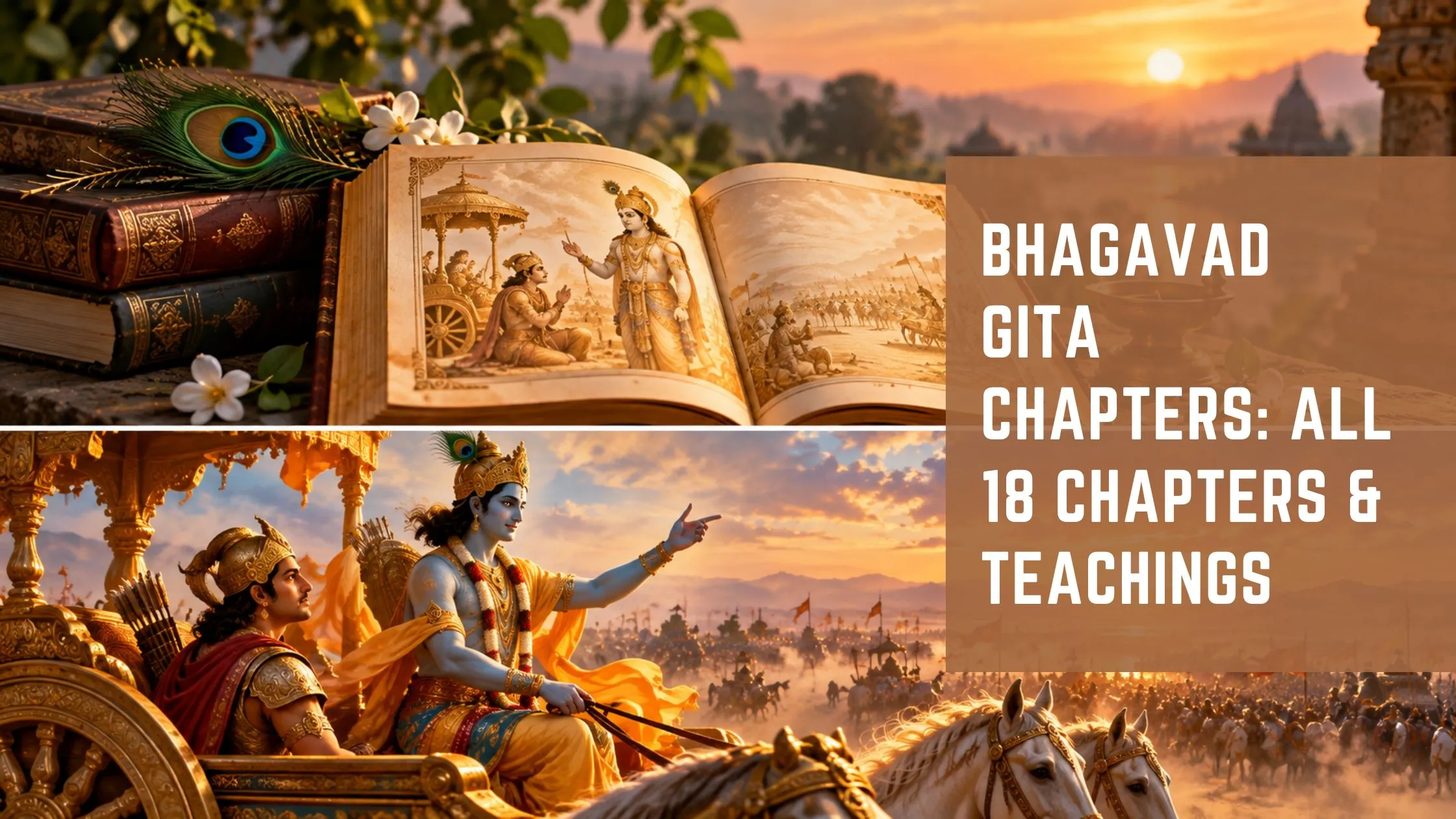
The Bhagavad Gita is not simply a religious text. It is a profound dialogue between Lord Krishna and Arjuna, presented on the battlefield of Kurukshetra. Faced with a painful moral crisis, Arjuna becomes confused about his duty. Krishna responds by explaining the nature of the self, karma, dharma, meditation, devotion, knowledge, detachment, and liberation.
The Bhagavad Gita contains 18 chapters, traditionally known as Yoga. Each chapter presents a different aspect of spiritual wisdom while gradually guiding Arjuna from confusion toward clarity.
The 18 chapters together form a journey from despair and questioning to knowledge, discipline, devotion, surrender, and liberation.
Table of Contents
- Key Takeaways
- What Are the 18 Chapters of the Bhagavad Gita?
- Chapter 1: Arjuna Vishada Yoga — The Yoga of Arjuna's Despair
- Chapter 2: Sankhya Yoga — The Yoga of Knowledge
- Chapter 3: Karma Yoga — The Yoga of Action
- Chapter 4: Jnana Karma Sannyasa Yoga — Knowledge and Renunciation of Action
- Chapter 5: Karma Sannyasa Yoga — Renunciation
- Chapter 6: Dhyana Yoga — The Yoga of Meditation
- Chapter 7: Jnana Vijnana Yoga — Knowledge and Realization
- Chapter 8: Akshara Brahma Yoga — The Imperishable Brahman
- Chapter 9: Raja Vidya Raja Guhya Yoga — The Supreme Knowledge
- Chapter 10: Vibhuti Yoga — Divine Glories
- Chapter 11: Vishvarupa Darshana Yoga — The Universal Form
- Chapter 12: Bhakti Yoga — The Yoga of Devotion
- Chapter 13: Kshetra Kshetrajna Vibhaga Yoga
- Chapter 14: Gunatraya Vibhaga Yoga — The Three Gunas
- Chapter 15: Purushottama Yoga — The Supreme Person
- Chapter 16: Daivasura Sampad Vibhaga Yoga
- Chapter 17: Shraddhatraya Vibhaga Yoga — Three Types of Faith
- Chapter 18: Moksha Sannyasa Yoga — The Yoga of Liberation
- The Bhagavad Gita's Central Message
- A Simple Way to Understand the 18 Chapters
- Why the Bhagavad Gita Still Matters Today
- Frequently Asked Questions
- Conclusion
Key Takeaways
The Bhagavad Gita contains 18 chapters and 700 verses in its commonly accepted form.
Each chapter is traditionally associated with a particular form of Yoga.
Karma Yoga teaches responsible action without attachment to results.
Jnana Yoga emphasizes spiritual knowledge and discrimination.
Dhyana Yoga explores meditation and control of the mind.
Bhakti Yoga emphasizes devotion and loving remembrance of the Divine.
The final chapters bring together knowledge, action, devotion, dharma, and liberation.
The Gita's teachings can be applied to relationships, work, decision-making, discipline, and everyday life.
What Are the 18 Chapters of the Bhagavad Gita?
Each chapter addresses a different stage of Arjuna's spiritual and psychological journey.
| Chapter | Sanskrit Name | Main Theme | Key Life Lesson |
|---|---|---|---|
| 1 | Arjuna Vishada Yoga | Arjuna's despair | A crisis can become the beginning of wisdom |
| 2 | Sankhya Yoga | Knowledge of self | Know the difference between the body and the Self |
| 3 | Karma Yoga | Path of action | Perform your duty without selfish attachment |
| 4 | Jnana Karma Sannyasa Yoga | Knowledge and action | Spiritual knowledge transforms action |
| 5 | Karma Sannyasa Yoga | Renunciation | True renunciation is freedom from attachment |
| 6 | Dhyana Yoga | Meditation | Master the mind through disciplined practice |
| 7 | Jnana Vijnana Yoga | Knowledge of Divine nature | See the Divine as the foundation of existence |
| 8 | Akshara Brahma Yoga | Eternal reality | Remember the Divine with steady awareness |
| 9 | Raja Vidya Raja Guhya Yoga | Supreme knowledge | Devotion opens the way to the Divine |
| 10 | Vibhuti Yoga | Divine manifestations | Recognize greatness as an expression of the Divine |
| 11 | Vishvarupa Darshana Yoga | Universal form | See the vastness of Divine reality |
| 12 | Bhakti Yoga | Devotion | Cultivate love, compassion, and humility |
| 13 | Kshetra Kshetrajna Vibhaga Yoga | Body and knower | Understand the difference between the field and its knower |
| 14 | Gunatraya Vibhaga Yoga | Three Gunas | Understand how Sattva, Rajas, and Tamas influence life |
| 15 | Purushottama Yoga | Supreme Being | Discover the deeper spiritual reality beyond the changing world |
| 16 | Daivasura Sampad Vibhaga Yoga | Divine and demonic qualities | Character determines the direction of life |
| 17 | Shraddhatraya Vibhaga Yoga | Three kinds of faith | Faith influences thought, action, and lifestyle |
| 18 | Moksha Sannyasa Yoga | Liberation and surrender | Fulfill your dharma and surrender attachment to outcomes |

Chapter 1: Arjuna Vishada Yoga — The Yoga of Arjuna's Despair
The first chapter begins with Arjuna seeing his relatives, teachers, and friends standing on opposing sides of the battlefield.
His courage disappears, and he becomes overwhelmed by grief and moral confusion.
Central Teaching
Arjuna's despair is important because it creates the question that leads to the entire teaching of the Gita.
Life Lesson
Sometimes confusion is not the end of the journey; it is the beginning of deeper understanding.
Chapter 2: Sankhya Yoga — The Yoga of Knowledge
Chapter 2 introduces many of the Gita's central teachings.
Krishna explains the distinction between the temporary body and the eternal Self. He also introduces Karma Yoga and the qualities of a person with steady wisdom.
One of the best-known teachings appears here:
"You have a right to perform your duty, but not to the fruits of your actions." — Bhagavad Gita 2.47
Life Lesson
Focus on sincere effort rather than becoming consumed by the result.
Chapter 3: Karma Yoga — The Yoga of Action
Krishna explains why action is unavoidable and why people should perform their responsibilities without selfish attachment.
The Gita does not simply tell us to abandon work. Instead, it teaches us how to transform our relationship with action.
Life Lesson
Work becomes meaningful when it is performed as duty rather than merely for personal reward.
Chapter 4: Jnana Karma Sannyasa Yoga — Knowledge and Renunciation of Action
This chapter explains the relationship between knowledge, action, and spiritual wisdom.
Krishna discusses the purpose of divine manifestation and explains how spiritual knowledge can free a person from the binding effects of action.
Key Idea
Knowledge changes how we understand ourselves, our duties, and our actions.
Life Lesson
Right knowledge can transform ordinary action into a spiritual practice.
Chapter 5: Karma Sannyasa Yoga — Renunciation
Chapter 5 compares renunciation and selfless action.
Krishna explains that genuine renunciation is not merely abandoning responsibilities. True renunciation involves letting go of attachment and selfish identification with action.
Life Lesson
You can live actively in the world while cultivating inner detachment.
Chapter 6: Dhyana Yoga — The Yoga of Meditation
Chapter 6 focuses on meditation, discipline, self-control, and mastery of the mind.
Krishna explains that the mind can become either a friend or an obstacle depending on how it is trained.
"The mind can be the friend of the self and also its enemy." — Bhagavad Gita 6.5
Life Lesson
A disciplined mind can become your greatest strength.
Chapter 7: Jnana Vijnana Yoga — Knowledge and Realization
Krishna explains His relationship with the material and spiritual dimensions of existence.
The chapter encourages Arjuna to move beyond intellectual knowledge toward spiritual realization.
Life Lesson
Knowing about spirituality and experiencing spiritual understanding are not always the same thing.
Chapter 8: Akshara Brahma Yoga — The Imperishable Brahman
This chapter explores Brahman, the Self, karma, the nature of existence, and remembrance of the Divine.
A major theme is the importance of consciousness and remembrance at the time of death.
Life Lesson
What we repeatedly remember and cultivate shapes the direction of our consciousness.
Chapter 9: Raja Vidya Raja Guhya Yoga — The Supreme Knowledge
Chapter 9 presents what Krishna describes as profound and confidential spiritual knowledge.
It emphasizes devotion and the accessibility of the Divine.
Life Lesson
Spirituality does not necessarily require complicated external practices; sincerity and devotion are central.
Chapter 10: Vibhuti Yoga — Divine Glories
Krishna describes various manifestations through which His greatness can be recognized.
The chapter encourages Arjuna to see extraordinary qualities and forms of excellence as reminders of the Divine.
Life Lesson
Learn to recognize beauty, wisdom, strength, and greatness without allowing them to become objects of ego.
Chapter 11: Vishvarupa Darshana Yoga — The Universal Form
One of the most dramatic moments of the Bhagavad Gita occurs when Krishna reveals His Vishvarupa, the universal form.
Arjuna experiences the overwhelming scale and power of Divine reality.
Life Lesson
Our individual perspective is limited. Reality can be much larger than what the human mind immediately perceives.
Chapter 12: Bhakti Yoga — The Yoga of Devotion
Chapter 12 focuses on Bhakti Yoga, the path of loving devotion.
Krishna describes qualities associated with a devoted person, including compassion, humility, patience, self-control, and freedom from excessive hatred.
Life Lesson
True devotion is reflected not only in worship but also in character.
Chapter 13: Kshetra Kshetrajna Vibhaga Yoga
This chapter examines the relationship between the field (Kshetra) and the knower of the field (Kshetrajna).
It encourages deeper awareness of the body, mind, nature, and consciousness.
Life Lesson
Understanding yourself requires looking beyond physical identity and observing the deeper nature of consciousness.
Chapter 14: Gunatraya Vibhaga Yoga — The Three Gunas
Krishna explains the three gunas:
Sattva — clarity, harmony, knowledge
Rajas — activity, ambition, desire
Tamas — inertia, ignorance, confusion
These qualities influence human behavior and experience.
Life Lesson
Self-awareness begins when you recognize the tendencies influencing your thoughts and actions.
Chapter 15: Purushottama Yoga — The Supreme Person
Chapter 15 uses the image of an inverted cosmic tree to describe the changing material world.
Krishna explains the distinction between the temporary world and the Supreme Reality.
Life Lesson
Do not mistake temporary achievements and identities for the entirety of your existence.
Chapter 16: Daivasura Sampad Vibhaga Yoga
This chapter describes divine and destructive qualities.
Qualities such as truthfulness, compassion, humility, and self-control are contrasted with qualities such as arrogance, anger, and harmful conduct.
Life Lesson
Your character is shaped by the qualities you repeatedly choose to cultivate.
Chapter 17: Shraddhatraya Vibhaga Yoga — Three Types of Faith
Chapter 17 explains how faith is influenced by the three gunas.
Krishna discusses faith, food, sacrifice, discipline, and charity.
Life Lesson
What we believe influences how we live, behave, and make choices.
Chapter 18: Moksha Sannyasa Yoga — The Yoga of Liberation
The final chapter brings together many of the Gita's central teachings.
Krishna discusses:
Dharma
Karma
Renunciation
Knowledge
Devotion
The three gunas
Duty
Surrender
Liberation
The chapter culminates in one of the Gita's most famous teachings:
"Abandon all varieties of dharma and take refuge in Me alone." — Bhagavad Gita 18.66
The conclusion is not simply about abandoning worldly responsibilities. It emphasizes surrendering the ego and dependence on personal control while seeking the Divine.
Life Lesson
Do your duty sincerely, cultivate wisdom and devotion, and release excessive attachment to outcomes.

The Bhagavad Gita's Central Message
Although the 18 chapters explore many subjects, several ideas repeatedly appear throughout the text:
1. Do Your Duty
Perform your responsibilities with sincerity.
2. Control Attachment
Attachment to outcomes can disturb the mind.
3. Know the Self
The Gita repeatedly distinguishes the deeper Self from temporary physical identity.
4. Discipline the Mind
A restless mind can create suffering, while a trained mind can support clarity.
5. Practice Devotion
Bhakti offers a path based on love, remembrance, humility, and surrender.
6. Seek Spiritual Knowledge
Wisdom helps us understand action, identity, duty, and reality more deeply.
A Simple Way to Understand the 18 Chapters
You can view the Bhagavad Gita as a spiritual journey:
Chapter 1: "I am confused."
↓
Chapters 2–6: "How should I act and control myself?"
↓
Chapters 7–12: "Who is the Divine, and how can I know Him?"
↓
Chapters 13–17: "What am I, and how do nature and qualities influence me?"
↓
Chapter 18: "How can I live my dharma and move toward liberation?"
This progression makes the Gita easier to understand as a complete spiritual conversation rather than 18 disconnected chapters.
Why the Bhagavad Gita Still Matters Today
The situations we face may be different from those of Arjuna, but many human struggles remain familiar:
Career confusion
Fear of failure
Relationship difficulties
Stress and overthinking
Attachment
Anger
Desire
Decision-making
Lack of purpose
Difficulty controlling the mind
The Gita approaches these challenges through self-awareness, disciplined action, wisdom, devotion, and detachment.
Its value lies not only in reading its verses but in reflecting on how those teachings can influence everyday choices.
Frequently Asked Questions
How many chapters are there in the Bhagavad Gita?
The Bhagavad Gita has 18 chapters, traditionally called Yoga, and the commonly accepted text contains 700 verses.
What is the first chapter of the Bhagavad Gita?
The first chapter is Arjuna Vishada Yoga, meaning the Yoga of Arjuna's Despair.
Which chapter teaches Karma Yoga?
Karma Yoga is especially prominent in Chapter 3, although the teaching of selfless action is developed throughout the Gita.
Which chapter is about meditation?
Chapter 6, Dhyana Yoga, focuses particularly on meditation, mental discipline, and self-control.
Which chapter is Bhakti Yoga?
Chapter 12 is Bhakti Yoga, dedicated primarily to devotion and the qualities of a devoted person.
Which is the final chapter of the Bhagavad Gita?
Chapter 18, Moksha Sannyasa Yoga, is the final chapter and brings together the Gita's major teachings on duty, knowledge, action, devotion, renunciation, and liberation.
What is the main message of the Bhagavad Gita?
At its core, the Gita teaches a life of responsible action, self-knowledge, disciplined mind, devotion, and freedom from excessive attachment to results.
Conclusion
The 18 chapters of the Bhagavad Gita take Arjuna from despair to understanding.
Each chapter contributes something different: Chapter 1 introduces the crisis, Chapter 2 establishes foundational wisdom, Chapters 3–6 explore action and discipline, Chapters 7–12 deepen understanding of the Divine and devotion, Chapters 13–17 explore consciousness, nature, character, and faith, and Chapter 18 brings these teachings together.
The deeper question is not simply "What does each chapter say?"
It is:
"What can I learn from these teachings about the way I live today?"
From Karma Yoga to Bhakti Yoga, from meditation to self-knowledge, the Gita offers a framework for reflecting on action, purpose, relationships, emotions, and spiritual growth.
Explore more Bhagavad Gita teachings, verse explanations, and practical spiritual lessons at thegita.in.