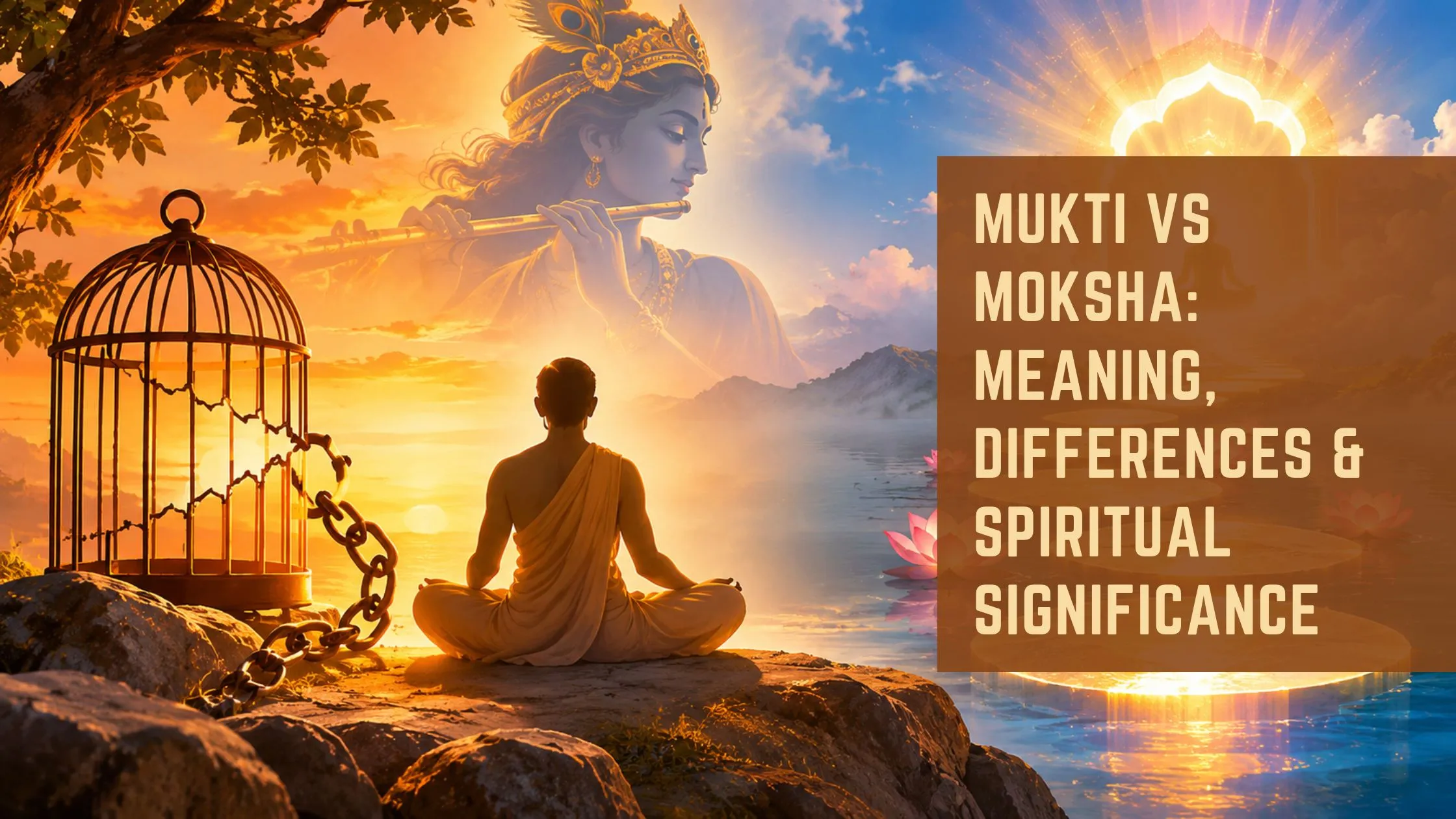
Have you ever wondered what happens when the soul becomes free from the endless cycle of birth, death, and rebirth? Hindu philosophy describes this ultimate spiritual freedom through two important concepts: Mukti and Moksha.
Both words are deeply connected with liberation, self-realization, and freedom from worldly attachments. They are often used interchangeably in Hindu scriptures and spiritual discussions. However, different philosophical traditions sometimes explain their meanings with subtle distinctions.
While Mukti generally refers to liberation or freedom, Moksha represents the ultimate spiritual goal of freedom from Samsara (the cycle of birth and death).
Understanding Mukti vs Moksha helps us explore one of the deepest questions of human existence: Is true happiness found in the material world, or in realizing our eternal spiritual nature?
Table of Contents
- Key Takeaways
- 1. What Is Mukti? Meaning and Spiritual Significance
- 2. What Is Moksha? Meaning and Importance in Hinduism
- 3. Mukti vs Moksha: Key Differences Explained
- 4. Types of Mukti and Moksha in Hindu Philosophy
- 5. What Does the Bhagavad Gita Say About Mukti and Moksha?
- 6. How Can a Person Attain Mukti or Moksha?
- 7. Inspirational Quotes on Mukti and Moksha
- 8. Why Are Mukti and Moksha Relevant in Modern Life?
- 9. Frequently Asked Questions (FAQs)
- Conclusion
Key Takeaways
Mukti means freedom, release, or liberation from bondage.
Moksha refers to spiritual liberation from Samsara.
Both concepts are closely connected in Hindu philosophy.
Karma, Jnana, Bhakti, and Dhyana Yoga are important spiritual paths.
The Bhagavad Gita teaches that self-realization and devotion help individuals move towards liberation.
True spiritual freedom involves overcoming attachment, ego, and ignorance.
1. What Is Mukti? Meaning and Spiritual Significance
The Sanskrit word Mukti comes from the root Much, meaning to release or become free.
In Hinduism, Mukti refers to liberation from bondage, ignorance, worldly attachments, and suffering. It represents freedom from the limitations that prevent the soul from realizing its true spiritual nature.
Mukti is not simply about escaping difficulties or achieving temporary happiness. It is about understanding that our true identity is beyond the physical body and material possessions.
Important aspects of Mukti
Freedom from attachment and desires.
Overcoming ignorance and ego.
Realizing the eternal nature of the soul.
Becoming free from the influence of worldly bondage.
Experiencing spiritual peace and inner freedom.
Spiritual Lesson: True freedom begins when we stop allowing material desires, fear, and ego to control our lives.
2. What Is Moksha? Meaning and Importance in Hinduism
The word Moksha comes from the Sanskrit root Much, which also means liberation or release.
Moksha is considered one of the four Purusharthas (goals of human life) in Hinduism, alongside Dharma, Artha, and Kama.
It represents liberation from Samsara, the continuous cycle of birth, death, and rebirth, and freedom from the bondage of Karma and ignorance.
According to Hindu philosophy, the ultimate realization of Moksha involves understanding the relationship between Atman (the individual self) and Brahman (ultimate reality), although different philosophical schools explain this relationship differently.
Why is Moksha important?
It represents the highest spiritual goal.
It brings freedom from the cycle of rebirth.
It involves overcoming ignorance and attachment.
It leads to the realization of spiritual truth.
It represents freedom from worldly bondage.
Spiritual Lesson: Moksha teaches us that material achievements are temporary, but spiritual realization leads towards the highest purpose of life.
3. Mukti vs Moksha: Key Differences Explained
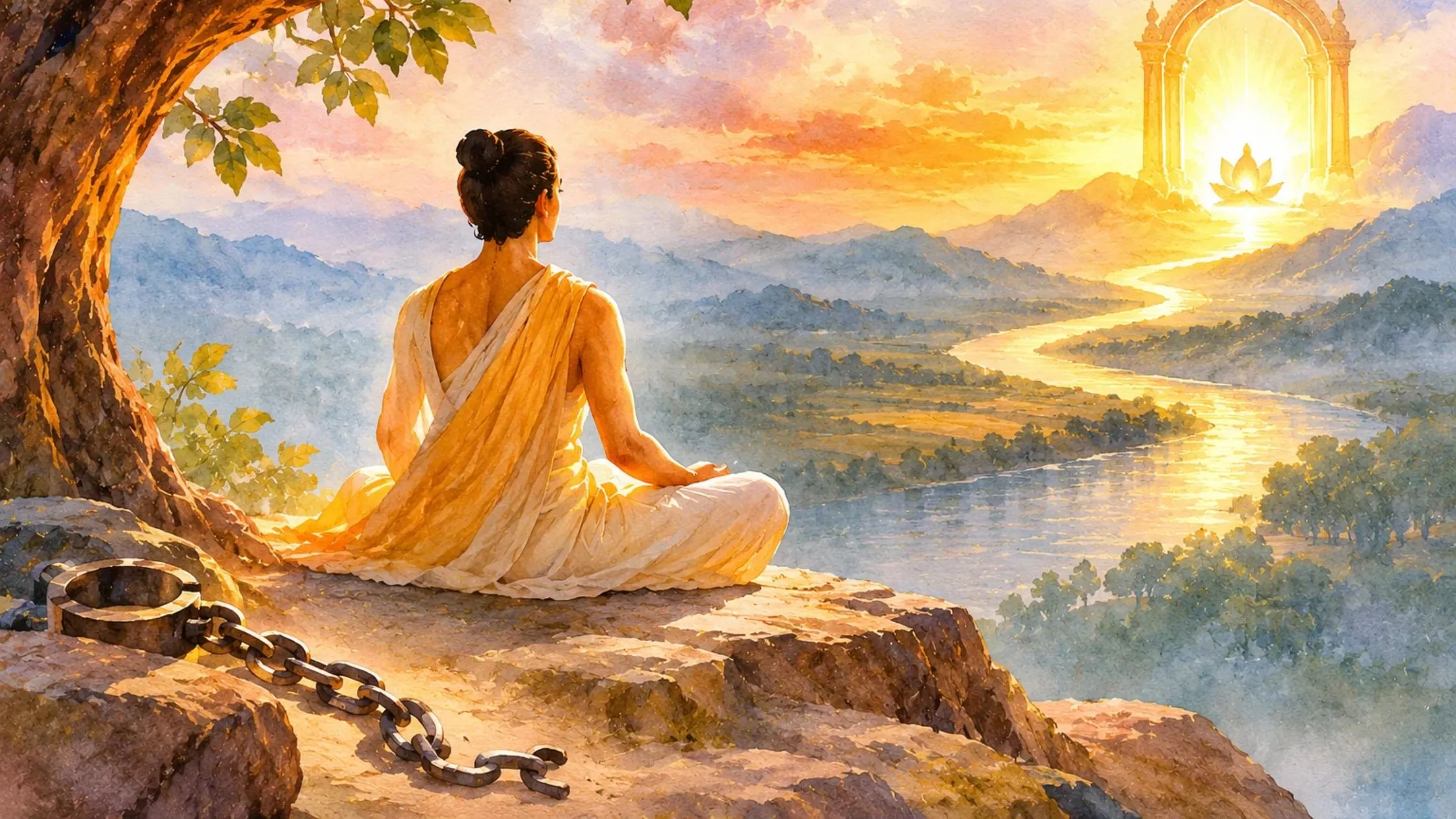
Mukti and Moksha are often considered synonyms. Both describe liberation from worldly bondage and spiritual ignorance.
However, their usage can differ depending on philosophical and religious traditions.
| Basis | Mukti | Moksha |
|---|---|---|
| Meaning | Freedom or release | Spiritual liberation |
| Origin | Sanskrit root Much | Sanskrit root Much |
| Main idea | Becoming free from bondage | Ultimate freedom from Samsara |
| Focus | Liberation and release | Spiritual realization |
| Spiritual goal | Freedom from ignorance and attachment | Freedom from rebirth and bondage |
| Usage | Broad term for liberation | Commonly used for ultimate liberation |
| Hindu philosophy | Used across spiritual traditions | One of the four Purusharthas |
Important: There is no universally accepted strict distinction between Mukti and Moksha. Many Hindu traditions use both words to describe the same ultimate spiritual liberation.
4. Types of Mukti and Moksha in Hindu Philosophy
Different Hindu traditions describe liberation through different spiritual experiences and philosophical interpretations.
A. Types of Mukti
In some Vaishnava traditions, particularly those describing liberation in relation to Vishnu, five forms of Mukti are discussed:
Salokya: Attaining residence in the divine realm of the Lord.
Samipya: Becoming close to the divine.
Sarupya: Attaining a form similar to the divine.
Sarsti: Sharing divine opulence or spiritual qualities.
Sayujya: Attaining union or absorption in the divine, interpreted differently across traditions.
These are traditional theological descriptions, not universally accepted stages of liberation.
B. Types of Moksha
Hindu philosophy also discusses different forms of liberation:
Jivanmukti: Liberation while still living in the physical body.
Videhamukti: Liberation after the death of the physical body.
Krama Mukti: Gradual liberation through a spiritual progression, described in certain Vedantic traditions.
These concepts explain different understandings of how spiritual liberation may be realized.
5. What Does the Bhagavad Gita Say About Mukti and Moksha?
The Bhagavad Gita provides profound teachings about liberation, self-realization, devotion, and freedom from attachment.
Lord Krishna explains that human beings should perform their duties without becoming attached to the results.
Three important paths discussed in the Bhagavad Gita are:
Karma Yoga – The Path of Selfless Action
Karma Yoga teaches individuals to perform their responsibilities sincerely without selfish attachment to rewards.
Bhagavad Gita 2.47
कर्मण्येवाधिकारस्ते मा फलेषु कदाचन।
Meaning: You have the right to perform your prescribed duty, but you are not entitled to the fruits of your actions.
Lesson: Focus on your actions rather than becoming emotionally dependent on their results.
Bhakti Yoga – The Path of Devotion
Bhakti Yoga teaches surrender, love, faith, and devotion towards God.
Bhagavad Gita 18.66
सर्वधर्मान्परित्यज्य मामेकं शरणं व्रज।
Meaning: Abandon all other forms of dependence and surrender unto Me alone.
Lesson: True devotion helps individuals overcome ego and develop complete faith in the Divine.
Jnana Yoga – The Path of Knowledge
Jnana Yoga focuses on understanding the difference between the temporary physical body and the eternal soul.
Bhagavad Gita 2.20
न जायते म्रियते वा कदाचिन्।
Meaning: The soul is never born, nor does it ever die.
Lesson: Real spiritual knowledge begins when we understand that our true identity is beyond the temporary body.
6. How Can a Person Attain Mukti or Moksha?
Hindu philosophy describes liberation as a spiritual journey involving self-discipline, knowledge, devotion, and inner transformation.
Some important practices include:
Practice selfless Karma: Perform your duties without selfish expectations.
Develop spiritual knowledge: Understand the nature of Atman and Brahman.
Follow Bhakti: Cultivate devotion and surrender to God.
Practice meditation: Calm the mind and develop self-awareness.
Control desires: Avoid excessive attachment to material possessions.
Follow Dharma: Live with honesty, compassion, and responsibility.
Overcome ego: Recognize that pride and selfishness create spiritual bondage.
There is no single universally prescribed method. Different Hindu traditions emphasize different paths according to their philosophical teachings.
7. Inspirational Quotes on Mukti and Moksha
Here are some meaningful spiritual thoughts inspired by Hindu philosophy.
| Spiritual Quote | Life Lesson |
|---|---|
| True freedom begins when the mind becomes free from desires. | Control your attachments. |
| The soul is eternal, while the body is temporary. | Understand your true identity. |
| Liberation is not found in possessions but in spiritual realization. | Look beyond material happiness. |
| Surrender your ego and discover the peace within. | Practice humility and devotion. |
| Freedom from attachment is the beginning of spiritual growth. | Live without unnecessary expectations. |
| The journey towards Moksha begins with self-awareness. | Understand yourself first. |
8. Why Are Mukti and Moksha Relevant in Modern Life?
In today's world, people often measure happiness through money, success, popularity, and material achievements. However, even after achieving these things, many continue to experience stress, fear, dissatisfaction, and emotional attachment.
The teachings of Mukti and Moksha remind us that lasting peace cannot depend entirely on external circumstances.
Their principles can be applied in everyday life:
Let go of unnecessary expectations.
Accept situations that are beyond your control.
Perform your responsibilities with honesty.
Avoid comparing your journey with others.
Practice gratitude and forgiveness.
Develop inner peace through meditation and self-reflection.
Even if the ultimate spiritual goal is difficult to understand, its teachings can help us live a more meaningful and balanced life.
9. Frequently Asked Questions (FAQs)
1. Are Mukti and Moksha the same?
Mukti and Moksha are generally used as synonyms in Hindu philosophy. Both refer to liberation from spiritual bondage, although their usage can vary across traditions.
2. What is the main difference between Mukti and Moksha?
Mukti broadly means freedom or release, whereas Moksha commonly refers to ultimate liberation from Samsara, the cycle of birth and death.
3. Can a person attain Moksha while alive?
Yes. The concept of Jivanmukti describes spiritual liberation while a person is still alive in the physical body.
4. What are the four paths to Moksha?
Karma Yoga, Bhakti Yoga, Jnana Yoga, and Dhyana Yoga are important spiritual paths discussed in Hindu philosophy.
5. Does the Bhagavad Gita explain Moksha?
Yes. The Bhagavad Gita discusses liberation through selfless action, devotion, spiritual knowledge, detachment, and surrender to God.
6. Is Moksha the ultimate goal of human life?
In Hinduism, Moksha is regarded as one of the four Purusharthas and the ultimate spiritual goal of liberation.
7. What happens after attaining Moksha?
According to Hindu philosophy, Moksha means freedom from Samsara and spiritual bondage. Different schools explain the liberated soul's relationship with Brahman or God differently.
Conclusion
Mukti and Moksha are two deeply meaningful concepts that reveal the essence of Hindu spiritual philosophy. Although their interpretations may vary, both point towards freedom from ignorance, attachment, and worldly bondage.
Mukti reminds us of the importance of becoming free from limitations, while Moksha represents the ultimate spiritual liberation from the cycle of birth and death.
The Bhagavad Gita teaches that the path towards liberation begins with selfless actions, devotion, spiritual knowledge, and surrender to the Divine.
Ultimately, the journey towards spiritual freedom is not just about understanding ancient scriptures; it is about transforming the way we think, act, and live.
Life Lesson: When you free your mind from ego, attachment, and endless desires, you begin to discover the deeper meaning of true spiritual freedom.
Explore more spiritual wisdom, Bhagavad Gita teachings, and timeless life lessons at TheGita.in.