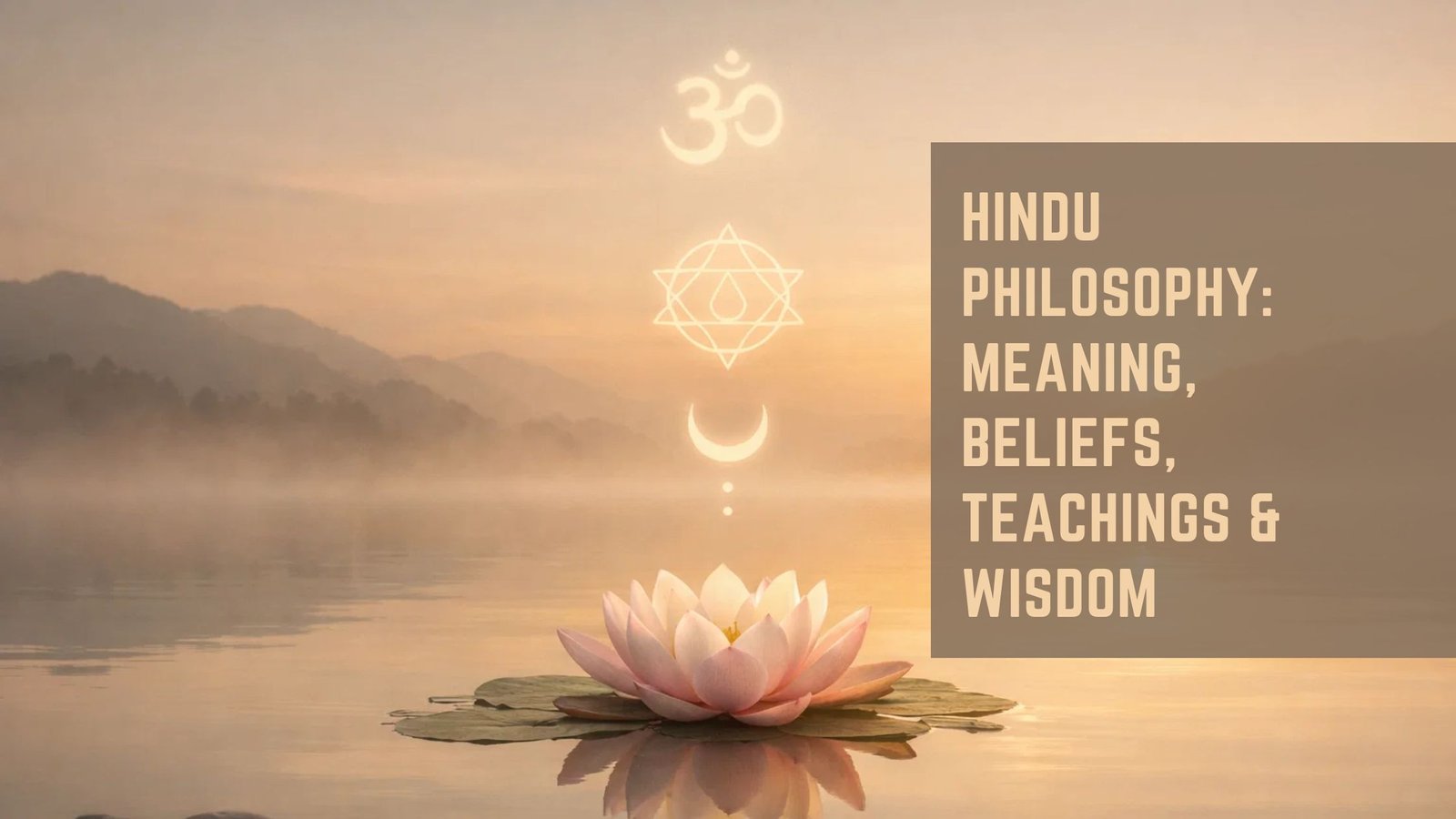
Hindu philosophy is one of the world’s oldest and most profound systems of thought. It is not limited to religion alone but offers a complete way of understanding life, consciousness, morality, and the universe. Rooted in spiritual inquiry rather than rigid dogma, Hindu philosophy encourages questioning, self-realization, and harmony between the inner self and the outer world.
Rather than presenting a single founder or one fixed doctrine, philosophy evolved over thousands of years through sages, seers, and enlightened minds. It explains who we are, why we suffer, how we should live, and what ultimate freedom truly means.
Table of Contents
What Is Hindu Philosophy?
philosophy refers to the diverse yet interconnected schools of thought that originated in ancient India. These philosophies explore metaphysics (reality), epistemology (knowledge), ethics (duty and conduct), and liberation (freedom from suffering).
At its core, philosophy teaches that:
- Truth can be realized through self-awareness
- The soul is eternal
- Life has a moral structure
- Liberation is possible through knowledge, devotion, and right action
Foundations of Hindu Philosophy
The Vedas: The Root of Wisdom
The philosophical journey begins with the Vedas, the oldest sacred texts of Hindu thought. They introduce ideas of cosmic order, truth (ṛta), and spiritual discipline.
The Upanishads: Knowledge of the Self
The Upanishads focus on deep metaphysical questions such as:
- What is the soul?
- What is reality?
- What is the ultimate truth?
Quote (Upanishadic Wisdom):
“Tat Tvam Asi” — That Thou Art
This statement expresses the unity of the individual soul with the universal consciousness.

Core Concepts of Hindu Philosophy
1. Dharma (Righteous Living)
Dharma refers to ethical duty, moral responsibility, and living in harmony with cosmic law. It varies according to age, role, and circumstances.
Life Lesson:
Living truthfully and responsibly creates inner peace and social balance.
2. Karma (Action and Consequence)
Karma teaches that every action—physical, verbal, or mental—has consequences. It emphasizes personal responsibility rather than fate.
Quote:
“As you sow, so shall you reap.”
3. Samsara (Cycle of Birth and Death)
Samsara is the continuous cycle of birth, death, and rebirth driven by karma and ignorance.
Lesson:
Attachment binds the soul; awareness frees it.
4. Moksha (Liberation)
Moksha is liberation from samsara and the realization of one’s true nature. It is the ultimate goal of philosophy.
Paths to Liberation in Hindu Philosophy
Jnana Yoga – The Path of Knowledge
This path emphasizes wisdom, self-inquiry, and discrimination between the real and unreal.
Quote:
“Knowledge alone liberates.”
Bhakti Yoga – The Path of Devotion
Devotion to the Divine with love and surrender is a powerful spiritual path.
The teachings of the Bhagavad Gita beautifully balance devotion, action, and knowledge.
Gita Quote:
“You have the right to perform your duty, but not to the fruits of action.”
Karma Yoga – The Path of Selfless Action
Performing one’s duty without attachment purifies the mind and leads to spiritual growth.
Lesson:
Work becomes worship when done selflessly.
Raja Yoga – The Path of Meditation
Focused on mental discipline, meditation, and control of the mind, this path leads to direct realization.
Schools of Hindu Philosophy
philosophy developed six classical schools:
- Nyaya – Logic and reasoning
- Vaisheshika – Nature of reality and atoms
- Samkhya – Dualism of consciousness and matter
- Yoga – Practical discipline of mind and body
- Mimamsa – Ritual and duty
- Vedanta – Ultimate reality and liberation
Among these, Vedanta—especially Advaita Vedanta—emphasizes non-duality and oneness.
Hindu Epics and Philosophy
The Ramayana and the Mahabharata are not just stories but philosophical guides to human life, ethics, and duty.
Life Lesson from Epics:
Even divine beings face moral dilemmas—what matters is choosing righteousness.
Hindu Philosophy and the Concept of God
Hindu philosophy does not enforce a single concept of God. It recognizes:
- One ultimate reality (Brahman)
- Multiple forms of divine expression
- Personal and impersonal aspects of the Absolute
This inclusiveness allows both devotion and philosophical inquiry to coexist.
Relevance of Hindu Philosophy in Modern Life
Hindu philosophy remains deeply relevant today:
- It teaches stress management through detachment
- Promotes ethical living in complex societies
- Encourages inner peace in a fast-paced world
- Supports harmony with nature and sustainability
Modern Reflection Quote:
“When the mind is calm, clarity follows.”
Important Quotes from Hindu Philosophy
- “The soul is neither born nor does it die.”
- “When desires end, suffering ends.”
- “The mind can be your best friend or your worst enemy.”
These teachings offer practical wisdom for daily life.
Inner Awareness and the Discipline of Silence
One of the most subtle teachings found in ancient Indian thought is the importance of silence and inner awareness. Silence is not merely the absence of speech; it is the space where clarity arises. When the mind becomes quiet, deeper understanding unfolds naturally. Through contemplation and mindful observation, individuals begin to notice how reactions are born and how wisdom replaces impulse. This inward discipline helps cultivate patience, emotional balance, and self-mastery in everyday life.
Balance Between Material Life and Spiritual Growth
Human life is seen as a harmonious blend of worldly responsibility and inner evolution. Earning wealth, nurturing relationships, and fulfilling duties are not rejected but guided by ethical awareness. When material pursuits are aligned with values, they become supportive rather than obstructive. This balance teaches that prosperity and spirituality can coexist, provided actions are guided by integrity, moderation, and compassion.
The Role of Compassion and Non-Violence
Compassion is regarded as a natural expression of higher understanding. Non-violence is not limited to physical acts but extends to thoughts, words, and intentions. By cultivating empathy, individuals learn to respond rather than react. This gentle strength reduces inner conflict and creates harmony in social interactions. Such an approach encourages respect for all forms of life and fosters peaceful coexistence.
Acceptance of Change and Impermanence
Life is understood as a continuous flow rather than a fixed state. Change is not viewed as an enemy but as a teacher. Accepting impermanence helps reduce fear and attachment, allowing individuals to face challenges with resilience. When change is embraced with awareness, loss becomes growth and uncertainty becomes opportunity. This perspective nurtures emotional stability and deeper trust in life’s unfolding journey.
This timeless wisdom continues to guide humanity even today, proving its Modern Relevance in helping individuals find clarity, balance, and purpose in contemporary life.
FAQs
What is the main goal of Hindu philosophy?
The main goal is self-realization and liberation (moksha) from suffering and ignorance.
Is Hindu philosophy a religion or a way of life?
It is both—a spiritual philosophy and a practical way of living consciously.
Does Hindu philosophy believe in one God or many gods?
It recognizes one ultimate reality expressed in many forms.
How is Hindu philosophy different from other philosophies?
It emphasizes direct experience, inner realization, and multiple paths to truth.
Can Hindu philosophy be followed without rituals?
Yes, self-inquiry, ethical living, and awareness are central, even without rituals.
Conclusion
Hindu philosophy is not confined to ancient texts or rituals; it is a living wisdom that guides humanity toward truth, compassion, and freedom. It teaches us to live responsibly, think deeply, and realize our inner potential.
In a world searching for meaning, balance, and peace, Hindu philosophy offers a timeless compass—reminding us that the journey inward is the most sacred journey of all.
For more timeless spiritual insights, life lessons, and wisdom drawn from ancient Indian thought, explore more articles on thegita.in, where philosophy meets practical living.