What if the wisdom shaping your thoughts today was first spoken thousands of years ago beside sacred rivers, under starlit skies, and preserved entirely through memory?
The history of Brahman is not merely the story of a community or a social class. It is the story of knowledge, spiritual inquiry, sacred traditions, and humanity’s eternal search for truth. From the earliest Vedic hymns to modern spiritual discussions, the Brahman tradition has played a profound role in preserving and transmitting divine wisdom.
Understanding Brahman history allows us to look beyond common stereotypes and discover a civilization built upon learning, discipline, philosophy, and service to society. The story stretches across millennia and remains relevant even in today’s rapidly changing world.
Table of Contents
Key Takeaways
- Learn the origins of Brahman tradition in the Vedic age.
- Understand the role of Brahmans in preserving sacred knowledge and spiritual practices.
- Discover timeless lessons from Brahman philosophy that remain valuable today.
The Master Table
| Name | Key Symbol/Weapon | Reason for Importance | Legacy |
|---|---|---|---|
| Vashistha | Kamandalu and Staff | Royal Guru and Vedic Sage | Symbol of wisdom and spiritual authority |
| Vishwamitra | Sacred Knowledge | Composer of Vedic hymns | Demonstrated power of determination |
| Yajnavalkya | Vedic Scriptures | Philosopher of Upanishads | Advanced spiritual understanding |
| Chanakya | Knowledge and Strategy | Teacher and Political Thinker | Influenced governance and ethics |
Understanding the Meaning of Brahman
The word “Brahman” originally comes from the Sanskrit root Brih, meaning “to expand” or “to grow.”
In spiritual philosophy, Brahman refers to the ultimate reality—the infinite consciousness that exists beyond time and space. In social and historical contexts, the term Brahman (or Brahmin) refers to those traditionally dedicated to learning, teaching, performing rituals, and preserving sacred knowledge.
Ancient Hindu texts emphasize that true Brahmanhood was determined by qualities, conduct, wisdom, and spiritual discipline rather than birth alone.
“Janmana jayate shudrah, samskarad bhaved dvijah.”
“By birth everyone is ordinary; through education and refinement one becomes enlightened.”
This teaching highlights the importance of character and learning.
The Origins of Brahman History
The Vedic Period
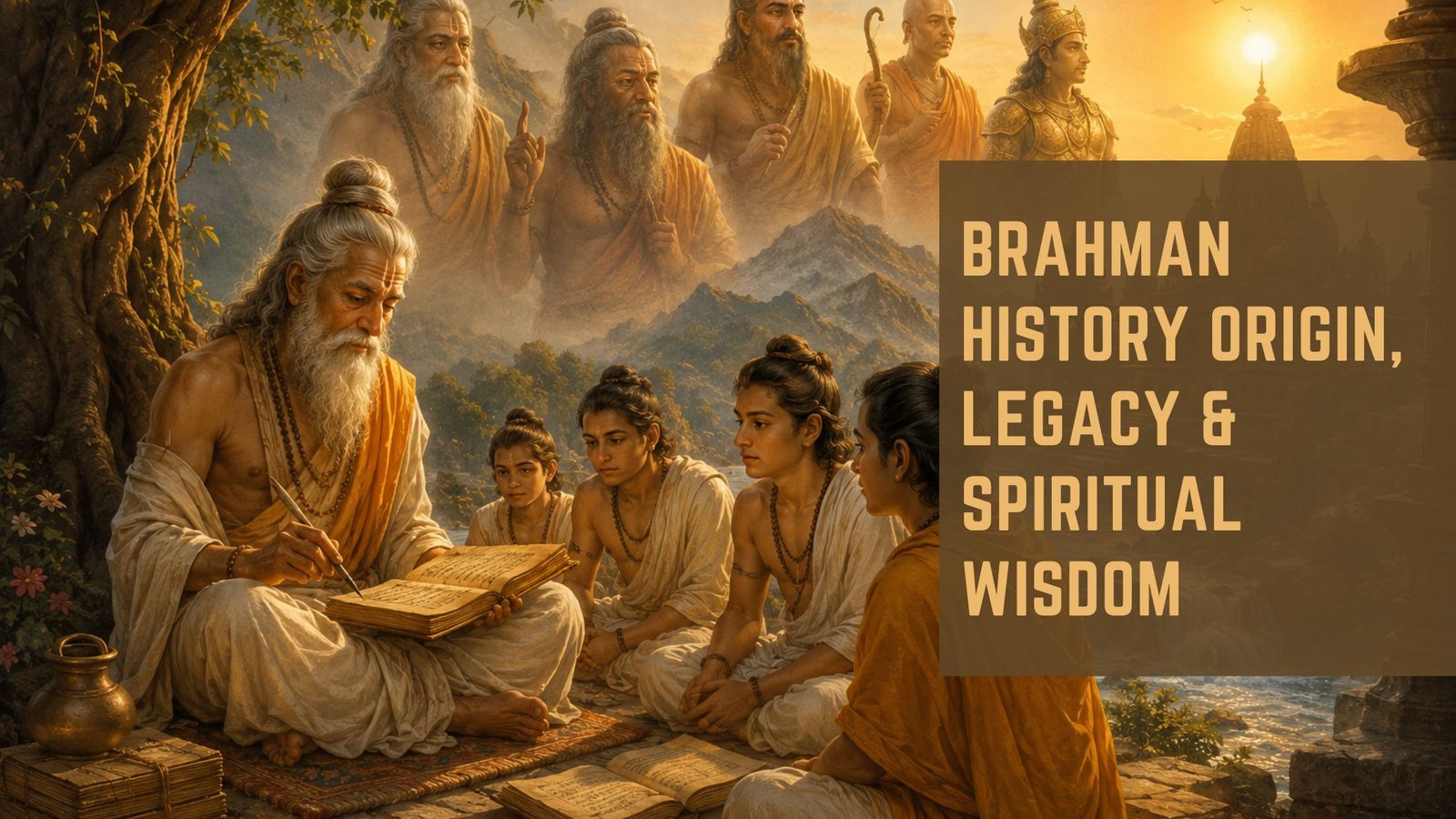
The earliest references to Brahmans appear in the Vedas, among the oldest surviving scriptures in human history.
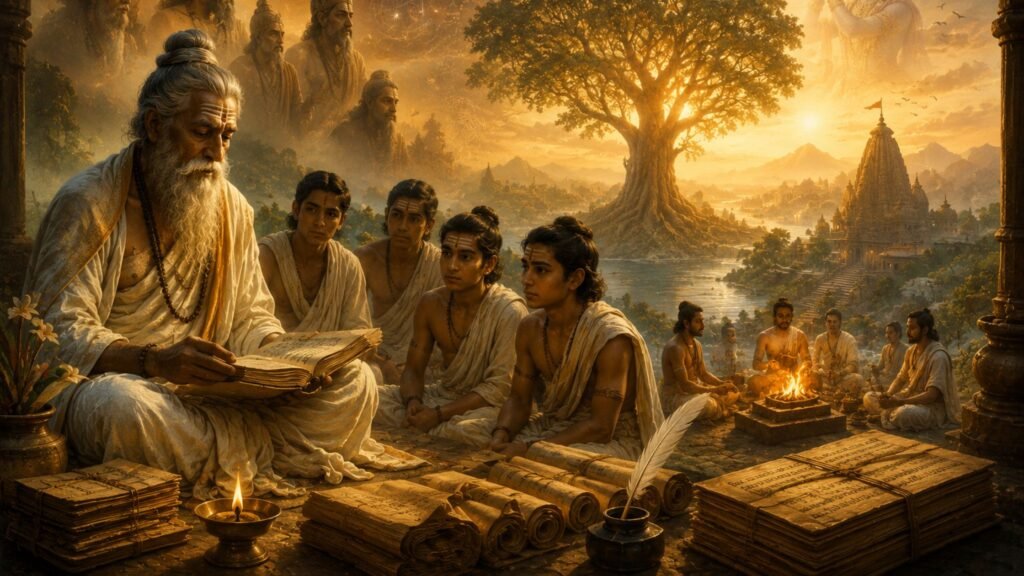
During the Vedic age, society depended on individuals who could memorize, preserve, and teach sacred hymns. Since writing was not commonly used for preserving scripture, knowledge passed orally from teacher to student.
Brahmans became custodians of:
- Vedic chants
- Sacred rituals
- Spiritual philosophy
- Ethical teachings
- Educational traditions
Their primary responsibility was not political power or wealth but the preservation of wisdom.
The Gurukul System
Ancient India developed one of the world’s most sophisticated educational systems through Gurukuls.
Students lived with their teachers and learned:
- Philosophy
- Mathematics
- Astronomy
- Ethics
- Literature
- Spiritual practices
The Gurukul tradition transformed education into a lifelong pursuit of wisdom rather than mere career preparation.
The Legend of Sage Vashistha
Their Role in the Epics
Sage Vashistha appears prominently in the Ramayana as the royal guru of the Ikshvaku dynasty and advisor to King Dasharatha.
The Story
Known for his immense wisdom and spiritual power, Vashistha guided kings while remaining detached from worldly ambitions. His teachings emphasized self-control, righteousness, and devotion to truth.
He became a model of how spiritual wisdom can guide political leadership without becoming corrupted by power.
The Modern Lesson
Knowledge should serve society rather than personal ego.
Key Quote
“Satyam vada, dharmam chara.”
“Speak the truth and walk the path of righteousness.”
The Legend of Vishwamitra
Their Role in the Epics
Vishwamitra plays a major role in the Ramayana by guiding Rama and Lakshmana during their early spiritual and martial training.
The Story
Originally a king, Vishwamitra embarked on a remarkable journey of self-transformation. Through discipline, meditation, and perseverance, he attained the status of a revered sage.
His life demonstrates that spiritual greatness is earned through effort rather than inherited privilege.
The Modern Lesson
Personal transformation is possible regardless of one’s background.
Key Quote
“Tapasa brahma vijijnasasva.”
“Through discipline and spiritual effort, seek ultimate truth.”
The Legend of Yajnavalkya
Their Role in Ancient Wisdom
Yajnavalkya is one of the most influential philosophers of the Upanishads.
The Story
His dialogues explored profound questions:
- What is the nature of the self?
- What survives death?
- What is ultimate reality?
His teachings shifted spiritual inquiry from external rituals toward inner realization.
The Modern Lesson
True wisdom comes from questioning, reflection, and self-discovery.
Key Quote
“Atma va are drastavyah.”
“The Self must be realized and understood.”
The Legend of Chanakya
Their Role in Brahman History
Chanakya was a scholar, teacher, economist, and strategist who helped establish the Mauryan Empire.
The Story
Despite living a simple life, Chanakya shaped political history through knowledge and vision. His work emphasized ethical governance, education, and long-term thinking.
The Modern Lesson
Knowledge becomes powerful when applied for collective welfare.
Key Quote
“Education is the best friend. An educated person is respected everywhere.”
The Evolution of Brahman Tradition
As centuries passed, Brahman communities diversified across India.
Different regions developed unique traditions while maintaining common commitments to:
- Learning
- Spirituality
- Teaching
- Ritual practices
- Cultural preservation
Many Brahman scholars contributed significantly to:
- Sanskrit literature
- Astronomy
- Mathematics
- Medicine
- Philosophy
- Temple architecture
Figures such as Aryabhata, Bhaskara, and numerous philosophers expanded humanity’s understanding of science and spirituality.
The Spiritual Philosophy Behind Brahman History
Ancient scriptures consistently emphasize qualities over status.
The Bhagavad Gita describes the characteristics associated with Brahmanical ideals:
- Self-control
- Purity
- Wisdom
- Knowledge
- Faith
- Compassion
These virtues remain universally relevant regardless of caste, nationality, or religion.
“Shamo damas tapah shaucham kshantir arjavam eva cha.”
“Peacefulness, self-control, purity, patience, and honesty are marks of spiritual excellence.”
Comparison Section: Ancient and Modern Perspectives
Ancient View
- Focused on preserving sacred knowledge.
- Education centered on character development.
- Learning was considered a spiritual duty.
- Wisdom was transmitted orally.
Modern View
- Education is more accessible and widespread.
- Knowledge is preserved digitally.
- Professional specialization has increased.
- Spiritual and philosophical teachings continue to evolve.
Common Ground
- Lifelong learning remains valuable.
- Ethical leadership is still essential.
- Wisdom is more important than information.
- Service to society remains a noble goal.
The Continuing Relevance of Brahman History
The significance of Brahman history extends beyond social classifications.
Its enduring lessons include:
Respect for Knowledge
Civilizations flourish when learning is valued.
Discipline Matters
Great achievements require sustained effort.
Seek Truth
Questioning and self-reflection lead to deeper understanding.
Service Before Self
Knowledge gains meaning when used to help others.
In an age dominated by information overload, these principles are more relevant than ever.
Frequently Asked Questions
What is the origin of Brahman history?
Brahman history originates in the Vedic period, where individuals dedicated to preserving and teaching sacred knowledge became central figures in society.
What was the primary role of Brahmans?
Their primary responsibilities included education, preservation of scriptures, conducting rituals, and guiding society through spiritual wisdom.
Are Brahmans mentioned in the Ramayana and Mahabharata?
Yes. Sages such as Vashistha, Vishwamitra, Drona, Kripacharya, and others play important roles in these epics.
What is the difference between Brahman and Brahmin?
Brahman refers to the ultimate spiritual reality in Hindu philosophy, while Brahmin (Brahman in social context) refers to members of a traditional scholarly and priestly community.
What lesson can modern readers learn from Brahman history?
The greatest lesson is that knowledge, discipline, humility, and service remain timeless virtues regardless of social background.
Conclusion
The history of Brahman is ultimately a history of humanity’s quest for wisdom. Across thousands of years, sages, teachers, philosophers, and scholars preserved sacred knowledge that continues to inspire millions.
Beyond rituals and social structures lies a deeper message: true greatness comes from learning, self-discipline, compassion, and the pursuit of truth.
As civilizations rise and fall, technologies change, and societies evolve, the ideals associated with the Brahman tradition continue to remind us that knowledge is sacred, wisdom is timeless, and the search for truth never ends.
TheGita.in Exploring the Timeless Legacy of Knowledge, Wisdom, and Dharma.