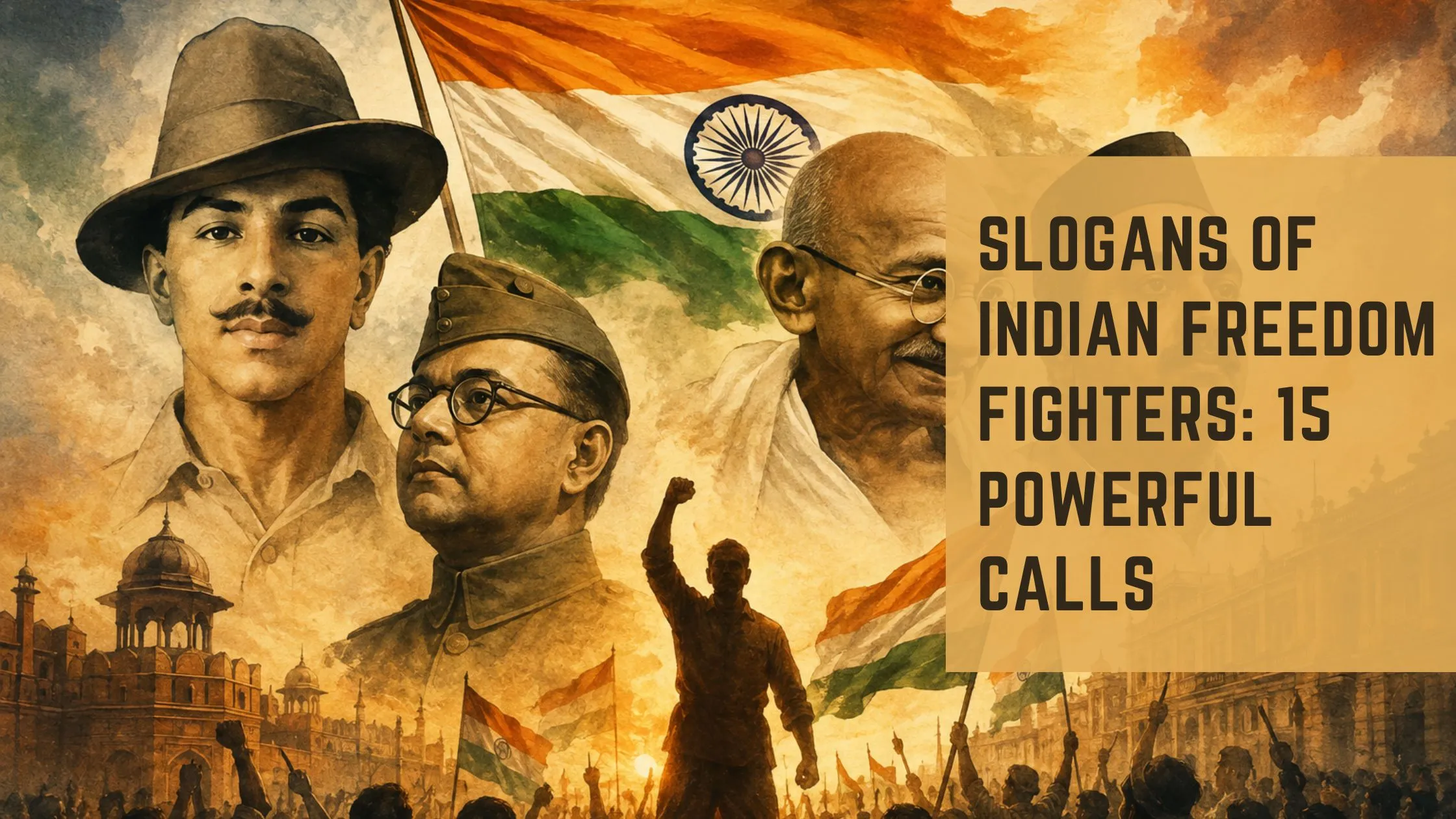
India’s freedom struggle was shaped not only by movements, protests, marches, revolutionary activities, and sacrifices, but also by words that could reach millions of people. The slogans of Indian freedom fighters transformed complex political ideas into short, memorable calls that ordinary people could repeat, understand, and carry into public life.
Some slogans demanded Swaraj, or self-rule. Others called for resistance, sacrifice, unity, courage, or an end to colonial rule. They appeared at public meetings, demonstrations, political gatherings, newspapers, processions, and revolutionary activities.
The power of these words is still visible today. Every Independence Day, Republic Day, and national celebration brings many of these historic expressions back into public memory.
Importantly, not every famous patriotic expression was created by a freedom fighter. For example, “Vande Mataram” was written by Bankim Chandra Chatterjee and became an important symbol of the freedom movement. The Ministry of Defence’s Rashtraparv notes that the song became an inspiring anthem during the struggle for independence.
Table of Contents
Key Takeaways
- Freedom slogans made powerful political ideas easy to remember.
- Different leaders used different messages according to their methods and movements.
- Tilak’s slogan emphasized Swaraj.
- Gandhi’s call emphasized determination and mass participation.
- Bhagat Singh and his associates popularized revolutionary expressions such as “Inquilab Zindabad.”
- Subhas Chandra Bose used powerful calls including “Jai Hind” and “Chalo Dilli.”
- Lala Lajpat Rai used “Simon Go Back” during opposition to the Simon Commission.
- Many of these expressions continue to inspire Indians today.
15 Famous Slogans of Indian Freedom Fighters
The following slogans of Indian freedom fighters represent different stages, philosophies, and approaches within India’s independence movement.
| Slogan | Leader/Association | Main Message |
|---|---|---|
| Swaraj is my birthright, and I shall have it | Bal Gangadhar Tilak | Self-rule |
| Do or Die | Mahatma Gandhi | Determination |
| Inquilab Zindabad | Revolutionary movement; associated with Bhagat Singh | Long live the revolution |
| Jai Hind | Subhas Chandra Bose | National unity |
| Give me blood and I will give you freedom | Subhas Chandra Bose | Sacrifice |
| Chalo Dilli | Subhas Chandra Bose | March toward freedom |
| Simon Go Back | Lala Lajpat Rai and protesters | Opposition to Simon Commission |
| Quit India | Indian freedom movement | End British rule |
| Vande Mataram | Bankim Chandra Chatterjee | Devotion to the motherland |
| Sarfaroshi Ki Tamanna | Ram Prasad Bismil and revolutionary tradition | Courage and sacrifice |
| Dushman Ki Goliyon Ka Hum Samna Karenge | Chandrashekhar Azad | Defiance |
| Bharat Mata Ki Jai | Nationalist movement | Patriotism |
| Bande Mataram | Freedom movement | National awakening |
| Purna Swaraj | Indian nationalist movement | Complete independence |
| Simon Go Back | Anti-Simon Commission movement | Political resistance |
These expressions were not identical in meaning or origin. Some were slogans, some were political calls, some were songs, and some became popular through movements. Understanding that distinction makes the history more accurate.
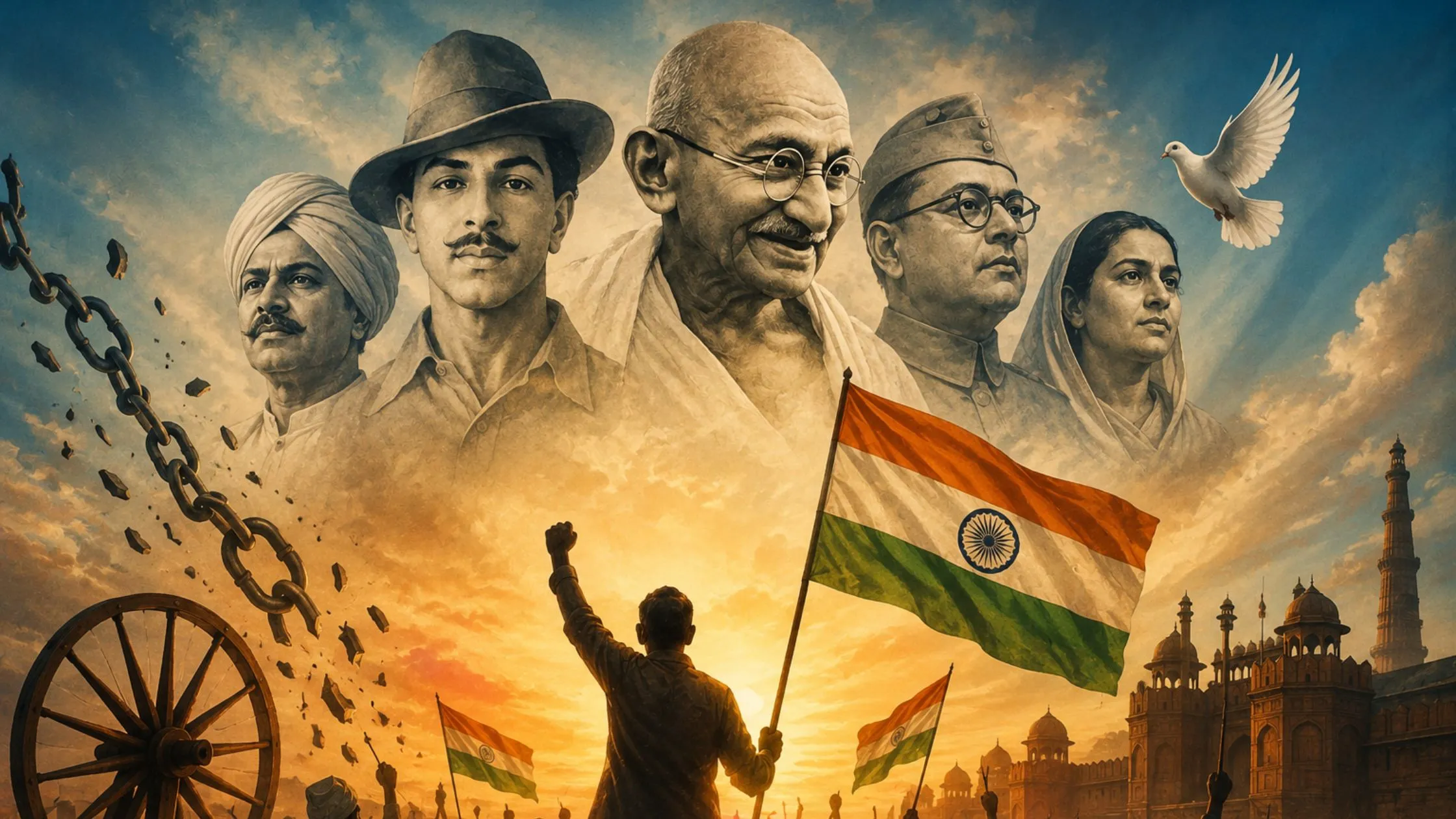
1. “Swaraj Is My Birthright, and I Shall Have It” — Bal Gangadhar Tilak
Among the most famous slogans of Indian freedom fighters, this declaration is associated with Lokmanya Bal Gangadhar Tilak.
The slogan expressed a direct demand for Swaraj, or self-government. It helped turn the idea of political freedom into a powerful public demand.
The Lok Sabha Secretariat has described Tilak as an important nationalist leader and notes that his famous call galvanized generations of Indians against colonial rule.
The significance of the slogan lies in its confidence. It did not present self-rule as a distant possibility. Instead, it framed it as a right that Indians should actively claim.
Why it mattered
Tilak’s approach helped strengthen political awareness among ordinary Indians. His efforts to connect public festivals and cultural activities with political consciousness also helped broaden participation in the nationalist movement.
2. “Do or Die” — Mahatma Gandhi
“Do or Die” became one of the defining calls of the Quit India Movement of 1942.
Mahatma Gandhi used the phrase while launching the movement against British rule. The Government of India’s Press Information Bureau records the historic call and explains that the Quit India Movement began on August 8, 1942.
Unlike a call for violence, Gandhi’s message was connected with determination and the demand for freedom. The movement brought people from different sections of society into a mass struggle.
The slogan’s enduring strength comes from its simplicity: freedom required complete commitment.
3. “Inquilab Zindabad” — Bhagat Singh and the Revolutionary Movement
Among the most recognizable slogans of Indian freedom fighters, “Inquilab Zindabad” means “Long Live the Revolution.”
It became strongly associated with Bhagat Singh and the revolutionary movement. Government records describing Bhagat Singh, Rajguru, and Sukhdev note that the three shouted “Inquilab Zindabad” while facing execution.
The expression represented a desire for profound political and social transformation. For young revolutionaries, independence was not merely about changing rulers; it was also connected with creating a more just society.
Today, the slogan remains one of the most recognizable expressions of India’s revolutionary history.
4. “Jai Hind” — Subhas Chandra Bose
“Jai Hind” became closely associated with Netaji Subhas Chandra Bose and the Indian National Army.
The phrase literally conveys victory or glory to India. Its strength comes from being short, inclusive, and easy to use across linguistic and regional boundaries.
The President of India’s Independence Day address has described “Jai Hind” as the rallying cry associated with Subhas Chandra Bose and the end of colonial rule.
The expression eventually moved beyond the freedom movement and became a widely used national greeting and patriotic salutation.
5. “Give Me Blood and I Will Give You Freedom” — Subhas Chandra Bose
Few slogans of Indian freedom fighters are as dramatic as Subhas Chandra Bose’s call: “Give me blood and I will give you freedom.”
The slogan appealed directly to sacrifice and action. Bose used it while mobilizing Indians for the struggle against British rule.
The Press Information Bureau records the famous Hindi expression, “Tum mujhe khoon do, main tumhe azadi dunga,” and connects it with Bose’s call to young Indians to join the independence struggle.
The message was uncompromising: freedom demanded extraordinary commitment.
6. “Chalo Dilli” — Subhas Chandra Bose
“Chalo Dilli,” meaning “March to Delhi,” was another major call associated with Bose and the Indian National Army.
It represented the determination to advance toward the heart of British power in India. Government material on Netaji describes “Chalo Dilli” as his famous war cry to INA soldiers.
The slogan combined a geographical destination with a larger political goal: freedom.
7. “Simon Go Back” — Lala Lajpat Rai
“Simon Go Back” became one of the strongest protest slogans against the Simon Commission.
When the commission arrived in Lahore in 1928, Lala Lajpat Rai led a peaceful protest against it. The Government of India records that Rai gave the slogan “Simon Go Back” during the demonstration.
The slogan was effective because its meaning was immediately understandable. It rejected a political commission that Indians believed did not adequately represent Indian interests.
8. “Vande Mataram” — A Symbol of National Awakening
Although “Vande Mataram” was written by Bankim Chandra Chatterjee rather than being a slogan coined by a freedom fighter, it became deeply connected with India’s freedom movement.
The Government of India notes that it was composed in 1875 and later included in Anandamath. It became an important symbol of national consciousness and inspired generations during the independence movement.
Its emotional power came from its portrayal of the motherland as worthy of love, respect, and devotion.
9. “Dushman Ki Goliyon Ka Hum Samna Karenge” — Chandrashekhar Azad
Chandrashekhar Azad became a symbol of courage and resistance. His famous declaration about facing the enemy’s bullets reflects the fearless spirit associated with his revolutionary life.
The expression has continued to appear in popular accounts of the revolutionary movement because it captures Azad’s determination never to surrender easily.
For many Indians, his story represents the willingness of young revolutionaries to risk everything for independence.
10. “Bharat Mata Ki Jai” — A Patriotic National Call
“Bharat Mata Ki Jai” translates broadly as “Victory to Mother India.”
It became an important patriotic expression during the nationalist movement and remains widely used during national celebrations.
Unlike slogans tied to one specific political action, this expression emphasizes emotional attachment to the nation and the idea of India as a motherland.
What Made These Slogans So Powerful?
The effectiveness of the slogans of Indian freedom fighters came from several factors.
1. They were easy to remember
A slogan needed to travel from one person to another. Short phrases were easier to repeat at rallies, marches, meetings, and demonstrations.
2. They created emotional connection
Words such as freedom, Swaraj, revolution, sacrifice, and Bharat connected political demands with personal emotion.
3. They encouraged participation
A powerful slogan did not require a political education to understand. It could turn a spectator into a participant.
4. They represented different approaches
India’s freedom movement included constitutional politics, mass movements, non-violent resistance, revolutionary activities, and armed struggle. The slogans reflected this diversity.
5. They survived beyond the movement
Many of these expressions did not disappear after 1947. They became part of India’s public vocabulary and continue to appear in schools, national celebrations, speeches, literature, and cultural events.
Slogans of Indian Freedom Fighters and Their Meaning Today
The slogans of Indian freedom fighters are more than historical quotations. They can also be understood as reminders of values.
| Historical Value | Modern Interpretation |
| Swaraj | Responsibility and self-reliance |
| Freedom | Respect for rights and dignity |
| Sacrifice | Commitment to a larger purpose |
| Unity | Standing together despite differences |
| Courage | Facing challenges without fear |
| Responsibility | Contributing positively to society |
| Patriotism | Serving the nation through meaningful action |
For modern readers, the most important lesson is that independence is not simply a historical date. It is also a responsibility.
Political freedom created the foundation for a democratic nation, but citizens continue to shape the country through education, honesty, social responsibility, innovation, compassion, and respect for others.
Why Should Students Learn These Slogans?
Students often encounter these phrases in history textbooks, Independence Day speeches, quizzes, and school programmes. Learning the background behind them makes those words much more meaningful.
Instead of memorizing a slogan only for an examination, students can ask:
- Who said it?
- What historical event was happening?
- What did the slogan demand?
- Who was its intended audience?
- How did people respond?
- What value does it represent today?
This approach turns a list of patriotic phrases into a story about India’s independence movement.
Frequently Asked Questions
1. What are the most famous slogans of Indian freedom fighters?
Some of the most famous include “Swaraj is my birthright, and I shall have it,” “Do or Die,” “Inquilab Zindabad,” “Jai Hind,” “Give me blood and I will give you freedom,” and “Simon Go Back.”
2. Who gave the slogan “Swaraj is my birthright”?
The slogan is famously associated with Bal Gangadhar Tilak, a major nationalist leader who advocated self-rule. The Lok Sabha Secretariat officially recognizes his famous call for Swaraj.
3. Who gave the slogan “Do or Die”?
Mahatma Gandhi gave the “Do or Die” call during the Quit India Movement in 1942.
4. Who used “Inquilab Zindabad”?
“Inquilab Zindabad” became strongly associated with Bhagat Singh and the revolutionary movement. Government records specifically mention Bhagat Singh and his comrades shouting the slogan before their execution.
5. Who gave the slogan “Jai Hind”?
“Jai Hind” is closely associated with Subhas Chandra Bose and the Indian National Army. It later became a widely used patriotic salutation.
6. What was Subhas Chandra Bose's famous slogan?
One of Bose’s best-known calls was “Give me blood and I will give you freedom.” He also used “Chalo Dilli” to inspire the Indian National Army.
7. Who said “Simon Go Back”?
The slogan was used during protests against the Simon Commission. Lala Lajpat Rai led a major protest in Lahore where the call “Simon Go Back” was raised.
8. Was “Vande Mataram” a slogan?
“Vande Mataram” was originally a patriotic song by Bankim Chandra Chatterjee, but it became a powerful political and cultural expression during the freedom movement.
Conclusion
The slogans of Indian freedom fighters captured the emotions and aspirations of a nation struggling to become free. From Tilak’s demand for Swaraj and Gandhi’s call for determined action to Bhagat Singh’s revolutionary spirit and Bose’s uncompromising calls for sacrifice, each expression reflected a different chapter of India’s freedom struggle.
These words remind us that independence was not achieved through one person or one movement alone. It was shaped by the courage, sacrifices, ideas, and participation of countless Indians.
On Independence Day, remembering the slogans of Indian freedom fighters is therefore more than an exercise in history. It is an opportunity to understand the values behind those words and to consider how freedom, responsibility, courage, unity, and service can shape India’s future.
Want to explore more stories, facts, and inspiring lessons from India’s history and culture? Visit TheGita.in for thoughtful articles on spirituality, Indian wisdom, life lessons, and timeless ideas that continue to matter today.