What if the greatest victory in life is not defeating someone else, but overcoming the fear, anger, greed, and negativity within yourself?
This is one of the most powerful messages behind Durga Puja, one of India's most vibrant and spiritually significant Hindu festivals. Every year, millions of devotees welcome Goddess Durga with prayers, beautifully decorated pandals, devotional music, traditional food, and hearts filled with hope.
Durga Puja 2026 brings this celebration of divine feminine power, courage, devotion, and the victory of good over evil to life once again. The festival honours Goddess Durga's triumph over Mahishasura and reminds us that even when injustice appears powerful, truth and righteousness can ultimately prevail.
Beyond its spectacular celebrations, Durga Puja offers meaningful lessons for everyday life: stand against wrongdoing, protect what is right, remain courageous during difficult times, and never underestimate the strength within you.
In this guide, discover Durga Puja 2026 dates, the story of Goddess Durga, important rituals, spiritual significance, inspiring quotes, practical lessons, and ways to celebrate the festival meaningfully.
Table of Contents
- Key Takeaways
- Durga Puja 2026: Important Dates and Calendar
- What Is Durga Puja and Why Is It Celebrated?
- The Story of Goddess Durga and Mahishasura
- Durga Puja Rituals: How the Festival Is Celebrated
- Powerful Durga Puja Quotes for Inspiration
- 7 Spiritual Lessons from Goddess Durga for Everyday Life
- Durga Puja and the Bhagavad Gita: A Shared Message of Righteousness
- How to Celebrate Durga Puja 2026 Meaningfully
- Frequently Asked Questions About Durga Puja 2026
- Conclusion
Key Takeaways
Durga Puja 2026: The main five-day celebration in West Bengal runs from October 17 to October 21.
Mahalaya: October 10, 2026, marks the beginning of the traditional countdown to the festival.
Maha Ashtami: October 19, 2026, is one of the most important days of worship.
Vijayadashami: October 21, 2026, marks the ceremonial farewell to Goddess Durga in Bengal.
Main significance: The festival celebrates divine feminine power and the victory of good over evil.
Spiritual message: True strength means conquering inner negativity while standing for truth and justice.
Durga Puja 2026: Important Dates and Calendar
Durga Puja is observed during the Hindu month of Ashwin, according to the lunar calendar. The exact ritual dates can vary by region and local Panchang.
According to Incredible India and the West Bengal government's 2026 Puja calendar, the principal celebration runs from October 17 to October 21. Some calendars list preparatory Shashthi-related observances on October 16. Source: Incredible India.
| Date | Festival or observance | Significance |
|---|---|---|
| October 10, Saturday | Mahalaya | Welcomes the beginning of Devi Paksha and the countdown to Durga Puja. |
| October 17, Saturday | Maha Shashthi | The ceremonial invocation and welcoming of Goddess Durga. |
| October 18, Sunday | Maha Saptami | Ritual worship, including Navapatrika Puja in Bengali traditions. |
| October 19, Monday | Maha Ashtami | Special prayers, Pushpanjali, and Sandhi Puja according to the local Panchang. |
| October 20, Tuesday | Maha Navami | Special worship and Homa or Havan in many traditions. |
| October 21, Wednesday | Vijayadashami | Farewell rituals and Durga Visarjan in Bengal. |
Note: Dates and ritual timings may vary by location and regional calendar. Check your local temple or Panchang before performing time-sensitive rituals.

What Is Durga Puja and Why Is It Celebrated?
Durga Puja is a Hindu festival dedicated to Goddess Durga, who represents divine strength, protection, courage, and the triumph of righteousness.
The festival is especially celebrated with grandeur in West Bengal, Assam, Tripura, Odisha, Jharkhand, and other parts of India. Bengali communities across the world also celebrate it with devotion and cultural pride.
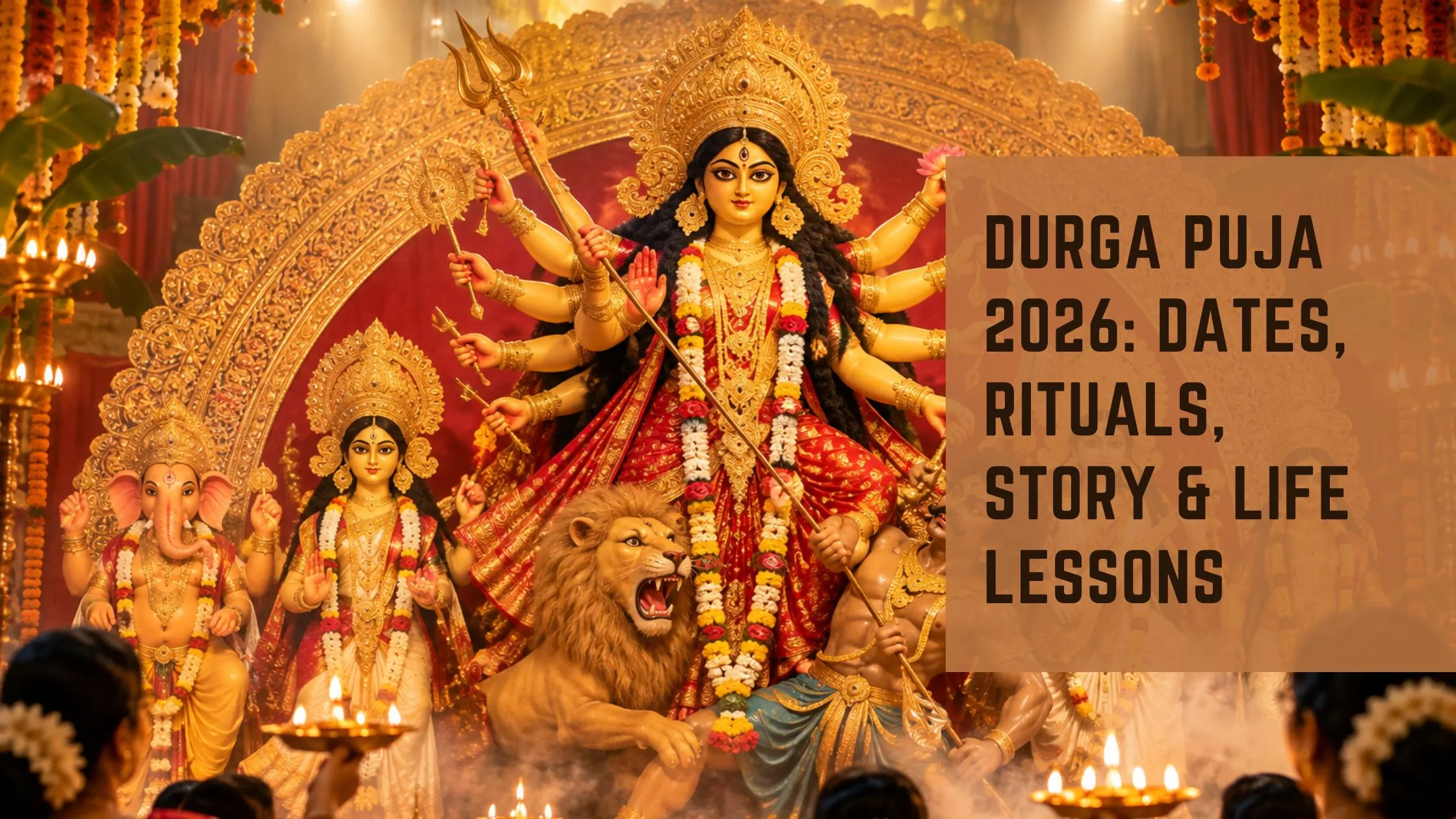
Goddess Durga is commonly depicted riding a lion or tiger and holding various weapons in her multiple hands. These symbols represent her ability to confront different forms of evil and protect the world from destructive forces.
The festival has three important dimensions:
Religious: Worshipping Goddess Durga and seeking her blessings.
Cultural: Celebrating art, music, dance, traditional clothing, and community life.
Spiritual: Understanding the victory of good over evil, both in society and within ourselves.
Durga Puja is also recognised by UNESCO as an element of humanity's Intangible Cultural Heritage, reflecting its extraordinary artistic and community significance.
The Story of Goddess Durga and Mahishasura
According to Hindu mythology, Mahishasura was a powerful demon who received a boon that made him believe he could not be defeated by a man or a god. Empowered by this protection, he began troubling the heavens and threatening the balance of the universe.
The gods were unable to defeat him individually. Their divine energies came together to manifest Goddess Durga, who embodied extraordinary strength, wisdom, and determination.
Armed with divine weapons and riding a lion, Goddess Durga fought Mahishasura in a fierce battle. After a prolonged struggle, she defeated him and restored peace.
This victory is the central spiritual theme of Durga Puja.
What Does the Story Teach Us?
Mahishasura can also be understood symbolically as the destructive tendencies within human beings: ego, anger, greed, arrogance, and the desire to dominate others.
Goddess Durga represents the courage and wisdom needed to overcome these tendencies.
Life lesson: You do not become powerful by controlling others. You become powerful by mastering yourself and standing firmly for what is right.
Durga Puja Rituals: How the Festival Is Celebrated
Durga Puja combines devotion, traditional rituals, artistic expression, and community participation. Practices differ among families, temples, and regions.
1. Mahalaya: Welcoming the Goddess
Mahalaya marks the traditional beginning of the countdown to Durga Puja. Devotees listen to devotional recitations, including Mahishasura Mardini in Bengali cultural tradition, and prepare to welcome the Goddess.
It is a time for reflection, remembrance, and spiritual preparation.
2. Maha Shashthi: The Goddess Is Invoked
Shashthi marks the formal beginning of the main Bengali Durga Puja celebrations. Rituals such as Bodhon, Amantran, and Adhivas are performed according to tradition.
Beautifully decorated pandals become centres of prayer and community gatherings.
3. Maha Saptami: Sacred Worship and Offerings
On Saptami, many Bengali communities perform Navapatrika Puja. A group of nine plants is ritually prepared and worshipped as part of the ceremony.
Devotees offer flowers, fruits, and prayers while participating in aarti and other devotional practices.
4. Maha Ashtami: The Day of Devotion and Courage
Maha Ashtami is among the most spiritually significant days of Durga Puja.
Common observances include:
Pushpanjali: Offering flowers to Goddess Durga with prayers.
Kumari Puja: Worshipping a young girl as a symbolic expression of the Divine Mother in traditions that observe it.
Sandhi Puja: A special worship performed at the transition between Ashtami and Navami, at the locally calculated auspicious time.
For many devotees, Ashtami represents the power of faith and the courage to overcome adversity.
5. Maha Navami: Celebrating Divine Strength
Maha Navami is marked by special worship, devotional ceremonies, and Homa or Havan in many traditions.
Families and communities gather to offer prayers and seek blessings for peace, prosperity, wisdom, and protection.
6. Vijayadashami: The Victory of Good Over Evil
Vijayadashami marks the concluding day of the principal Bengali Durga Puja celebrations.
Sindoor Khela is observed by many married Bengali women as a traditional farewell ritual. Devotees participate in processions and Durga Visarjan, symbolising the Goddess's ceremonial departure.
The immersion of the idol reminds us of the temporary nature of physical forms and the enduring importance of faith, values, and spiritual connection.
Powerful Durga Puja Quotes for Inspiration
These original reflections capture the spiritual message of the festival and can also be shared as devotional captions.
“When courage awakens within you, even the darkest chapter of life can become the beginning of victory.”
“May Maa Durga give you the strength to face your fears, the wisdom to choose what is right, and the faith to keep moving forward.”
“True victory begins when kindness defeats hatred, patience defeats anger, and truth defeats fear.”
“Let the power of Maa Durga remind you that you are stronger than the negativity you carry.”
“Worship is not only about bowing before the Goddess; it is also about bringing courage, compassion, and honesty into your daily life.”
7 Spiritual Lessons from Goddess Durga for Everyday Life
The deeper beauty of Durga Puja lies in the lessons we can carry beyond the festival.
1. Courage Is More Powerful Than Fear
Goddess Durga's battle against Mahishasura reminds us that challenges cannot always be avoided. Sometimes, we must face them with determination.
Apply it: Take one positive step towards a difficult task instead of allowing fear to control your decisions.
2. Goodness Requires Action
Good intentions matter, but protecting others and opposing injustice may require action.
Apply it: Speak respectfully against wrongdoing and support people who need help.
3. Control Your Inner Demons
Anger, jealousy, greed, and ego can damage relationships and cloud judgement.
Apply it: Pause before reacting, reflect on your behaviour, and apologise when you make a mistake.
4. Strength and Compassion Can Coexist
Durga represents immense power, but divine protection is directed towards restoring balance rather than causing harm for its own sake.
Apply it: Be firm about your boundaries without losing respect for others.
5. Unity Creates Greater Strength
In the traditional story, the gods' combined energies manifest as Goddess Durga.
Apply it: Value cooperation, respect different abilities, and work with others to solve difficult problems.
6. Have Faith During Difficult Times
Faith can offer emotional steadiness when the future feels uncertain. It does not mean ignoring problems; it means facing them with hope and responsibility.
Apply it: Combine prayer or meditation with practical steps towards solving your problems.
7. Let Go and Begin Again
Durga Visarjan symbolises farewell, change, and the continuation of life beyond a single celebration.
Apply it: Release what you cannot control, learn from the past, and make room for a healthier beginning.
Durga Puja and the Bhagavad Gita: A Shared Message of Righteousness
The Bhagavad Gita and the spiritual symbolism of Durga Puja both encourage people to act with courage, wisdom, and commitment to righteousness.
In the Bhagavad Gita, Lord Krishna teaches Arjuna to perform his duty without becoming attached to the fruits of his actions.
Bhagavad Gita 2.47:
कर्मण्येवाधिकारस्ते मा फलेषु कदाचन।
“You have a right to perform your prescribed duty, but you are not entitled to the fruits of action.”
The verse teaches us to focus on sincere effort rather than becoming overwhelmed by outcomes.
Similarly, the story of Goddess Durga reminds us that overcoming difficulties requires courage, determination, and purposeful action.
Together, these teachings encourage us to:
Do what is right, even when it is difficult.
Focus on effort rather than obsessing over results.
Practise self-control and resist destructive impulses.
Protect truth and justice without surrendering to hatred.
For readers of thegita.in, Durga Puja is an opportunity to connect devotional traditions with the timeless wisdom of the Bhagavad Gita.
How to Celebrate Durga Puja 2026 Meaningfully
You do not need an elaborate celebration to experience the spiritual beauty of Durga Puja.
Here are simple ways to make the festival meaningful:
Offer prayers: Visit a temple or create a peaceful prayer space at home.
Read sacred texts: Spend a few minutes reading the Durga Saptashati or the Bhagavad Gita.
Practise gratitude: Reflect on the people and experiences that have strengthened you.
Help someone: Donate food, support a community initiative, or assist someone in need.
Respect cultural traditions: Visit pandals respectfully and follow local customs.
Celebrate sustainably: Choose eco-friendly decorations and support responsible idol immersion practices.
Share positivity: Send thoughtful wishes and encourage friends and family with meaningful messages.
The real beauty of celebration lies not only in what we do during the festival, but also in how its values shape our lives afterwards.
Frequently Asked Questions About Durga Puja 2026
1. When is Durga Puja in 2026?
The main five-day Durga Puja celebration in West Bengal runs from October 17 to October 21, 2026. Mahalaya falls on October 10.
2. When is Maha Ashtami in 2026?
Maha Ashtami falls on Monday, October 19, 2026, in the main Bengali Durga Puja calendar.
3. When is Maha Navami in 2026?
Maha Navami falls on Tuesday, October 20, 2026, in the Bengali Durga Puja calendar.
4. When is Vijayadashami in 2026?
Vijayadashami falls on Wednesday, October 21, 2026, in Bengal. Dussehra observances elsewhere in India may follow different regional calendar conventions.
5. Why is Durga Puja celebrated?
Durga Puja celebrates Goddess Durga's victory over Mahishasura. It symbolises the triumph of good over evil, the protection of righteousness, and the power of the Divine Mother.
6. What is the difference between Durga Puja and Navratri?
Both festivals honour Goddess Durga and her divine power. Navratri traditionally spans nine nights of worship, while Bengali Durga Puja centres on the principal days of Shashthi through Vijayadashami. Their rituals and emphasis vary across regions.
7. What should we do on Maha Ashtami?
Devotees may offer Pushpanjali, attend temple prayers, participate in Sandhi Puja, and observe other family or community traditions. Follow local customs and the appropriate Panchang for ritual timings.
8. What is the spiritual message of Durga Puja?
Its central message is that courage, righteousness, wisdom, and divine grace can help overcome evil. The festival also encourages us to recognise and transform our own negative tendencies.
Conclusion
Durga Puja 2026 is more than a celebration of beautifully decorated pandals, devotional music, traditional food, and joyful gatherings. It is a reminder that courage can rise in the face of fear, goodness can stand against injustice, and hope can survive even the most difficult circumstances.
The story of Goddess Durga teaches us to confront our inner demons, protect what is right, and act with wisdom rather than arrogance. The Bhagavad Gita complements this message by reminding us to fulfil our responsibilities with sincerity and without becoming consumed by the results.
As you celebrate Durga Puja, may the blessings of Maa Durga inspire you to live with courage, compassion, discipline, and faith.
The greatest victory is not simply defeating the darkness around you; it is allowing the light of wisdom to grow within you.
May Maa Durga bless you and your family with strength, peace, happiness, and prosperity. Shubho Durga Puja!
Explore more spiritual wisdom, Bhagavad Gita teachings, life lessons, and devotional insights at The Gita.