
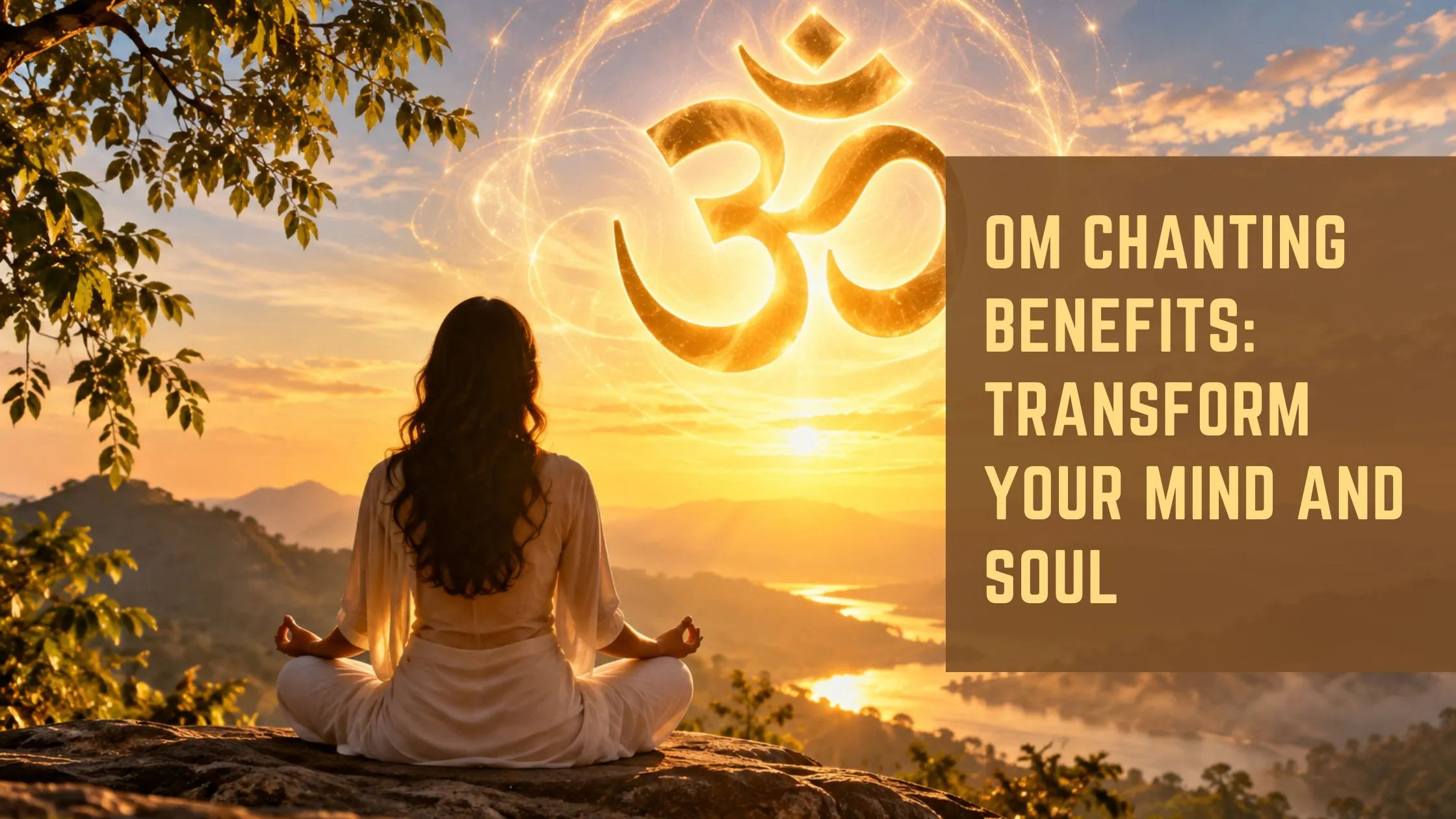
Have you ever wondered why a single sound, Om (ॐ), has been chanted for thousands of years to calm the mind, deepen meditation, and connect with the divine? What makes this sacred sound so meaningful in Hindu spirituality?
In the rush of modern life, our minds are constantly filled with worries, distractions, and endless thoughts. Finding a moment of inner peace can feel difficult. This is where Om chanting offers a simple spiritual practice that invites us to pause, breathe, and reconnect with ourselves.
Om is more than a sound used during prayer. In Hindu philosophy, it represents profound spiritual truths, the unity of existence, and the journey toward self-realization. Understanding the Om chanting benefits can help us appreciate how this ancient practice fits into our daily lives.
In this guide, we will explore the spiritual significance of Om, its potential mental and physical benefits, the correct chanting method, the best time to chant, and the life lessons hidden within this sacred sound.
Table of Contents
- Key Takeaways
- What Is Om (ॐ) and Why Is It Sacred?
- 10 Important Om Chanting Benefits
- What Do A, U, and M Represent in Om?
- How to Chant Om Correctly
- What Is the Best Time to Chant Om?
- What Does Science Say About Om Chanting?
- Powerful Spiritual Lessons From Om Chanting
- Frequently Asked Questions
- Conclusion
Key Takeaways
Om is a sacred syllable deeply connected with Hindu spiritual traditions.
Regular Om chanting may support relaxation, attention, and emotional well-being.
The sounds A-U-M are traditionally associated with different states of consciousness.
Consistent chanting can become a meaningful part of meditation and self-reflection.
Om chanting does not require expensive equipment or complicated rituals.
Its spiritual value lies in awareness, sincerity, and regular practice.
What Is Om (ॐ) and Why Is It Sacred?
Om, also written as Aum, is one of the most important sacred syllables in Hinduism. It appears in several Hindu scriptures, including the Upanishads and the Bhagavad Gita.
In the Mandukya Upanishad, Om is explored in relation to consciousness and the nature of the self. It is associated with waking, dreaming, deep sleep, and a fourth state traditionally described as transcending these ordinary states.
Om is therefore not simply a word to pronounce. It is a spiritual symbol that encourages contemplation of existence, consciousness, and the relationship between the individual self and ultimate reality.
Spiritual quote:
“Om is the bow, the self is the arrow, and Brahman is spoken of as the target.”
— Inspired by the Mundaka Upanishad, 2.2.4
This teaching uses the imagery of a bow and arrow to describe spiritual concentration and the search for ultimate truth.

10 Important Om Chanting Benefits
The benefits of Om chanting can be understood through spiritual tradition, personal experience, and emerging scientific research on vocalization and meditation. Individual experiences vary, and chanting should not be considered a guaranteed treatment for health conditions.
1. May Help Calm the Mind
One of the most commonly reported Om chanting benefits is a feeling of calmness. Sitting quietly, breathing slowly, and repeating a single sound can create a break from everyday distractions.
Chanting can also provide a simple focus when thoughts begin to wander.
Life lesson: Peace does not always come from changing your surroundings. Sometimes, it begins by changing how you respond to them.
2. Supports Meditation and Mindfulness
Om chanting gives the mind a focal point. Instead of following every thought, you can gently bring your attention back to the sound and your breathing.
This makes it a useful starting point for beginners who find silent meditation challenging.
3. May Improve Focus and Attention
Repeating Om with awareness encourages you to remain present. Over time, this routine may help you practise directing your attention rather than reacting automatically to every distraction.
Chanting is not a substitute for adequate sleep, study, or other habits that support concentration, but it can complement them.
4. Encourages Emotional Balance
When you pause to chant, you create an opportunity to observe your emotions without immediately reacting to them.
This practice may help some people approach stressful situations with greater patience and awareness. It does not mean that difficult emotions will disappear; instead, it encourages a more thoughtful response.
5. Connects You With Spiritual Awareness
In Hindu philosophy, Om is closely associated with Brahman, the ultimate reality underlying existence.
Chanting with contemplation can become a way to reflect on questions such as: Who am I beyond my thoughts? What gives life its deeper meaning? How can I live with greater awareness?
The spiritual benefit lies in the reflection and sincerity behind the practice, not merely in repeating the sound.
6. Encourages Slow, Mindful Breathing
Chanting Om naturally involves inhaling and extending the voice during exhalation. When practised comfortably, this may encourage slower breathing and relaxation.
Avoid forcing your breath or trying to hold it for unusually long periods. Natural, comfortable breathing is sufficient.
7. May Support Relaxation Before Sleep
A short, quiet chanting session before bedtime may help some people transition from a busy day to a calmer evening routine.
Choose a comfortable volume and stop if chanting makes you feel uncomfortable. Om chanting is not a guaranteed cure for insomnia.
8. Helps Create a Consistent Spiritual Routine
A few minutes of daily chanting can become an anchor in your schedule. Whether practised in the morning or evening, this regular pause encourages discipline and self-reflection.
The aim is not to chant for an impressive length of time but to practise with attention and consistency.
9. Encourages Self-Awareness
During chanting, you may notice recurring thoughts, emotional reactions, or physical tension. Observing these experiences without judging yourself can support greater self-understanding.
This awareness can help you respond more thoughtfully in everyday situations.
10. Cultivates a Sense of Inner Connection
For many practitioners, Om chanting is a devotional act that creates a sense of connection with the divine, the universe, or a deeper dimension of life.
This experience is personal and may differ according to individual beliefs and traditions.
What Do A, U, and M Represent in Om?
The traditional explanation of Om often examines its three audible elements and the silence that follows.
| Element | Traditional association | Spiritual reflection |
|---|---|---|
| A | Waking state | Awareness of the external world |
| U | Dreaming state | Inner experiences and thoughts |
| M | Deep sleep | A state beyond ordinary waking awareness |
| Silence after Om | The fourth state, Turiya | Awareness beyond the three ordinary states |
These associations are especially important in the Mandukya Upanishad. The silence is not merely an absence of sound; it is contemplated as pointing toward a reality beyond ordinary experience.
The interpretation is philosophical and spiritual rather than a scientific measurement of consciousness.
How to Chant Om Correctly
You do not need special equipment or advanced spiritual knowledge to begin. Follow these simple steps.
Choose a quiet place: Sit somewhere comfortable where you can relax without interruption.
Keep your posture steady: Sit on a chair or cushion with your back comfortably upright.
Relax your body: Release tension in your shoulders, jaw, and face.
Breathe naturally: Take a gentle inhalation without forcing the breath.
Chant Om slowly: Begin with an open “A” sound, transition into “U,” and finish with a gentle “M” hum.
Notice the silence: After the sound ends, pause briefly and observe your breathing and awareness.
Repeat comfortably: Continue for five minutes if that feels suitable, gradually adjusting your practice according to comfort.
There is no need to shout, strain your throat, or compete with anyone else's chanting. You may chant aloud, softly, or mentally according to your preference and tradition.
What Is the Best Time to Chant Om?
Om can be chanted at different times of the day. The best time is one that allows you to practise regularly and without unnecessary distractions.
| Time | Why you might choose it |
|---|---|
| Early morning | To begin the day with reflection and intention |
| Before meditation | To establish a clear focus |
| During a quiet afternoon | To pause and reset your attention |
| In the evening | To reflect on the day and unwind |
| Before bedtime | To support a peaceful wind-down routine |
Early morning is traditionally preferred by many spiritual practitioners, but it is not the only appropriate time. Consistency and comfort matter more than following a rigid schedule.
What Does Science Say About Om Chanting?
Research on meditation, slow breathing, and vocal chanting suggests that these practices may support relaxation and aspects of emotional well-being. Some small studies have investigated Om chanting specifically, including possible changes in brain activity and autonomic responses.
However, the evidence remains limited. More rigorous research is needed to establish which effects are specific to Om chanting and how reliably they occur.
It is important to distinguish between spiritual beliefs and scientifically demonstrated outcomes. Om's sacred significance comes from its place in Hindu traditions; its potential health effects should be evaluated through appropriate research.
Om chanting can complement healthy daily habits, but it should not replace professional medical or mental health care.
Powerful Spiritual Lessons From Om Chanting
Beyond the immediate experience of making a sound, Om can inspire several meaningful life lessons.
Lesson 1: Make Space for Silence
Life becomes overwhelming when every moment is filled with noise. Silence gives us an opportunity to listen to ourselves and reflect before acting.
Lesson 2: Return to the Present
You cannot change every past event or predict every future outcome. Bringing your attention to the present moment helps you engage more consciously with what is happening now.
Lesson 3: Practise Consistency Over Perfection
Five attentive minutes can be a meaningful beginning. A sustainable spiritual practice is more valuable than an ambitious routine that quickly becomes a burden.
Lesson 4: Observe Your Thoughts Without Becoming Their Prisoner
Thoughts and emotions are experiences, not the whole of who you are. Learning to observe them can create room for wiser decisions.
Lesson 5: Look Beyond the Surface
Om reminds spiritual seekers to explore questions that go beyond material success and outward appearances. It invites reflection on purpose, consciousness, compassion, and the deeper meaning of life.
A reflection to remember:
When the mind becomes quiet, we create space to understand ourselves more clearly.
Frequently Asked Questions
1. What are the main benefits of Om chanting?
Om chanting may encourage relaxation, mindfulness, focused attention, and a regular meditation practice. Its spiritual significance includes contemplation of consciousness and ultimate reality.
2. How many times should I chant Om daily?
Beginners can start with five to eleven repetitions or a few minutes of comfortable chanting. There is no single number that is compulsory for everyone.
3. Can I chant Om every day?
Yes. Many people include Om chanting in their daily spiritual routine. Practise comfortably and choose a schedule you can maintain.
4. Is Om chanting better in the morning or at night?
Both can be suitable. Morning chanting may help establish a reflective start to the day, while evening chanting may provide a quiet transition from daily activities.
5. Can beginners chant Om?
Yes. Beginners can start with a few gentle repetitions, focusing on comfortable breathing and the sound. No previous meditation experience is necessary.
6. What is the difference between Om and Aum?
Om and Aum are closely related representations of the same sacred syllable. Aum makes its traditional A-U-M components more explicit in transliteration.
7. Does Om chanting have scientific benefits?
Some research has examined Om chanting and related relaxation practices, but the evidence is limited. It may support relaxation for some people, and stronger research is needed to establish specific effects.
8. Can Om chanting remove negative thoughts?
Chanting does not guarantee that negative thoughts will disappear. It may help you observe thoughts with greater awareness and respond to them more calmly.
Conclusion
The true value of Om chanting lies not only in the sound itself but also in the attention, reflection, and intention you bring to the practice.
From its sacred place in Hindu philosophy to its use as a focus for meditation, Om offers a simple way to pause amid the noise of daily life. Its potential benefits include relaxation, mindfulness, and a deeper connection with one's spiritual values, although individual experiences differ.
You do not need to transform your entire routine overnight. Begin with a few quiet repetitions, breathe comfortably, and observe what you experience without expecting instant results.
The Gita's life lesson: Inner growth begins when we make time to understand ourselves. Let Om be a reminder to pause, become aware, and approach life with greater clarity and compassion.
For more spiritual insights, Bhagavad Gita teachings, and timeless wisdom, explore thegita.in.