
What if a conversation spoken thousands of years ago could describe your anxiety, confusion, fear, ambition, heartbreak, and purpose more accurately than modern psychology?
Imagine standing in the middle of a battlefield—not with swords and arrows around you, but with deadlines, emotional pain, broken relationships, self-doubt, and endless pressure. Now imagine someone calmly speaking words so timeless that they continue to guide millions even after thousands of years.
That is the miracle of the Bhagavad Gita Verses.
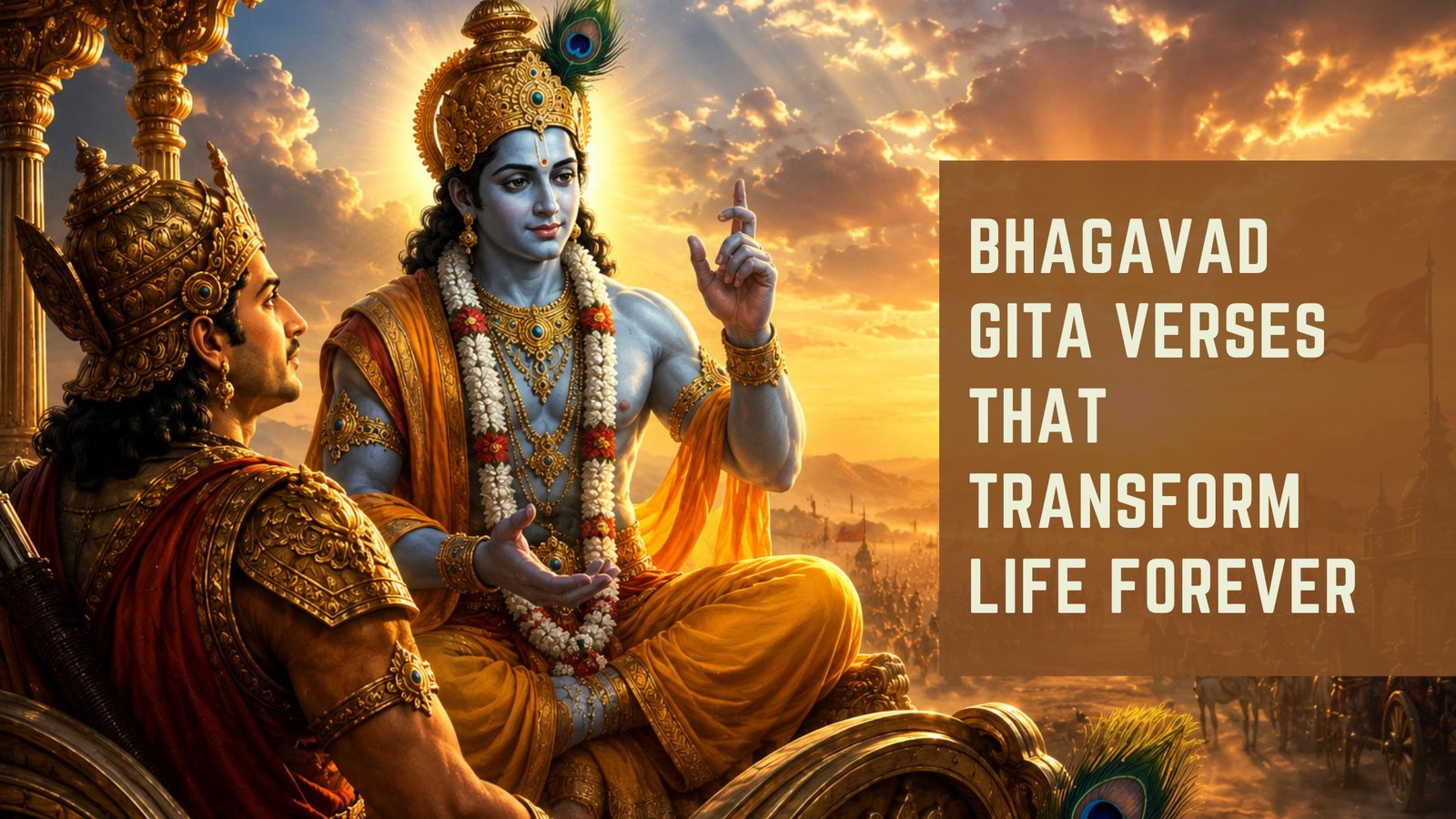
The sacred dialogue between Lord Krishna and Arjuna in the epic Mahabharata is not merely a religious scripture. It is a spiritual operating system for humanity. Every verse carries wisdom capable of transforming fear into courage, confusion into clarity, and suffering into awakening.
The Bhagavad Gita verses are not just philosophical teachings. They are living truths. They speak differently to every generation because human emotions never truly change. The battlefield of Kurukshetra still exists—only the weapons are different.
Today people search for peace through productivity, motivation through social media, and purpose through external success. Yet the Bhagavad Gita quietly offers answers that have survived empires, wars, and civilizations.
This article explores the most powerful Bhagavad Gita verses, their meanings, stories, modern relevance, and spiritual lessons that continue to shape human consciousness.
Table of Contents
Key Takeaways
- Learn the deeper meaning behind the most transformative Bhagavad Gita verses.
- Discover how Lord Krishna’s teachings solve modern emotional and spiritual struggles.
- Understand timeless life lessons about duty, peace, karma, fear, and self-realization.
The Master Table of Bhagavad Gita Wisdom
| Verse Theme | Key Symbol/Weapon | Reason It Matters | Core Lesson |
|---|---|---|---|
| Karma Yoga | Sudarshan Chakra | Represents righteous action | Focus on action, not results |
| Self-Control | Chariot | Mind must be guided wisely | Discipline creates inner peace |
| Fearlessness | Krishna’s Divine Form | Reveals cosmic truth | Fear disappears with spiritual vision |
| Devotion | Flute of Krishna | Symbol of divine connection | Love leads to liberation |
| Wisdom | Lotus | Purity amidst chaos | Stay untouched by negativity |
| Duty (Dharma) | Gandiva Bow | Arjuna’s responsibility | Avoiding duty creates suffering |
| Detachment | Ocean | Stability despite waves | True peace comes from non-attachment |

The Eternal Battlefield Why Bhagavad Gita Verses Matter
The Legend
The Bhagavad Gita Verses appears in the Bhishma Parva of the Mahabharata. Before the great war begins, warrior prince Arjuna becomes emotionally shattered. Seeing his relatives, teachers, and loved ones on both sides of the battlefield, he refuses to fight.
At that moment, Lord Krishna becomes not just his charioteer but his spiritual guide.
The battlefield becomes symbolic of every human struggle.
The Story
Arjuna collapses in confusion. His hands tremble. His famous Gandiva bow slips from his grip. He questions morality, purpose, duty, and existence itself.
Instead of forcing him into battle, Krishna delivers 700 verses of profound wisdom that explain life, death, karma, soul, meditation, devotion, and liberation.
Those verses became the Bhagavad Gita.
The Modern Lesson
Modern humans also freeze under pressure:
- Fear of failure
- Emotional exhaustion
- Career confusion
- Relationship pain
- Anxiety about the future
The Gita teaches that clarity emerges when ego becomes silent.
Key Quote
“Whenever dharma declines and adharma rises, I manifest myself.”
— Bhagavad Gita 4.7
Karma Yoga The Most Powerful Bhagavad Gita Verses About Action
The Legend
One of the most quoted Bhagavad Gita verses is Krishna’s teaching on Karma Yoga—the yoga of selfless action.
The Story
Arjuna fears the consequences of war. Krishna explains that humans control actions, not outcomes. Attachment to results creates suffering.
The Modern Lesson
People today tie self-worth to results:
- Salary
- Followers
- Success
- Recognition
The Gita teaches that peace comes from sincere effort, not obsessive attachment to outcomes.
This lesson is revolutionary in a world addicted to validation.
Key Quote
“You have the right to perform your duty, but not to the fruits of your actions.”
— Bhagavad Gita 2.47
Karma>Attachment
This simple truth changes everything:
Work with devotion. Let go of anxiety.
The Soul Never Dies The Bhagavad Gita Verses That Removes Fear
The Legend
Arjuna fears death on the battlefield. Krishna introduces one of the deepest spiritual concepts ever spoken—the immortality of the soul.
The Story
Krishna explains that the body changes, ages, and dies, but the soul is eternal. Death is merely a transition.
This teaching transformed the understanding of life in Indian philosophy forever.
The Modern Lesson
Modern society fears aging, endings, and uncertainty because identity is attached to the physical body.
The Bhagavad Gita teaches that consciousness transcends temporary existence.
This wisdom reduces fear and increases spiritual courage.
Key Quote
“The soul is neither born, nor does it ever die.”
— Bhagavad Gita 2.20
Why Bhagavad Gita Verses Still Resonates
- It comforts grieving hearts.
- It reduces fear of death.
- It inspires spiritual awakening.
- It teaches that life has a higher purpose.
Mastering the Mind The Greatest Internal Battle
The Legend
Arjuna admits that controlling the mind feels impossible.
Krishna agrees that the mind is restless—but trainable.
The Story
The Gita compares the uncontrolled mind to a storm. Desires, distractions, anger, and fear pull humans away from peace.
Through meditation, discipline, and self-awareness, the mind becomes an ally instead of an enemy.
The Modern Lesson
The modern world profits from distraction.
Constant scrolling, comparison, noise, and stimulation weaken inner stillness.
The Bhagavad Gita verses on meditation feel more relevant today than ever before.
Key Quote
“For one who has conquered the mind, the mind is the best friend.”
— Bhagavad Gita 6.6
Practical Wisdom From This Verse
- Control reactions before controlling situations.
- Peace begins internally.
- Discipline creates freedom.
- Mental clarity is spiritual power.
Krishna’s Universal Form The Most Terrifying and Beautiful Vision
The Legend
In one of the most dramatic moments in the Bhagavad Gita, Krishna reveals his Vishvarupa—the universal cosmic form.
The Story
Arjuna asks Krishna to reveal his true divine nature.
Krishna grants divine vision.
Arjuna witnesses infinite universes, countless beings, celestial energies, creation, destruction, and time itself existing within Krishna.
The vision is overwhelming.
The Modern Lesson
Humans often believe they control everything. The Vishvarupa reminds humanity of its smallness within the cosmic order.
At the same time, it reveals that divinity exists everywhere.
Key Quote
“Time I am, destroyer of worlds.”
— Bhagavad Gita 11.32
Spiritual Meaning
The verse teaches:
- Everything changes.
- Ego is temporary.
- Divine intelligence governs existence.
- Surrender removes fear.
Detachment The Secret to Inner Peace
The Legend
Krishna repeatedly teaches Arjuna about detachment—not abandonment of life, but freedom from unhealthy attachment.
The Story
Arjuna wants certainty, emotional comfort, and guaranteed outcomes.
Krishna explains that attachment creates suffering because life constantly changes.
Detachment allows humans to live fully without becoming emotionally enslaved.
The Modern Lesson
Today people become attached to:
- Social approval
- Relationships
- Wealth
- Expectations
- Identity
The Bhagavad Gita verses teach emotional balance rather than emotional suppression.
Key Quote
“A person who is not disturbed by happiness and distress becomes eligible for liberation.”
— Bhagavad Gita 2.15
Why Detachment Is Misunderstood
Detachment does NOT mean:
- Lack of love
- Coldness
- Isolation
It means:
- Loving without control
- Working without obsession
- Living without fear
Bhakti Yoga The Path of Divine Love
The Legend
After discussing knowledge and action, Krishna reveals devotion as the simplest and most powerful spiritual path.
The Story
Krishna explains that pure devotion transcends rituals and intellectual pride.
Even a simple offering made with love becomes sacred.
The Modern Lesson
Modern people seek connection yet feel emotionally empty.
Bhakti Yoga teaches that the heart needs spiritual intimacy, not just achievement.
Devotion transforms loneliness into belonging.
Key Quote
“Whoever offers me with devotion a leaf, a flower, a fruit, or water, I accept it.”
— Bhagavad Gita 9.26
Spiritual Insight
Bhakti teaches:
- God values sincerity over status.
- Love is higher than ego.
- Divine connection heals emotional emptiness.
Comparison Section Ancient Wisdom vs Modern Living
Bhagavad Gita Teachings Compared to Modern Mentality
Bhagavad Gita Wisdom
- Focus on duty
- Practice self-control
- Detach from outcomes
- Seek inner peace
- Value spiritual growth
- Control desires
- Live consciously
Modern Society
- Obsession with results
- Endless distraction
- Emotional dependency
- External validation
- Material comparison
- Constant craving
- Reactive living
Why the Gita Remains Timeless
The Bhagavad Gita survives because it addresses universal human struggles:
- Fear
- Desire
- Ego
- Suffering
- Purpose
- Identity
- Death
- Love
Human technology evolved.
Human emotions did not.
The Hidden Spiritual Science of Bhagavad Gita Verses
The Legend
Ancient sages believed sacred sound carried transformative power.
The Story
The Sanskrit verses of the Bhagavad Gita were traditionally memorized and recited because sound vibration itself was considered spiritually purifying.
Each shloka combines philosophy with rhythmic energy.
The Modern Lesson
Scientific studies increasingly explore meditation, chanting, mindfulness, and nervous system regulation.
The Gita understood inner psychology long before modern neuroscience existed.
Key Quote
“One who sees inaction in action and action in inaction is truly wise.”
— Bhagavad Gita 4.18
Deeper Meaning
This verse teaches:
- External busyness is not true productivity.
- Inner stillness creates wisdom.
- Conscious action is superior to restless activity.
Arjuna Represents Every Human Being
The Legend
Arjuna is not weak because he doubts. His greatness lies in seeking truth.
The Story
Before receiving wisdom, Arjuna openly admits confusion.
That honesty becomes the doorway to enlightenment.
The Modern Lesson
Modern culture often glorifies pretending to be strong.
The Bhagavad Gita teaches that transformation begins when humans admit inner conflict.
Seeking guidance is strength, not weakness.
Key Quote
“Now I am confused about my duty and have lost all composure.”
— Bhagavad Gita 2.7
Why This Matters Today
Many people silently struggle with:
- Anxiety
- Directionlessness
- Emotional exhaustion
- Spiritual emptiness
The Gita reminds humanity that confusion can become the beginning of awakening.
FAQ
Which Bhagavad Gita verse is most powerful?
Bhagavad Gita 2.47 is considered one of the most powerful verses because it teaches action without attachment to results.
Can Bhagavad Gita verses reduce anxiety?
Yes. The teachings on detachment, self-control, meditation, and acceptance help reduce mental stress and emotional suffering.
Is the Bhagavad Gita only for Hindus?
No. The Bhagavad Gita speaks about universal human emotions, morality, consciousness, and spirituality. People worldwide study it for wisdom and personal growth.
Why are Bhagavad Gita verses still relevant today?
Because they address timeless human struggles such as fear, confusion, ego, desire, purpose, and emotional pain.
Which chapter of the Bhagavad Gita is best for beginners?
Chapter 2 is often recommended because it introduces core teachings about the soul, duty, wisdom, and self-control.
Conclusion
The Bhagavad Gita is not merely an ancient scripture hidden in history.
It is a mirror.
Every verse reflects the inner condition of humanity. The battlefield of Kurukshetra exists inside every human heart. Every day people choose between fear and courage, ego and surrender, distraction and awareness, selfishness and dharma.
That is why Bhagavad Gita verses continue to survive beyond time.
Lord Krishna did not speak only to Arjuna. He spoke to every future generation that would struggle with uncertainty, emotional conflict, and spiritual emptiness. “Read theGitain. Understand Life.