What is truth? Why do we suffer? What is the purpose of life? Is liberation possible while living in the world?
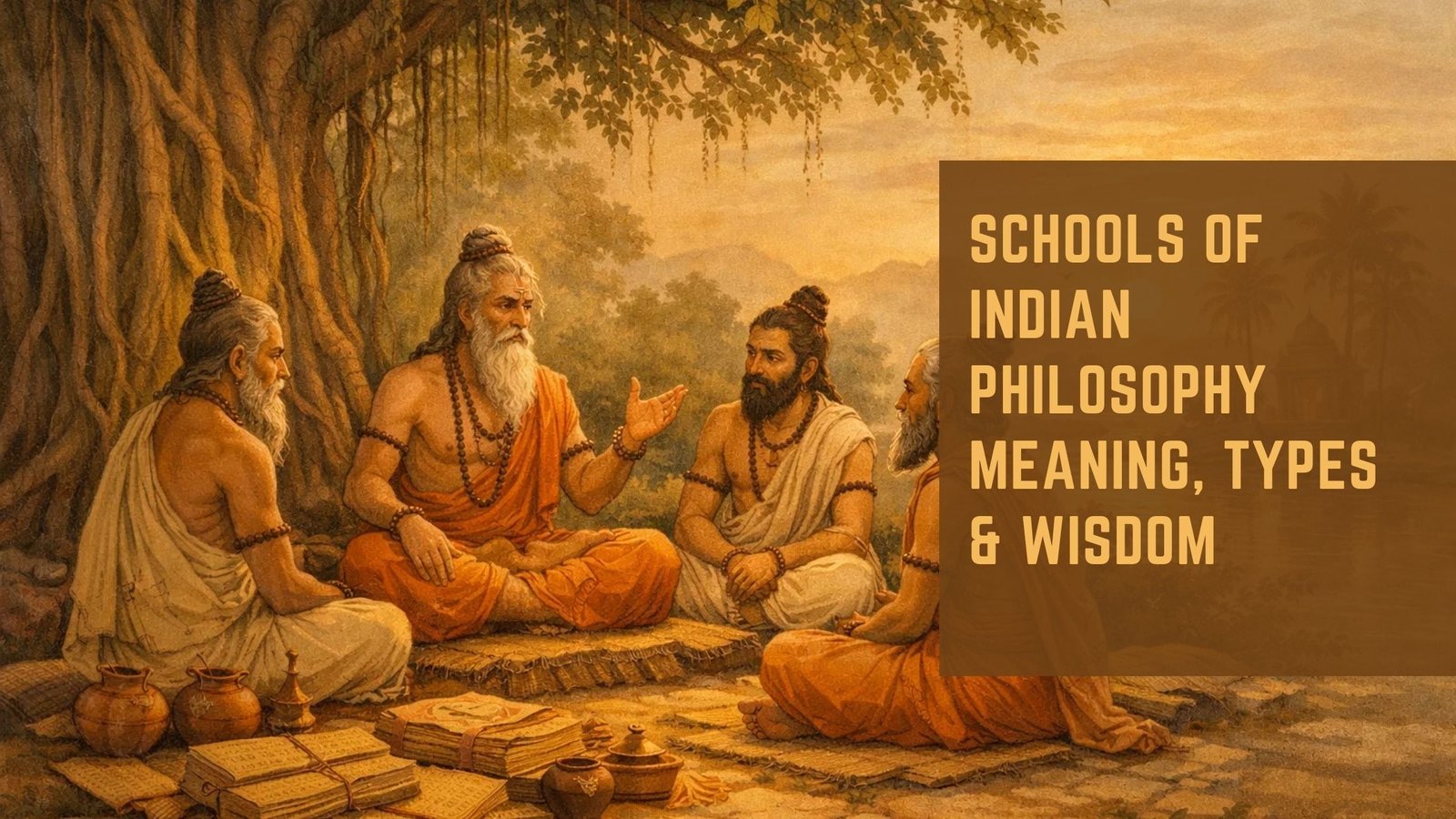
Thousands of years before modern psychology, philosophy, or neuroscience began exploring these questions, Indian sages were already debating them in forests, universities, and spiritual communities. Their insights gave birth to what we now call the Schools of Indian Philosophy a profound intellectual and spiritual tradition that shaped not only India but global thought.
Unlike many philosophical traditions that remain theoretical, the Schools of Indian Philosophy were deeply practical. They aimed not merely to think about life but to transform it. Each school offered a unique path toward understanding reality, consciousness, ethics, and liberation (moksha).
From logic-driven Nyaya philosophers to meditation-centered Yogis, from Buddhist thinkers questioning permanence to Vedantic sages proclaiming unity of existence these systems collectively form one of humanity’s richest philosophical heritages.
This guide explores every major school, their teachings, quotes, lessons, and relevance today.
Table of Contents
Key Takeaways
- Indian philosophy is divided into Orthodox (Astika) and Heterodox (Nastika) schools.
- The goal of most schools is liberation from suffering.
- Philosophy in India combines logic, spirituality, ethics, and psychology.
- Different schools offer different paths: knowledge, action, devotion, meditation, or discipline.
- Ancient teachings remain relevant for modern stress, identity, and purpose.
What Are the Schools of Indian Philosophy?
The Schools of Indian Philosophy are structured systems of thought developed between roughly 1500 BCE and medieval India. They explore:
- Nature of reality
- Consciousness and self
- Knowledge and perception
- Ethics and duty
- Liberation from suffering
Indian philosophy is unique because it integrates:
- Rational inquiry
- Spiritual experience
- Moral living
- Practical transformation

Classification of Indian Philosophy
1. Orthodox Schools (Astika)
Accept authority of the Vedas.
- Nyaya
- Vaisheshika
- Samkhya
- Yoga
- Mimamsa
- Vedanta
2. Heterodox Schools (Nastika)
Reject Vedic authority.
- Buddhism
- Jainism
- Charvaka
The Six Orthodox Schools of Indian Philosophy
1. Nyaya School Philosophy of Logic and Reason
Founder
Sage Gautama
Core Idea
Truth can be attained through logical reasoning and valid knowledge.
Nyaya developed sophisticated systems of logic centuries before Western formal logic.
Four Sources of Knowledge
- Perception
- Inference
- Comparison
- Testimony
Life Lesson
Clear thinking removes suffering caused by ignorance.
“Right knowledge leads to freedom.”
Nyaya teaches us to question assumptions a skill highly relevant in today’s information age.
2. Vaisheshika Philosophy of Reality and Atoms
Founder
Sage Kanada
Vaisheshika proposed an early atomic theory stating that reality consists of indivisible particles.
Categories of Reality
- Substance
- Quality
- Action
- Generality
- Particularity
- Inherence
Insight
The universe operates through natural laws.
Lesson
Observation and analysis deepen understanding of existence.
“Reality reveals itself to the attentive mind.”
3. Samkhya Philosophy of Consciousness
One of the oldest Schools of Indian Philosophy.
Founder
Sage Kapila
Dual Reality
- Purusha — pure consciousness
- Prakriti — material nature
Suffering arises when consciousness identifies with matter.
Psychological Relevance
Samkhya resembles modern cognitive awareness practices.
Lesson
You are the observer, not your thoughts.
“Liberation begins when awareness separates from attachment.”
4. Yoga Philosophy of Practice and Discipline
Founder
Patanjali
Yoga is not merely exercise; it is a philosophical system for mental mastery.
Eight Limbs of Yoga
- Yama (Ethics)
- Niyama (Discipline)
- Asana (Posture)
- Pranayama (Breath)
- Pratyahara (Withdrawal)
- Dharana (Concentration)
- Dhyana (Meditation)
- Samadhi (Union)
Modern Importance
Yoga addresses anxiety, distraction, and emotional imbalance.
“Yoga is the cessation of fluctuations of the mind.” Yoga Sutras
Lesson
Inner peace requires consistent practice.
5. Mimamsa Philosophy of Duty and Action
Focuses on ritual action and ethical responsibility.
Core Teaching
Right action sustains cosmic order (Dharma).
Key Idea
Actions produce consequences even if unseen.
Lesson
Discipline and duty create harmony.
“Dharma protects those who protect Dharma.”
6. Vedanta Philosophy of Ultimate Reality
Perhaps the most influential among the Schools of Indian Philosophy.
Based On
Upanishads, Bhagavad Gita, Brahma Sutras
Core Teaching
Ultimate reality is Brahman.
Major Sub-schools
- Advaita (Non-dualism)
- Vishishtadvaita (Qualified non-dualism)
- Dvaita (Dualism)
Famous Insight
Atman = Brahman.
“Tat Tvam Asi Thou art That.”
Lesson
The divine exists within every being.
The Heterodox Schools of Indian Philosophy
7. Buddhism Philosophy of Impermanence
Founded by Gautama Buddha.
Four Noble Truths
- Life involves suffering.
- Desire causes suffering.
- Ending desire ends suffering.
- Eightfold Path leads to liberation.
Lesson
Mindfulness dissolves suffering.
“Peace comes from within.”
8. Jainism Philosophy of Non-Violence
Founded by Mahavira.
Core Principle
Ahimsa (Non-violence).
Three Jewels
- Right Faith
- Right Knowledge
- Right Conduct
Modern Lesson
Ethical living transforms society.
“All souls are equal.”
9. Charvaka Materialistic Philosophy
Unique among Schools of Indian Philosophy.
Belief
Only direct perception is valid.
Rejected:
- Afterlife
- Karma
- Rituals
Lesson
Encourages critical skepticism.
“Live fully in the present.”
Comparison Table of Schools
| School | Focus | Path | Goal |
|---|---|---|---|
| Nyaya | Logic | Knowledge | Truth |
| Vaisheshika | Physics | Observation | Understanding reality |
| Samkhya | Consciousness | Discrimination | Liberation |
| Yoga | Practice | Meditation | Self-mastery |
| Mimamsa | Duty | Action | Dharma |
| Vedanta | Unity | Knowledge/Devotion | Moksha |
| Buddhism | Mindfulness | Middle Path | Nirvana |
| Jainism | Ethics | Non-violence | Liberation |
| Charvaka | Materialism | Experience | Pleasure |
Timeless Quotes from Indian Philosophy
| Philosophy | Quote | Meaning |
|---|---|---|
| Vedanta | “Aham Brahmasmi” | Self is divine |
| Yoga | “Still the mind.” | Peace through discipline |
| Buddhism | “All is impermanent.” | Accept change |
| Jainism | “Ahimsa Parmo Dharma.” | Non-violence supreme |
| Samkhya | “You are the witness.” | Detachment |
Life Lessons from the Schools of Indian Philosophy
1. Knowledge Removes Fear
Nyaya teaches critical thinking.
2. Awareness Ends Suffering
Samkhya and Yoga emphasize inner observation.
3. Ethics Shape Destiny
Mimamsa and Jainism highlight responsibility.
4. Unity Ends Division
Vedanta teaches oneness beyond differences.
5. Balance Creates Peace
Buddhism promotes the middle path.
Modern Relevance of Indian Philosophy
Today’s world struggles with:
- Anxiety
- Identity crisis
- Overconsumption
- Emotional instability
Ancient philosophies provide solutions:
- Yoga → mental health
- Vedanta → self-identity
- Buddhism → mindfulness
- Jainism → sustainability
- Nyaya → rational thinking
Indian philosophy acts as both spiritual guidance and psychological science.
Why These Philosophies Still Matter Today
Because they answer universal questions:
- Who am I?
- Why do I suffer?
- What is happiness?
- What is freedom?
Modern success often solves external problems but leaves internal emptiness. The Schools of Indian Philosophy address inner fulfillment.
FAQ
What are the main schools of Indian philosophy?
Nine major systems: Nyaya, Vaisheshika, Samkhya, Yoga, Mimamsa, Vedanta, Buddhism, Jainism, and Charvaka.
What is the difference between Astika and Nastika?
Astika accepts Vedas; Nastika does not.
Which philosophy focuses on meditation?
Yoga and Buddhism primarily emphasize meditation.
Which school teaches non-duality?
Advaita Vedanta.
Is Indian philosophy religious or philosophical?
It is both philosophical inquiry and spiritual practice.
Conclusion
The Schools of Indian Philosophy represent humanity’s collective search for truth, freedom, and meaning. Each school offers a different doorway, yet all lead toward deeper awareness.
Nyaya sharpens the intellect.
Yoga disciplines the mind.
Vedanta dissolves separation.
Buddhism cultivates compassion.
Jainism teaches responsibility.
Samkhya awakens witnessing consciousness.
Together, they form a map of human evolution intellectual, emotional, and spiritual.
In a world moving faster every day, these ancient systems remind us of something timeless:
True progress is not only outward growth but inward awakening. For more timeless wisdom and spiritual knowledge, visit TheGita.in where ancient philosophy meets modern life.