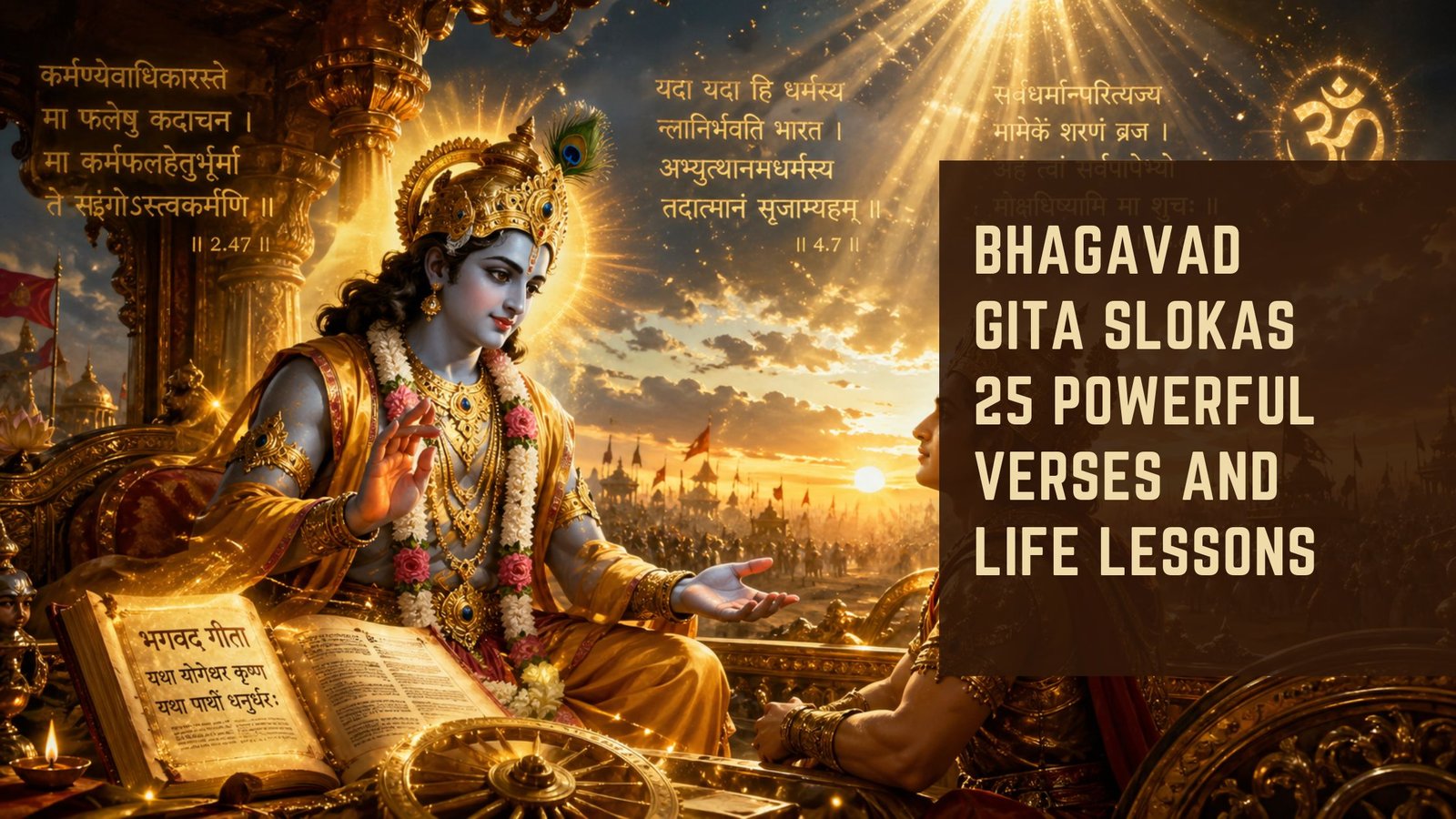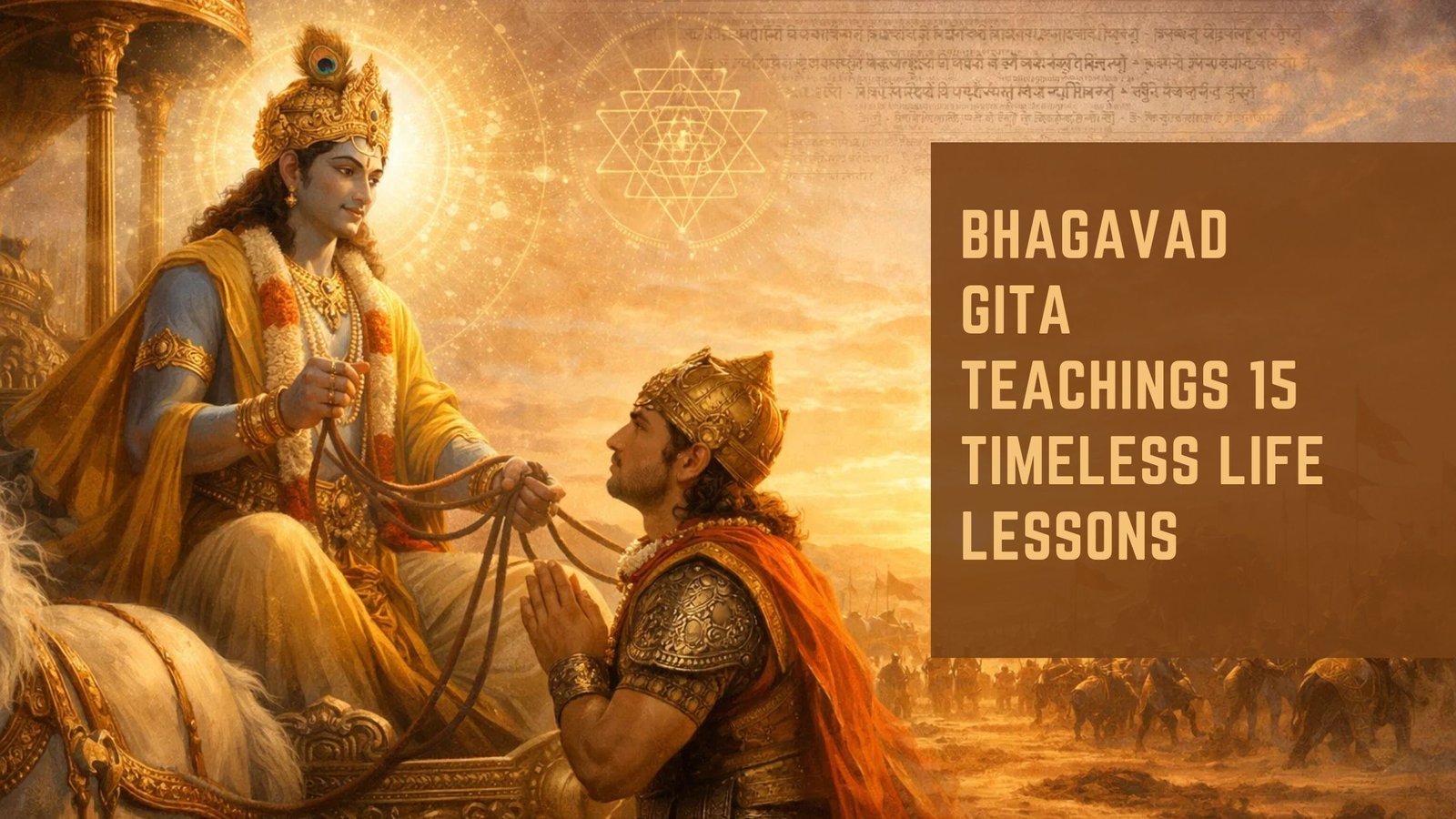
Bhagavad Gita teachings are not limited to religion or philosophy they are a complete manual for life. Spoken on the battlefield of Kurukshetra, the Gita captures a timeless dialogue between Lord Krishna and Arjuna, addressing fear, doubt, duty, purpose, and liberation.
In a moment of crisis, Arjuna represents every human mind confused, emotionally overwhelmed, and torn between duty and attachment. Krishna’s wisdom becomes universal guidance for anyone seeking clarity, peace, and right action in life.
This on-page guide explores 15 Bhagavad Gita teachings, supported by authentic quotes, explanations, modern relevance, and practical lessons making it a complete, SEO-optimized resource for seekers, students, and thinkers alike.
Table of Contents
Key Takeaways from Bhagavad Gita Teachings
- Life’s purpose is fulfilled through dharma (right duty)
- Action without attachment leads to freedom
- The soul is eternal, beyond birth and death
- True peace comes from inner discipline, not external success
- Devotion, knowledge, and action are equally powerful paths
- Self-awareness is the foundation of liberation
- Fear disappears when one understands the eternal Self
What Is the Bhagavad Gita?
The Bhagavad Gita is a 700-verse spiritual dialogue that forms part of the Mahabharata. It synthesizes karma yoga, bhakti yoga, jnana yoga, and dhyana yoga, offering a holistic path for human life.
Its teachings are not escapist they encourage living fully in the world while remaining inwardly free.
15 Bhagavad Gita Teachings Explained with Quotes & Lessons
1. Do Your Duty Without Attachment (Karma Yoga)
“You have the right to perform your prescribed duty, but not to the fruits of action.”
Bhagavad Gita 2.47
Lesson:
One of the most important Bhagavad Gita teachings is action without attachment. When you focus only on results, anxiety controls you. When you focus on effort, peace follows.
Modern relevance:
Work with excellence, but don’t let success or failure define your worth.
2. The Soul Is Eternal and Indestructible
“The soul is neither born nor does it ever die.”
Bhagavad Gita 2.20
Lesson:
The body changes, but the soul remains unchanged. Fear of death disappears when one understands this truth.
3. Control the Mind to Find Peace
“For one who has conquered the mind, the mind is the best of friends.”
Bhagavad Gita 6.6
Lesson:
Uncontrolled thoughts create suffering. Discipline of the mind brings freedom.
4. Detachment Leads to True Freedom
“Attachment leads to desire, desire leads to anger.”
Bhagavad Gita 2.62
Lesson:
Detachment does not mean renunciation of life—it means freedom from emotional slavery.
5. See the Same Divine in All Beings
“A wise person sees the same divine presence in all.”
Bhagavad Gita 5.18
Lesson:
This teaching promotes compassion, equality, and non-violence.
6. Devotion Is the Easiest Path (Bhakti Yoga)
“Offer Me your heart, and I shall deliver you.”
Bhagavad Gita 18.66
Lesson:
Surrender dissolves ego. Love becomes liberation.
7. Self-Knowledge Is Greater Than Ritual
“Knowledge is the purest form of wisdom.”
Bhagavad Gita 4.38
Lesson:
True spirituality begins with self-awareness, not external practices.
8. Balance Is Yoga
“Yoga is moderation in eating, sleeping, and working.”
Bhagavad Gita 6.17
Lesson:
Balance creates stability. Extremes lead to suffering.
9. Fear Comes from Identification with the Body
“The soul cannot be harmed by weapons.”
Bhagavad Gita 2.23
Lesson:
Fear dissolves when identity shifts from body to consciousness.
10. Desire Is the Root of Suffering
“It is desire, born of passion, that is the enemy.”
Bhagavad Gita 3.37
Lesson:
Uncontrolled desire chains the mind. Awareness breaks the chain.
11. Every Action Has Consequences
“As you sow, so shall you reap.”
Bhagavad Gita 4.17 (conceptual)
Lesson:
Responsibility for life rests in one’s own actions.
12. Meditation Leads to Inner Mastery
“Let the yogi remain steady in meditation.”
Bhagavad Gita 6.13
Lesson:
Meditation aligns mind, intellect, and soul.
13. Ego Is the Greatest Obstacle
“Ego binds the soul to suffering.”
Bhagavad Gita 3.27
Lesson:
Humility opens the door to wisdom.
14. True Renunciation Is Inner, Not External
“Renunciation is freedom from attachment.”
Bhagavad Gita 18.2
Lesson:
One can live in the world yet remain free.
15. Surrender Brings Liberation
“Abandon all varieties of dharma and surrender unto Me.”
Bhagavad Gita 18.66
Lesson:
Complete surrender ends struggle and begins grace.
Bhagavad Gita Teachings
| Teaching | Core Message | Chapter |
|---|---|---|
| Karma Yoga | Action without attachment | 2 |
| Eternal Soul | Immortality of Self | 2 |
| Mind Control | Inner mastery | 6 |
| Detachment | Freedom from desire | 2 |
| Bhakti | Power of devotion | 12 |
| Jnana | Wisdom over ritual | 4 |
| Surrender | Path to liberation | 18 |

Life Lessons from Bhagavad Gita Teachings
- Work sincerely, without anxiety
- Accept change as natural
- Develop inner discipline
- Practice compassion and humility
- Seek self-awareness over external validation
- Trust divine timing
- Balance material and spiritual life
Modern Relevance of Bhagavad Gita Teachings in Daily Life
The Bhagavad Gita teachings feel as if they were written for the modern mind. In an age of stress, competition, comparison, and constant pressure to succeed, the Gita reminds us that peace does not come from external achievement but from inner alignment. Whether it is workplace anxiety, relationship conflicts, or fear of failure, the Gita’s guidance on detached action, emotional balance, and self-discipline offers practical solutions. It teaches us how to remain calm in chaos and focused amid distractions skills that are essential in today’s fast-moving world.
Psychological Depth of Bhagavad Gita Teachings
Beyond spirituality, Bhagavad Gita teachings explore the deepest layers of human psychology. Concepts like desire, anger, attachment, fear, ego, and confusion are explained with remarkable clarity. The Gita does not suppress emotions; instead, it helps us understand their root causes. By observing the mind rather than reacting blindly, a person gains mastery over thoughts and impulses. This makes the Gita not only a spiritual scripture but also a timeless guide to emotional intelligence and mental resilience.
Why Bhagavad Gita Teachings Are a Lifelong Companion
The beauty of Bhagavad Gita teachings lies in their timeless adaptability. At different stages of life student, professional, seeker, or elder the same verses reveal new meanings. When ambition dominates, the Gita teaches balance. When loss strikes, it teaches impermanence. When ego rises, it teaches humility. This is why the Gita is not read once but lived repeatedly. Each reading deepens self-awareness and strengthens the connection between action, wisdom, and inner peace.
FAQs on Bhagavad Gita Teachings
Is Bhagavad Gita only for Hindus?
No. Bhagavad Gita teachings are universal and address human psychology, ethics, and consciousness.
Can Bhagavad Gita help with stress and anxiety?
Yes. Its teachings on detachment, meditation, and self-awareness are powerful tools for mental peace.
How can beginners start applying Gita teachings?
Start with karma yoga focus on effort, not outcome.
Is the Bhagavad Gita relevant in modern life?
More than ever. It addresses burnout, fear, ego, and purpose key challenges of modern society.
Conclusion
The Bhagavad Gita teachings are not theories they are lived wisdom. They guide action, calm the mind, awaken the soul, and align life with purpose. Whether you are facing confusion, ambition, loss, or success, the Gita offers clarity without judgment and strength without aggression.
In a noisy world, the Gita teaches silence.
In chaos, it teaches balance.
In fear, it teaches truth.
The Bhagavad Gita does not ask you to escape life it teaches you how to live it fully, consciously, and freely.
For more insights and life lessons from the Bhagavad Gita, you can explore resources like TheGita.in, a website that presents its timeless wisdom in a simple and relatable way.