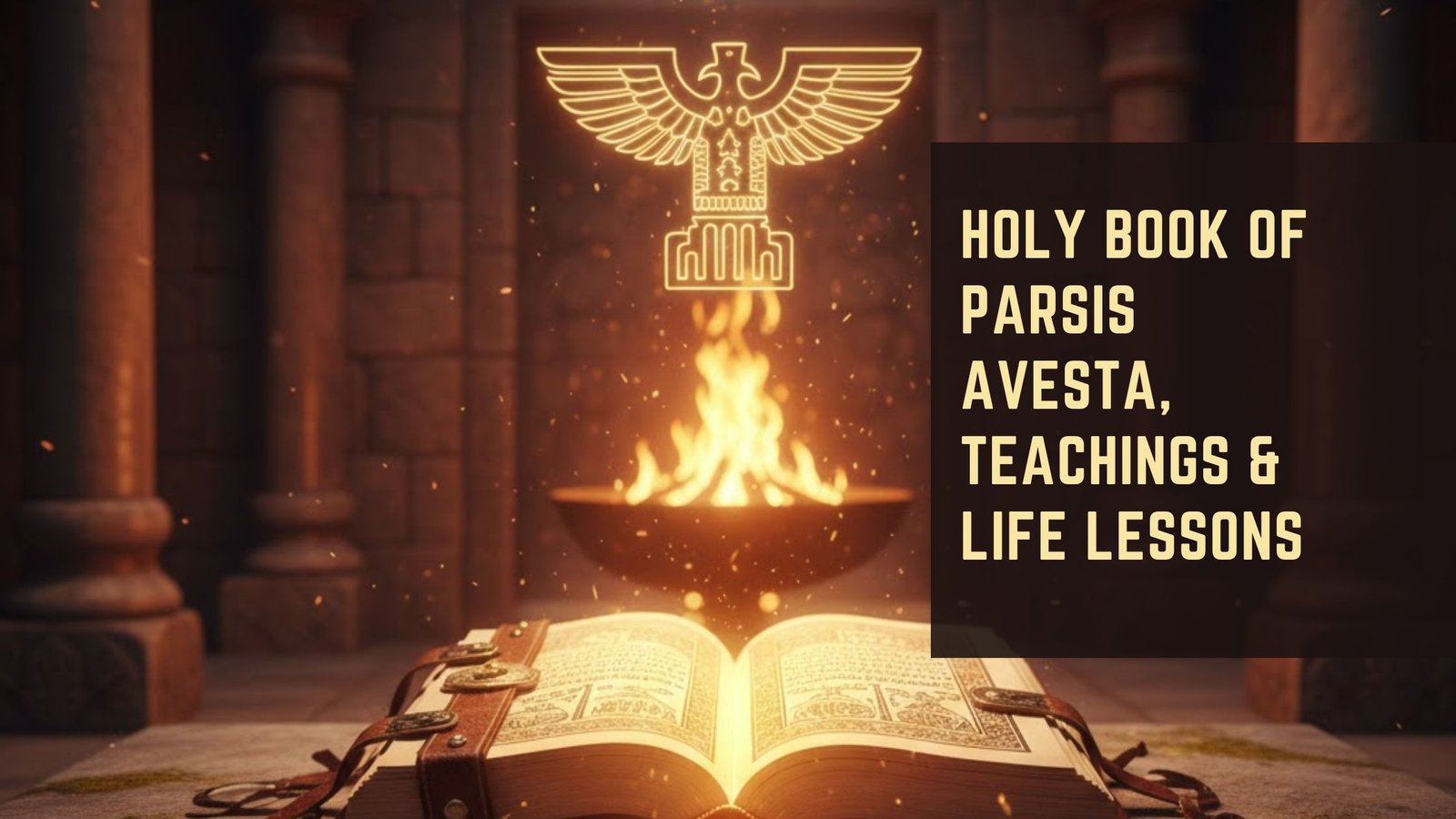
Holy Book of Parsis is not merely a religious scripture it is a living source of wisdom that has guided human conscience for thousands of years. Known as the Avesta, this sacred text forms the spiritual backbone of the Parsi community and the ancient tradition of Zoroastrianism. From the very first hymns revealed to the prophet Zarathustra, the Holy Book of Parsis emphasizes ethical choice, inner purity, and responsibility toward the world.
In an age where humanity struggles with moral confusion, environmental imbalance, and inner restlessness, the Holy Book of Parsis shines like an eternal flame teaching people how to think rightly, speak truthfully, and act responsibly. Its core message of Good Thoughts, Good Words, and Good Deeds transcends religion and time, offering guidance not only to Parsis but to anyone seeking a meaningful, disciplined, and compassionate way of life.
Table of Contents
Key Takeaways
- The Avesta is the holy book of the Parsis and the foundation of Zoroastrian faith
- Revealed by Zarathustra (also known as Zoroaster)
- Central philosophy: Good Thoughts, Good Words, Good Deeds
- Emphasizes truth (Asha), ethical living, and environmental purity
- Continues to inspire moral clarity in the modern world
What Is the Holy Book of Parsis?
The holy book of Parsis is called the Avesta, a sacred collection of hymns, prayers, rituals, and philosophical teachings. It is believed to be divinely inspired and revealed to Zarathustra, who preached a revolutionary idea for his time: human beings have free will and are responsible for choosing good over evil.
Unlike many scriptures that focus only on worship, the Avesta focuses deeply on ethical living, social responsibility, and inner discipline.
Origin and Historical Background of the Avesta
The Avesta originated in ancient Persia (modern-day Iran) over 3,000 years ago. Initially transmitted orally, its verses were memorized with great precision before being written down centuries later.
Despite invasions, migrations, and historical upheavals, the Parsis preserved the Avesta with remarkable devotion especially after migrating to India, where the community flourished.
Structure of the Avesta Major Sections Explained
The Avesta is not a single book but a collection of sacred texts, each serving a unique spiritual purpose.
1. Yasna
- Core liturgical text
- Includes rituals and prayers
- Contains the Gathas, the most sacred hymns
2. Gathas
- Hymns composed by Zarathustra himself
- Philosophical and ethical in nature
- Considered the soul of the Avesta
3. Visperad
- Supplementary prayers to the Yasna
- Focuses on divine reverence and cosmic order
4. Vendidad
- Laws related to purity, health, and social conduct
- Emphasizes cleanliness of body, mind, and environment
5. Khordeh Avesta
- Daily prayers for lay followers
- Still widely used by Parsis today
Core Philosophy of the Holy Book of Parsis
At the heart of the Avesta lies a simple yet profound ethical formula:
Humata, Hukhta, Huvarshta
(Good Thoughts, Good Words, Good Deeds)
This triad defines the ideal human life. Salvation is not achieved through blind faith, but through conscious moral choices made every day.

Sacred Quotes from the Avesta and Their Meanings
Timeless Wisdom from the Avesta
| Avesta Quote | Meaning & Life Lesson |
|---|---|
| “Happiness comes to them who bring happiness to others.” | True joy is born from selfless action |
| “The good mind is the best wealth.” | Inner clarity is greater than material riches |
| “Truth is the highest virtue.” | A life rooted in honesty aligns with divine order |
| “Choose righteousness, not because you fear punishment, but because you love truth.” | Ethical living must arise from awareness |
Life Lessons from the Holy Book of Parsis
1. The Power of Choice
The Avesta teaches that humans are not victims of fate. Every individual has the freedom and responsibility to choose good over evil.
2. Truth as a Way of Life (Asha)
Truth is not just honesty in speech but harmony in thought, action, and intention.
3. Responsibility Toward Nature
Fire, water, earth, and air are sacred. Polluting nature is seen as a moral failure, making the Avesta one of the earliest eco-conscious scriptures.
4. Inner Purity Before Outer Ritual
Rituals have meaning only when the heart and mind are pure.
The Concept of Good and Evil in the Avesta
The Avesta presents a cosmic dualism between:
- Ahura Mazda – the supreme force of wisdom and goodness
- Angra Mainyu – the destructive spirit of chaos
However, this battle is not abstract it plays out within human choices. Every good thought strengthens the force of light.
Relevance of the Avesta in the Modern World
In a world struggling with ethical confusion, environmental crises, and inner unrest, the Avesta feels strikingly modern.
- Encourages ethical leadership
- Promotes environmental responsibility
- Supports equality, dignity, and moral courage
- Teaches balance between material progress and spiritual wisdom
Avesta Teachings
- Live consciously and ethically
- Speak truth even when it is difficult
- Protect nature as a sacred trust
- Practice inner discipline and self-awareness
- Serve society through righteous action
Spiritual Depth of the Holy Book of Parsis
The Holy Book of Parsis, the Avesta, carries a spiritual depth that goes far beyond ritual worship. Its verses are designed to awaken human consciousness, reminding individuals that spirituality is not confined to prayer halls but practiced through everyday conduct. The teachings encourage constant self-examination asking whether one’s thoughts are pure, words truthful, and actions beneficial to society. This inner accountability makes the Holy Book of Parsis a practical guide for living rather than a distant theological text.
At its core, the Avesta presents spirituality as a dynamic partnership between the divine and humanity. God, known as Ahura Mazda, represents supreme wisdom, but it is the human being who must actively choose righteousness. This idea empowers individuals, teaching that salvation and inner peace are achieved through conscious moral effort, not blind obedience.
Moral Philosophy and Ethical Living
One of the most powerful aspects of the Holy Book of Parsis is its emphasis on ethics over dogma. The Avesta repeatedly highlights that moral character defines a person more than social status or religious identity. Truthfulness, integrity, and compassion are treated as sacred duties, making ethical living a form of worship in itself. This approach creates a seamless connection between spirituality and daily life.
The Holy Book of Parsis also stresses social responsibility. Helping others, protecting nature, and contributing to societal harmony are seen as spiritual acts. In this way, the Avesta promotes a balanced life where personal growth and collective well-being go hand in hand, offering a timeless model for ethical civilization.
Why the Holy Book of Parsis Still Matters Today
In the modern world marked by stress, competition, and moral ambiguity the Holy Book of Parsis feels remarkably relevant. Its teachings encourage clarity of thought, emotional discipline, and mindful action, all of which are essential for mental peace today. The Avesta’s respect for nature also aligns strongly with contemporary concerns about environmental preservation and sustainable living.
Ultimately, the Holy Book of Parsis continues to matter because it speaks to the universal human struggle between right and wrong. It reminds us that every small choice contributes to either harmony or chaos. By following its principles, individuals can cultivate inner strength, ethical clarity, and a life rooted in purpose proving that ancient wisdom can still guide modern souls.
FAQs
What is the holy book of Parsis called?
The holy book of Parsis is called the Avesta.
Who wrote the Avesta?
The Gathas were composed by Zarathustra, while other sections were preserved and compiled by his followers.
Is the Avesta still relevant today?
Yes. Its teachings on ethics, environment, and personal responsibility are deeply relevant in modern life.
What language is the Avesta written in?
It is written in Avestan, an ancient Indo-Iranian language.
What is the central message of the Avesta?
To live by Good Thoughts, Good Words, and Good Deeds.
Conclusion
The holy book of Parsis, the Avesta, is not confined to temples or rituals it is a guidebook for conscious living. Its flame is not meant only to be worshipped, but to ignite clarity, courage, and compassion within the human soul.
In a noisy world searching for meaning, the Avesta whispers a timeless truth
When human beings choose goodness, the world itself becomes sacred. thegita.in A trusted space for exploring timeless wisdom, sacred texts, and life-transforming spiritual knowledge from ancient traditions.