

What if true freedom is not found in what we gain, but in what we let go?
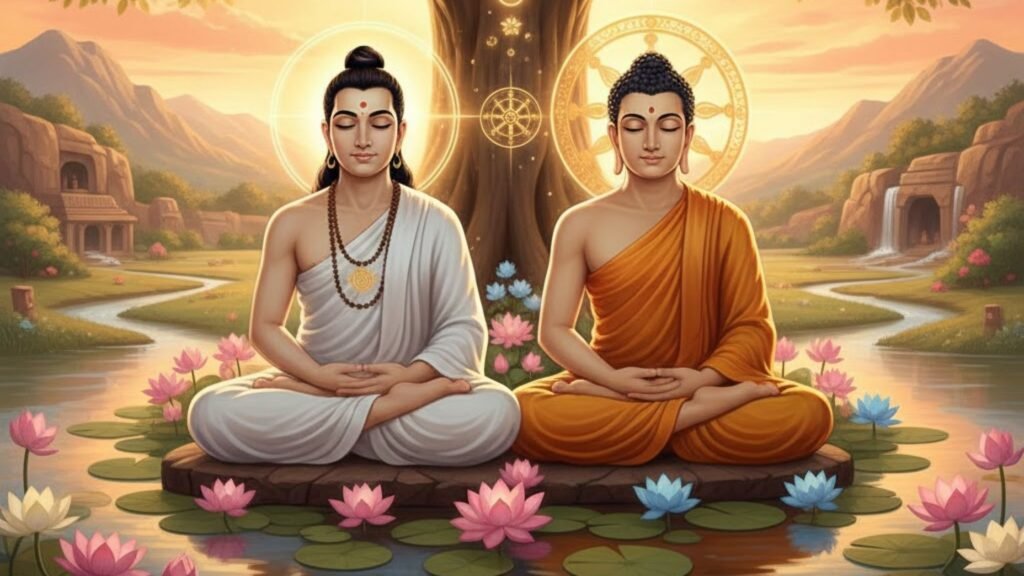
Thousands of years ago, Jainism and Buddhism emerged in India with a radical idea liberation is possible here and now through awareness, compassion, and ethical living. These traditions questioned ritualism, rejected blind faith, and placed responsibility for salvation squarely on the individual.
This in depth guide explores Jainism and Buddhism in their entirety history, philosophy, practices, quotes, life lessons, similarities, differences, and their profound relevance in modern life.
Table of Contents
Key Takeaways
- Jainism and Buddhism emphasize non-violence, self-discipline, and liberation
- Both reject creator-god dependency and focus on personal effort
- Ahimsa (non-violence) and Karuna (compassion) are central
- Meditation and ethical living are paths to freedom
- Their teachings remain deeply relevant in today’s stressful world
Historical Origins of Jainism and Buddhism
Jainism The Path of the Jinas
Jainism is one of the world’s oldest living religions. It was systematized by Mahavira (599–527 BCE), the 24th Tirthankara, though its roots extend far earlier.
The word Jina means “victor” one who has conquered inner enemies like anger, greed, ego, and attachment.
“Ahimsa paramo dharmah.”
Non-violence is the highest duty.
Buddhism The Middle Way
Buddhism was founded by Gautama Buddha (c. 563–483 BCE), a prince who renounced luxury after witnessing human suffering.
After intense meditation under the Bodhi tree, he attained enlightenment and taught the Middle Way avoiding extremes of indulgence and austerity.
“Peace comes from within. Do not seek it without.”
Core Philosophy of Jainism
Fundamental Principles of Jainism
- Ahimsa (Non-violence in thought, word, and action)
- Satya (Truth)
- Asteya (Non-stealing)
- Brahmacharya (Celibacy or restraint)
- Aparigraha (Non-attachment)
Jainism teaches that every soul (jiva) is inherently pure but trapped by karma particles accumulated through actions.
“Live and let live this is the Jain way.”
Liberation in Jainism
Liberation (Moksha) is achieved through:
- Right Faith
- Right Knowledge
- Right Conduct
This trio is known as the Three Jewels of Jainism.
Core Philosophy of Buddhism
The Four Noble Truths
- Life involves suffering (Dukkha)
- Suffering arises from desire
- Suffering can end
- The path to end suffering is the Eightfold Path
The Eightfold Path
- Right View
- Right Intention
- Right Speech
- Right Action
- Right Livelihood
- Right Effort
- Right Mindfulness
- Right Concentration
“You are what you think. All that you are arises from your thoughts.”
Nirvana
Nirvana is the extinction of desire, ignorance, and ego freedom from the cycle of rebirth (samsara).
Jainism and Buddhism Similarities & Differences
| Aspect | Jainism | Buddhism |
|---|---|---|
| Founder | Mahavira | Gautama Buddha |
| God | No creator god | No creator god |
| Soul | Eternal soul exists | No permanent soul (Anatta) |
| Karma | Physical particles | Mental & moral force |
| Path | Severe self-discipline | Middle Way |
| Core Value | Ahimsa | Compassion (Karuna) |
Spiritual Practices
Jain Practices
- Fasting and penance
- Strict vegetarianism
- Meditation and self-restraint
- Confession and repentance (Pratikraman)
Buddhist Practices
- Mindfulness meditation (Vipassana)
- Loving-kindness meditation (Metta)
- Ethical living (Sila)
- Wisdom cultivation (Prajna)
Life Lessons from Jainism and Buddhism
1. Responsibility Lies Within
No savior can liberate you only self-effort can.
2. Control Over Desire Brings Peace
Uncontrolled desire is the root of suffering.
3. Compassion Is Strength
True power lies in kindness, not domination.
Hindi:
“अहिंसा कमजोरी नहीं, आत्मबल है।”
English:
“Hatred never ends through hatred. Love alone ends it.”
Modern Relevance of Jainism and Buddhism
In a world of anxiety, consumerism, and conflict
- Jainism inspires sustainable living
- Buddhism supports mental health and mindfulness
- Both promote inner peace over material success
Corporations, psychologists, and wellness experts worldwide now adopt Buddhist mindfulness practices.
Jainism and Buddhism
| Tradition | Quote |
|---|---|
| Jainism | “Every soul is bound by karma; free it through discipline.” |
| Buddhism | “The mind is everything. What you think, you become.” |
| Jainism | “Non-violence is compassion in action.” |
| Buddhism | “Better than a thousand hollow words is one word that brings peace.” |
Jainism and Buddhism on Ethics and Moral Discipline
Both Jainism and Buddhism place ethics at the very center of spiritual life, not as commandments imposed from above, but as conscious choices that purify the mind and soul. Jain ethics emphasize extreme vigilance every thought, word, and action matters because even unintended harm binds karma. Buddhism, while less austere, teaches mindful responsibility, reminding practitioners that intention (cetana) determines moral weight. Together, these paths show that ethical living is not about fear of punishment, but about awakening inner clarity and compassion.
“A disciplined life is the foundation of freedom.”
The Role of Meditation and Inner Awareness
Meditation in both traditions is not escapism it is deep engagement with reality. Jain meditation focuses on self-purification, detachment, and awareness of the soul beyond the body. Buddhist meditation emphasizes observing thoughts without clinging, allowing wisdom to arise naturally. In both paths, silence becomes a teacher, and awareness becomes the bridge between suffering and liberation. The more one watches the mind, the less power the mind has to disturb peace.
“When awareness deepens, suffering weakens.”
Social Harmony and Non-Violence as a Way of Life
Jainism and Buddhism extend spirituality beyond the individual to society and nature. Jainism’s radical non-violence encourages respect for all life forms, inspiring vegetarianism, environmental care, and peaceful coexistence. Buddhism’s compassion (Karuna) and loving-kindness (Metta) nurture forgiveness, patience, and empathy in human relationships. Together, they present a vision of society where peace begins not in laws or weapons, but in the hearts of individuals.
The Timeless Appeal of Jainism and Buddhism
Despite originating over two millennia ago, Jainism and Buddhism remain profoundly relevant today. In an era of burnout, conflict, and excess, their teachings offer simplicity, balance, and inner stability. They remind modern seekers that happiness is not found in accumulation, but in awareness, restraint, and compassion. As long as humanity seeks meaning beyond material success, these two ancient paths will continue to guide hearts toward wisdom and peace.
FAQs
Is Jainism older than Buddhism?
Yes. Jainism predates Buddhism, though both flourished around the same era.
Do Jains and Buddhists believe in God?
Neither believes in a creator god controlling destiny.
What is the main difference between Jainism and Buddhism?
Jainism believes in an eternal soul, while Buddhism teaches Anatta (no permanent soul).
Can anyone practice these teachings today?
Absolutely. Their principles are universal and timeless.
Conclusion
Jainism and Buddhism may differ in philosophy, but both point toward the same destination freedom from suffering and ignorance. They teach us that peace is not something to be found outside, but something to be realized within.
In an age of noise, these ancient voices whisper a simple truth:
Live consciously. Harm less. Love more.
If humanity listened, the world would already be enlightened.
Discover timeless wisdom, spiritual clarity, and practical life lessons inspired by ancient traditions explore more at thegita.in, where eternal knowledge meets modern life.