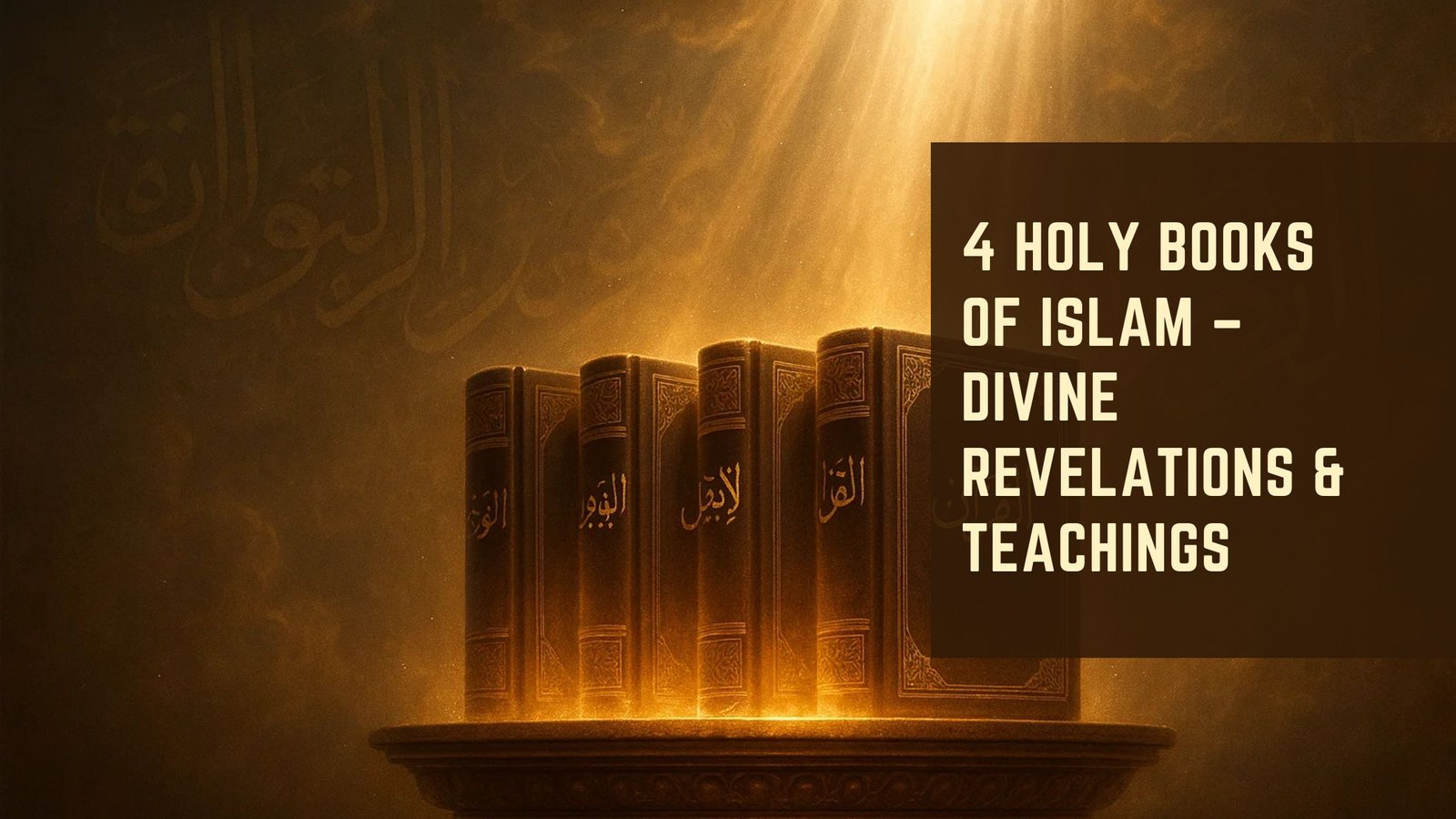
Islam is a faith deeply rooted in divine guidance and revelation. At the heart of Islamic belief lies the concept that Allah (God) has sent guidance to humanity through chosen prophets and sacred scriptures. Among these divine scriptures are the 4 holy books of Islam—each revealed to a prophet at a different time to guide people according to their era and circumstances. These books are: Tawrat, Zabur, Injil, and the final and complete revelation, the Qur’an.
These 4 holy books of Islam form the spiritual backbone of Islamic belief. They represent Allah’s continuous mercy toward humanity and His desire to guide people toward truth, morality, justice, and salvation.
“He has sent down upon you the Book in truth, confirming what was before it. And He revealed the Torah and the Gospel before, as guidance for mankind.”
— Qur’an 3:3
This verse itself confirms the divine origin of earlier scriptures and their connection with the final revelation.
Table of Contents
Understanding the Concept of Divine Books in Islam
In Islam, belief in all 4 holy books of Islam is a fundamental article of faith. A Muslim must believe not only in the Qur’an but also in the original revelations of Tawrat, Zabur, and Injil in their original, unaltered form. These 4 holy books of Islam were all revealed by the same God and carried the same core message: the Oneness of Allah, righteous living, and accountability in the Hereafter.
Each holy book was revealed:
- To a specific prophet
- For a specific community
- According to the needs of that time
However, the Qur’an is considered universal and final, meant for all of humanity until the end of time.
1. Tawrat (Torah) – The Book Given to Prophet Musa
Revelation and Historical Background
The Tawrat was revealed to Prophet Musa (Moses), a mighty messenger of Allah sent to the Children of Israel. The Torah was revealed on Mount Sinai and contained divine laws, commandments, and guidance for the Israelites.
The Tawrat addressed social justice, monotheism, moral discipline, and legal rulings. It was a comprehensive guide for a nation that had just been freed from oppression.
“And We wrote for him on the Tablets instruction about everything and an explanation for all things.”
— Qur’an 7:145
This verse confirms that the Tawrat was a complete divine guidance for its time.
Core Teachings of the Tawrat
- Oneness of Allah
- Commandments for moral living
- Prohibition of injustice and oppression
- Social responsibility
- Accountability before God
Spiritual Lessons from the Tawrat
- Obedience to divine law leads to collective success.
- Arrogance and rebellion result in downfall.
- Faith must be supported by righteous action.
Although the original Tawrat was divine, Muslims believe that over time it was altered by human hands. Therefore, the Qur’an serves as the final preserved criterion. Dive deep into sacred wisdom with our detailed Verse Explanation of divine revelations and timeless spiritual teachings.
2. Zabur (Psalms) – The Book Given to Prophet Dawud
Revelation and Nature of the Zabur
The Zabur was revealed to Prophet Dawud (David). Unlike the Tawrat, which focused heavily on law, the Zabur was a collection of spiritual hymns, prayers, and praises of Allah. It emphasized love, repentance, humility, and remembrance of God.
“And to Dawud We gave the Zabur.”
— Qur’an 4:163
The Zabur was not a book of legal rulings but a spiritual guide meant to purify hearts.
Main Themes of the Zabur
- Praise and glorification of Allah
- Supplication and repentance
- Trust in divine mercy
- Victory of truth over falsehood
- Patience in hardship
Key Lessons from the Zabur
- Spiritual closeness to Allah transforms the heart.
- True strength lies in humility.
- Remembering God brings inner peace.
The Zabur reflects the emotional and spiritual dimension of divine revelation and remains a powerful reminder of the beauty of worship.
3. Injil (Gospel) – The Book Given to Prophet Isa
Revelation and Purpose of the Injil
The Injil was revealed to Prophet Isa (Jesus) as a continuation of divine guidance for the Children of Israel. The Injil emphasized compassion, mercy, forgiveness, and spiritual purification.
“And We gave him the Gospel, in which was guidance and light.”
— Qur’an 5:46
The Injil served as a revival of true faith when earlier teachings had been corrupted or forgotten.
Central Teachings of the Injil
- Worship of One God
- Love and mercy
- Forgiveness and humility
- Detachment from worldly arrogance
- Preparation for the Hereafter
Spiritual Lessons from the Injil
- Mercy elevates the soul.
- Love for humanity is a sign of true faith.
- Materialism blinds the heart.
- True success lies in spiritual purity.
Islam teaches that the original Injil was a divine revelation, but what exists today has undergone human alterations. Muslims still deeply respect Prophet Isa as a great messenger of Allah.
4. Qur’an – The Final and Complete Book of Guidance
Revelation and Preservation of the Qur’an
The Qur’an is the final and complete revelation of Allah, sent to Prophet Muhammad ﷺ over a period of 23 years through the angel Jibreel (Gabriel). Unlike previous scriptures, the Qur’an is preserved word-for-word in its original form.
“Indeed, We have sent down the Qur’an, and surely We will guard it.”
— Qur’an 15:9
This divine promise makes the Qur’an unique among all sacred scriptures.
Core Teachings of the Qur’an
- Absolute Oneness of Allah (Tawheed)
- Guidance for personal and social life
- Moral ethics and justice
- Worship, prayer, fasting, charity
- Law, economics, family life
- Accountability in the Hereafter
Universal Message of the Qur’an
The Qur’an is not limited to one nation or time. It is a universal manual for humanity, addressing every aspect of human life—spiritual, moral, social, and legal.
Life Lessons from the Qur’an
- Patience brings divine reward.
- Gratitude increases blessings.
- Justice ensures peace.
- Faith gives purpose.
- Knowledge elevates humanity.
“This Qur’an guides to what is most upright.”
— Qur’an 17:9
Comparative Overview of the 4 Holy Books of Islam
| Holy Book | Prophet | Community | Primary Focus | Present Status |
|---|---|---|---|---|
| Tawrat | Musa (AS) | Israelites | Law & Justice | Altered |
| Zabur | Dawud (AS) | Israelites | Worship & Praise | Altered |
| Injil | Isa (AS) | Israelites | Mercy & Spirituality | Altered |
| Qur’an | Muhammad ﷺ | All Humanity | Complete Guidance | Preserved |
Why Muslims Believe in All Four Holy Books
Belief in all divine books is part of Iman (faith) in Islam. Denying any one of these books is considered a rejection of faith. Muslims believe that:
- All books came from the same God
- All prophets taught the same core message
- Differences occurred due to human interference
- The Qur’an confirms and protects the original message of all scriptures

Deep Spiritual Impact of the Holy Books
The holy books were not merely historical documents; they were spiritual revolutions. Each book revived faith, corrected moral corruption, and reconnected humanity with God. Their collective purpose was to:
- Establish divine consciousness
- Promote justice
- Purify hearts
- Prepare humanity for the Day of Judgment
Importance of the 4 Holy Books of Islam in Islamic Faith
The 4 Holy Books of Islam are the foundation of divine guidance in Islamic belief. These 4 Holy Books of Islam include the Tawrat, Zabur, Injil, and the Qur’an, all revealed by Allah to different prophets for the spiritual upliftment of humanity. Belief in the 4 Holy Books of Islam is an essential pillar of faith, and denying any of the 4 Holy Books of Islam is considered a rejection of true belief. Each of the 4 Holy Books of Islam was revealed in a specific era to guide a particular community, yet all the 4 Holy Books of Islam delivered the same core message—belief in One God, righteousness, justice, and accountability in the Hereafter.
Spiritual Teachings and Universal Message of the 4 Holy Books of Islam
The spiritual teachings of the 4 Holy Books of Islam focus on purification of the soul, moral discipline, obedience to Allah, and preparation for the life after death. The 4 Holy Books of Islam teach that worldly success without faith is meaningless and that true success lies in sincere worship. Through the 4 Holy Books of Islam, Allah sent laws, wisdom, prayers, mercy, and finally complete guidance through the Qur’an. The 4 Holy Books of Islam emphasize justice, patience, gratitude, humility, and compassion as the core qualities of a believer. Even today, the message of the 4 Holy Books of Islam continues to guide millions of hearts toward truth, peace, and divine consciousness.
FAQs
1. How many holy books are there in Islam?
Islam officially recognizes four major divine books: Tawrat, Zabur, Injil, and Qur’an. However, many other scriptures were also revealed to earlier prophets.
2. Are the Bible and Torah the same as Tawrat and Injil?
Muslims believe that the original Tawrat and Injil were divine, but the current versions of the Torah and Bible contain human alterations and additions.
3. Why is the Qur’an considered final?
Because Prophet Muhammad ﷺ is the final messenger and the Qur’an is preserved perfectly by divine promise.
4. Do Muslims respect Prophet Jesus and Moses?
Yes. Muslims deeply respect Musa (Moses) and Isa (Jesus) as great prophets of Allah.
5. Is it mandatory for Muslims to believe in previous books?
Yes. Belief in all divine scriptures is a fundamental pillar of Islamic faith.
Conclusion
The four holy books of Islam represent a continuous chain of divine guidance sent to humanity through different prophets across different eras. Each book had a specific mission for a specific people, yet all carried the same eternal truth: belief in One God and righteous living.
The Tawrat established law, the Zabur nurtured the soul, the Injil revived compassion, and the Qur’an perfected divine guidance for all of humanity. Together, they reflect Allah’s endless mercy and His desire for human salvation.
The Qur’an stands as the final guardian of all past revelations, preserving the original message and protecting it for future generations. Through these sacred books, Islam teaches that divine guidance was never limited to one nation or one time—it is a universal gift for all who seek truth.
“And your Lord is not unaware of what they do.”
— Qur’an 6:132
Discover more divine wisdom and spiritual teachings only on TheGita.in — your trusted source for timeless truth and inner awakening.