The Bhagavad Gita Chapter 4, known as Jnana Karma Sanyasa Yoga, is one of the most spiritually profound chapters of the entire scripture. In this chapter, Lord Krishna reveals the eternal science of divine knowledge, the philosophy of selfless action, and the mystery of true renunciation. This chapter beautifully bridges karma (action), jnana (knowledge), and bhakti (devotion) into a single spiritual path.
It teaches us how to live in the world without being bound by the world, how to work without ego, and how knowledge alone burns the bondage of karma.
Table of Contents
Meaning of Jnana Karma Sanyasa Yoga
- Jnana means divine knowledge or wisdom
- Karma means action
- Sanyasa means renunciation
- Yoga means union with the Divine
So, Jnana Karma Sanyasa Yoga means renunciation through the wisdom of selfless action. It does not teach abandonment of work but renunciation of attachment to the fruits of work.
The Divine Lineage of the Gita’s Knowledge
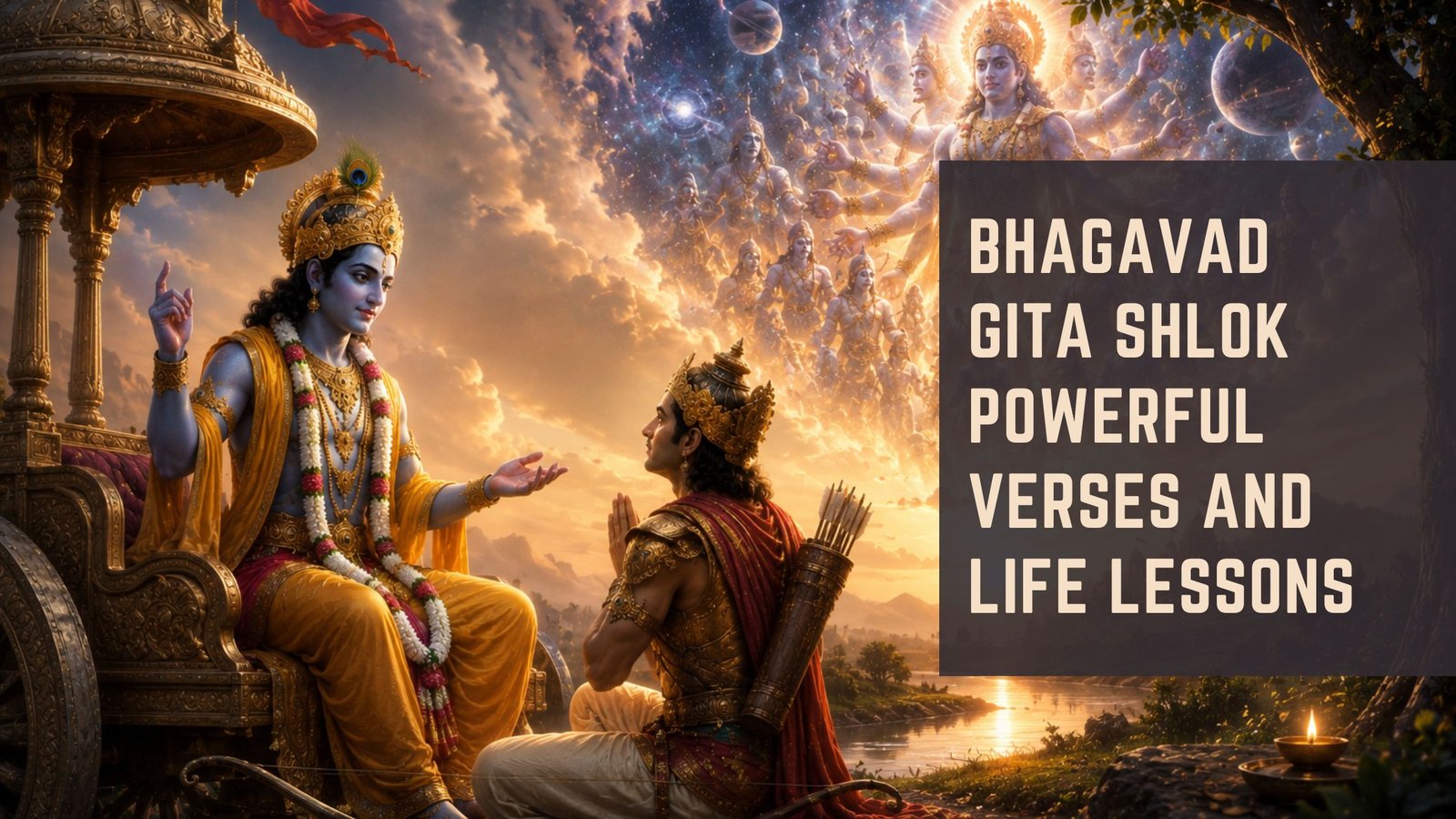
Lord Krishna begins this chapter by revealing that the knowledge of the Gita is eternal, passed from the Supreme to the Sun God, from the Sun God to Manu, and from Manu to Ikshvaku.
“इमं विवस्वते योगं प्रोक्तवानहमव्ययम्।”
“I instructed this imperishable yoga to the Sun God.” – Gita 4.1
This establishes that the Gita is not modern philosophy but eternal spiritual science meant for all eras.
Why Krishna Took Birth Despite Being Divine
A powerful truth is revealed in this chapter:
Even though Lord Krishna is unborn and imperishable, He takes birth to restore righteousness (Dharma).
“यदा यदा हि धर्मस्य ग्लानिर्भवति भारत…”
“Whenever righteousness declines and unrighteousness rises, I manifest Myself.” – Gita 4.7
This verse assures humanity that Divine guidance always returns when darkness increases.
Spiritual Insight:
God does not abandon the world. Divine grace descends repeatedly to protect the righteous.
The Mystery of Divine Birth and Action
Krishna explains that ordinary birth binds the soul, while His divine birth liberates those who understand it spiritually.
“One who knows the divine nature of My birth and actions is freed from rebirth.”
Understanding the spiritual truth of God’s incarnation leads to liberation.

The Secret of Action and Inaction
One of the most subtle teachings of this chapter is the paradox of action and inaction.
“He who sees inaction in action and action in inaction is truly wise.”
This means:
- A self-realized person remains inwardly still even while acting
- An ignorant person remains bound even while appearing inactive
True action is free from ego and desire.
Different Paths of Sacrifice Explained
Krishna presents multiple types of Yajna (sacrifice):
- Sacrifice through self-control
- Sacrifice through breath control (pranayama)
- Sacrifice through material offering
- Sacrifice through knowledge
“The sacrifice of knowledge is greater than any material sacrifice.”
This shows that spiritual wisdom is the highest offering humans can give to the Divine.
The Supreme Power of Knowledge
Knowledge is described as the ultimate purifier:
“Just as fire burns fuel to ashes, so does knowledge burn all karmic reactions.”
True spiritual knowledge:
- Destroys ignorance
- Frees from past karmas
- Leads to inner peace
- Establishes eternal bliss
Faith as the Gate to Knowledge
Without faith, knowledge cannot be realized:
“The man of faith attains knowledge and, having attained it, soon attains supreme peace.”
Faith is not blind belief—it is deep inner conviction born of sincerity.
Who is a True Renunciate?
Krishna makes a revolutionary statement:
A person who does his duty without attachment is the true sanyasi (renunciate), even if living an active life.
Renunciation is not external abandonment, but internal detachment.
Role of the Spiritual Teacher
Krishna emphasizes the importance of a true spiritual master:
“Approach a self-realized soul with humility, inquiry, and service. He will impart knowledge to you.”
Without a Guru:
- Knowledge becomes incomplete
- Spiritual life becomes confusing
- Ego remains dominant
Freedom from Doubt
Doubt is described as the deadliest enemy of spiritual growth:
“The doubting soul neither attains this world nor the next.”
Action combined with knowledge destroys doubt and ignorance simultaneously.
Key Life Lessons from Bhagavad Gita Chapter 4
1. Knowledge is the highest purifier
Spiritual ignorance is the root of all suffering.
2. Action without attachment leads to freedom
Work becomes worship when ego disappears.
3. God intervenes whenever righteousness declines
Divine grace is always active in human history.
4. Faith is essential for spiritual progress
Without faith, even truth remains unreachable.
5. A true renunciate is one who is inwardly detached
One can live fully in the world and still be liberated.
Modern Relevance of Chapter 4
In today’s world:
- People are lost in material pursuits
- Ego controls most decisions
- Stress arises from desire for results
Chapter 4 teaches:
- Work with excellence but surrender results
- Replace fear with faith
- Replace ego with service
This chapter is extremely relevant for:
- Professionals
- Students
- Leaders
- Seekers
- Household practitioners
Selected Powerful Quotes from Chapter 4
- “Whenever righteousness declines, I manifest Myself.”
- “Knowledge burns all karma to ashes.”
- “One who sees inaction in action is truly wise.”
- “Sacrifice of knowledge is superior to all sacrifices.”
- “The man of faith attains supreme peace.”
Each of these verses contains lifelong wisdom compressed into a single sentence.
Spiritual Psychology of Chapter 4
Chapter 4 addresses:
- The illusion of doership
- The psychology of desire
- The conflict between duty and ego
- The liberating force of awareness
It explains that suffering does not arise from work—it arises from attachment to the results of work.
Chapter 4 and Liberation
Moksha is attained not through:
- Running away from life
- Abandoning responsibilities
But through:
- Selfless action
- Divine knowledge
- Faith and surrender
- Guidance of a Guru
This chapter builds the foundation of spiritual freedom while living an active life.
Bhagavad Gita Chapter 4 and the Eternal Science of Knowledge
Bhagavad Gita Chapter 4 reveals the eternal science of divine knowledge that has been passed from generation to generation by the Supreme Himself. In Bhagavad Gita Chapter 4, Lord Krishna explains that true spiritual wisdom is timeless and independent of age or era. The teachings of Bhagavad Gita Chapter 4 establish that knowledge is not created by humans but is revealed by the Divine whenever humanity loses its moral direction. By understanding Bhagavad Gita Chapter 4, a seeker learns that ignorance is the real cause of bondage and knowledge is the only true path to liberation.
Bhagavad Gita Chapter 4 on Action, Inaction, and True Renunciation
One of the deepest teachings of Bhagavad Gita Chapter 4 is the mysterious relationship between action and inaction. Bhagavad Gita Chapter 4 explains that the person who performs action without attachment is actually inactive in the karmic sense. The philosophy of Bhagavad Gita Chapter 4 removes the misconception that renunciation means abandoning work. Instead, Bhagavad Gita Chapter 4 establishes that true renunciation is the renunciation of ego, desire, and ownership over results while remaining fully devoted to righteous action.
Bhagavad Gita Chapter 4 and the Supreme Power of Spiritual Knowledge
The most powerful message of Bhagavad Gita Chapter 4 is that knowledge burns all past karma just as fire reduces wood to ashes. According to Bhagavad Gita Chapter 4, no purifier in this world is as powerful as true spiritual knowledge. Faith, surrender, and disciplined action together awaken the wisdom described in Bhagavad Gita Chapter 4. When faith matures into realization, Bhagavad Gita Chapter 4 assures that the seeker attains supreme peace and freedom from the cycle of birth and death.
FAQs
Q1. What is the core message of Bhagavad Gita Chapter 4?
The core message is liberation through knowledge combined with selfless action.
Q2. Why does Krishna take birth if He is divine?
He incarnates to restore Dharma and guide humanity during moral decline.
Q3. What is true renunciation according to Chapter 4?
True renunciation is renouncing ego and attachment, not action.
Q4. Is knowledge alone sufficient for liberation?
No. Knowledge must be supported by faith, action, and surrender.
Q5. How is Chapter 4 related to daily life?
It teaches how to work without stress, fear, or bondage.
Conclusion
Bhagavad Gita Chapter 4 stands as a timeless spiritual lighthouse for humanity. It teaches that knowledge liberated through selfless action is the highest path of evolution. This chapter proves that one can live actively in the world and yet remain untouched by suffering.
Krishna’s message is simple yet profound:
You are not the doer.
You are not the enjoyer.
You are the eternal witness.
When action flows through wisdom, life becomes divine worship. When knowledge destroys ignorance, the soul returns to its natural state of peace.
Chapter 4 does not teach escape from life—it teaches mastery of life. Discover timeless wisdom and divine guidance only on The Gita — where sacred knowledge meets daily life.