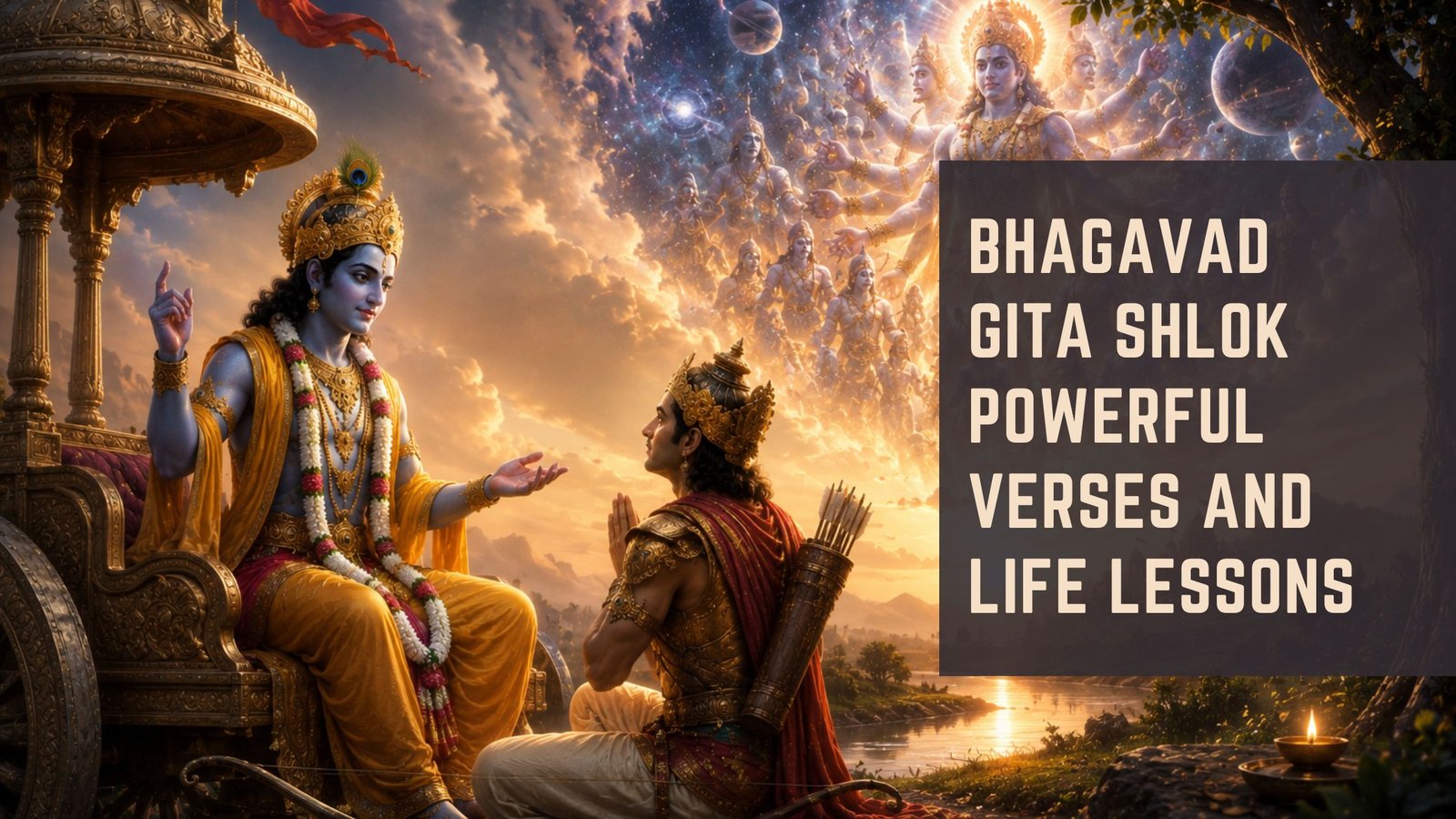
Bhagavad Gita Chapter 15, known as Purushottama Yoga, is one of the most profound chapters of the entire scripture. It reveals the ultimate nature of the Supreme Being and explains the bond between the eternal soul and the temporary world. This chapter is only 20 verses long, yet it contains the depth of the entire Gita.
This chapter unveils the cosmic symbolism, the purpose of human birth, the nature of Maya, and the path to liberation. It helps a seeker understand Who am I?, What is the world?, and Who is the Supreme Purusha?
Let’s explore this chapter in full depth.
Table of Contents
Chapter Introduction: What is Purushottama Yoga?
Purushottama Yoga means:
“The Yoga of the Supreme Divine Personality.”
In this chapter, Krishna explains three essential concepts:
- Kshara Purusha – the perishable, changing world
- Akshara Purusha – the imperishable soul
- Purushottama – the Supreme Being beyond both
This chapter establishes Krishna as Purushottama, the highest reality.
The Inverted Tree – Symbol of Samsara
One of the most powerful images of this chapter is the upside-down Ashvattha tree.
The Meaning of the Inverted Tree
Krishna says:
“ऊर्ध्वमूलमधःशाखम्…” (15.1)
“This world is like an upside-down tree, roots above, branches below.”
This tree represents Samsara — the cycle of birth and death.
Symbolic Interpretation
- Root above = God (the origin)
- Branches below = Creation & material world
- Leaves = Vedas
- Fruits = Karma (results of actions)
The message is simple:
Life is temporary, ever-changing, and only a reflection of the eternal.
Detachment – The Path to Freedom
Krishna teaches that the only way to escape this cosmic tree is through detachment.
Verse on Detachment
“असङ्गशस्त्रेण दृढेन छित्त्वा…” (15.3)
“Cut this tree with the weapon of detachment.”
Detachment does NOT mean running away but living with awareness, balance, and self-discipline.
The Soul — Eternal, Unchanging, Pure
Krishna explains that the soul is not bound, but due to ignorance, it appears bound to the body and world.
The Journey of the Soul
“The soul carries the senses from one body to another, just like air carries fragrances.” – Gita 15.8
This verse beautifully shows rebirth and continuity of consciousness.
God as the Inner Light
Krishna describes Himself as the source of all illumination.
Verse on Divine Light
“I am the light in the sun, moon, and fire.” – Gita 15.12
The Supreme is the spark of life, the energy in every being, the intelligence behind nature.
God as the Power of Digestion
A surprising but deeply spiritual verse appears here:
“I become the fire of digestion in the stomach.” – Gita 15.14
This shows how divine presence exists in the smallest functions of the body.
God as the Source of All Knowledge
Krishna also says:
“From Me come memory, knowledge, and forgetfulness.” – Gita 15.15
He is the cosmic intelligence that supports:
- memory
- wisdom
- inspiration
- intuition
The Three Purushas Explained
1. Kshara Purusha (The Perishable)
- All material bodies
- Changing world
- Nature (Prakriti)
2. Akshara Purusha (The Imperishable)
- The immortal soul
- Constant, unchanging
3. Purushottama – The Supreme
Krishna reveals:
“I am Purushottama, superior to both the perishable and imperishable.” – Gita 15.18
This is the highest declaration in the Gita.
Main Teachings of Bhagavad Gita Chapter 15
1. The world is impermanent
Everything is temporary — relationships, possessions, identity.
2. The soul is eternal
It cannot be destroyed or affected by material change.
3. God is the highest reality
Purushottama is beyond both matter and soul.
4. Detachment leads to liberation
A balanced mind frees one from bondage.
5. Knowledge of the self is the key
Self-awareness leads to spiritual awakening.
6. God exists in every aspect of life
Breath, digestion, intelligence, nature — everything is divine.
Powerful Quotes from Chapter 15
“This world is an upside-down tree with its roots in the divine.”
“The soul is eternal, carrying impressions from body to body.”
“Detach with awareness and reach the supreme goal.”
“I am the source of intelligence, memory, and wisdom.”
“I am Purushottama — the Supreme Divine Person.”
Life Lessons from Purushottama Yoga
1. Know the difference between temporary and eternal
True peace comes when you identify with the soul, not the body.
2. Practice balanced living
Live in the world but stay free from blind attachment.
3. Remember the divine in daily life
Even the act of breathing is infused with God’s presence.
4. Seek Self-Realization
The goal of life is to realize your true nature and connect with the Supreme.
5. Choose higher consciousness over material distractions
Awareness is the sword that cuts ignorance.
Modern Relevance of Chapter 15
1. Mental Peace
Understanding impermanence reduces stress and expectations.
2. Emotional Balance
Detachment helps handle relationships wisely.
3. Mindfulness
The chapter teaches awareness of the self and present moment.
4. Purpose of Life
It explains why humans are born — to know the Supreme Truth.
5. Freedom from Anxiety
Knowing you are the eternal soul removes fear of loss.
The Spiritual Science of the Ashvattha Tree
The Ashvattha (Peepal) tree described in Chapter 15 is not just a poetic metaphor — it is a deep spiritual model of human existence. Its branches symbolize our desires, attachments, ambitions, and fears. They keep expanding endlessly, pulling the soul deeper into worldly involvement. The more one feeds desires, the more the branches grow. Krishna teaches that unless one recognizes the root of this tree — which is the divine source — the seeker remains trapped in an endless cycle of chasing material fulfillment. Only when a person understands the origin of life does the journey of liberation truly begin.
Bhagavad Gita Chapter 15 and Detachment from Material Illusion
One of the most powerful messages of Bhagavad Gita Chapter 15 is the concept of detachment from material illusions. Krishna teaches that desires are the roots that bind the human mind to sorrow. Through Bhagavad Gita Chapter 15, one learns the practical approach of engaging in the world without becoming enslaved by worldly desires.
Spiritual masters often say that Bhagavad Gita Chapter 15 is a blueprint for inner liberation. It teaches how to interact with family, work, and society while maintaining inner stillness. The clarity offered in Bhagavad Gita Chapter 15 helps individuals break the cycle of unhealthy attachments and live a conscious life aligned with spiritual truth.

Bhagavad Gita Chapter 15 and the Nature of the Eternal Soul
A major emphasis of Bhagavad Gita Chapter 15 is the eternal nature of the soul. Krishna repeatedly reveals that the soul is neither born nor does it die, reinforcing the message that Bhagavad Gita Chapter 15 is a guide to realizing one’s divine identity. The teachings of Bhagavad Gita Chapter 15 beautifully explain how the soul migrates from one body to another, carrying impressions and desires, much like the wind carries scents from one place to another.
When one studies Bhagavad Gita Chapter 15 deeply, it becomes clear that ignorance is the only barrier that prevents humans from experiencing their true nature. The wisdom of Bhagavad Gita Chapter 15 encourages seekers to shift from body-consciousness to soul-consciousness, leading them toward lasting peace.
The Deeper Symbolism in Bhagavad Gita Chapter 15
Bhagavad Gita Chapter 15 reveals that the entire cosmic manifestation is not random but deeply interconnected with divine intelligence. Krishna explains that Bhagavad Gita Chapter 15 uses the inverted Ashvattha tree to remind humans that what they see in the physical world is only a shadow of the eternal truth. The seeker who contemplates the teachings of Bhagavad Gita Chapter 15 understands that spiritual growth begins only when one recognizes the difference between the changing material world and the unchanging spiritual essence. Through clear verse explanation, the wisdom of Purushottama Yoga becomes easy to absorb, practical to apply, and meaningful for spiritual growth.
FAQs
Q1. What is the main theme of Chapter 15?
The chapter reveals the nature of the soul, the temporary world, and the Supreme Being, Purushottama.
Q2. Why is the world compared to an inverted tree?
It symbolizes how the material world is a reflection of the divine, not the ultimate reality.
Q3. What is the significance of Purushottama?
Purushottama is the highest form of God, above both matter and the soul.
Q4. What is the main message for daily life?
Live with awareness, understand your eternal nature, and remain balanced.
Q5. Is Chapter 15 important?
It is one of the most important chapters, often recommended for daily recitation.
Conclusion
Bhagavad Gita Chapter 15 elevates the seeker to the highest spiritual understanding. It teaches that:
- The world is temporary
- The soul is eternal
- God is the Supreme Reality
- Detachment is liberation
- Awareness is the key to freedom
When a person realizes Purushottama, the Supreme Truth, they attain moksha, freedom from all suffering.
This chapter beautifully blends philosophy, devotion, and self-realization — making it one of the most transformative parts of the Bhagavad Gita. For more profound insights, daily spiritual wisdom, and complete Bhagavad Gita studies, visit — TheGita.in: Your Pathway to Divine Knowledge.