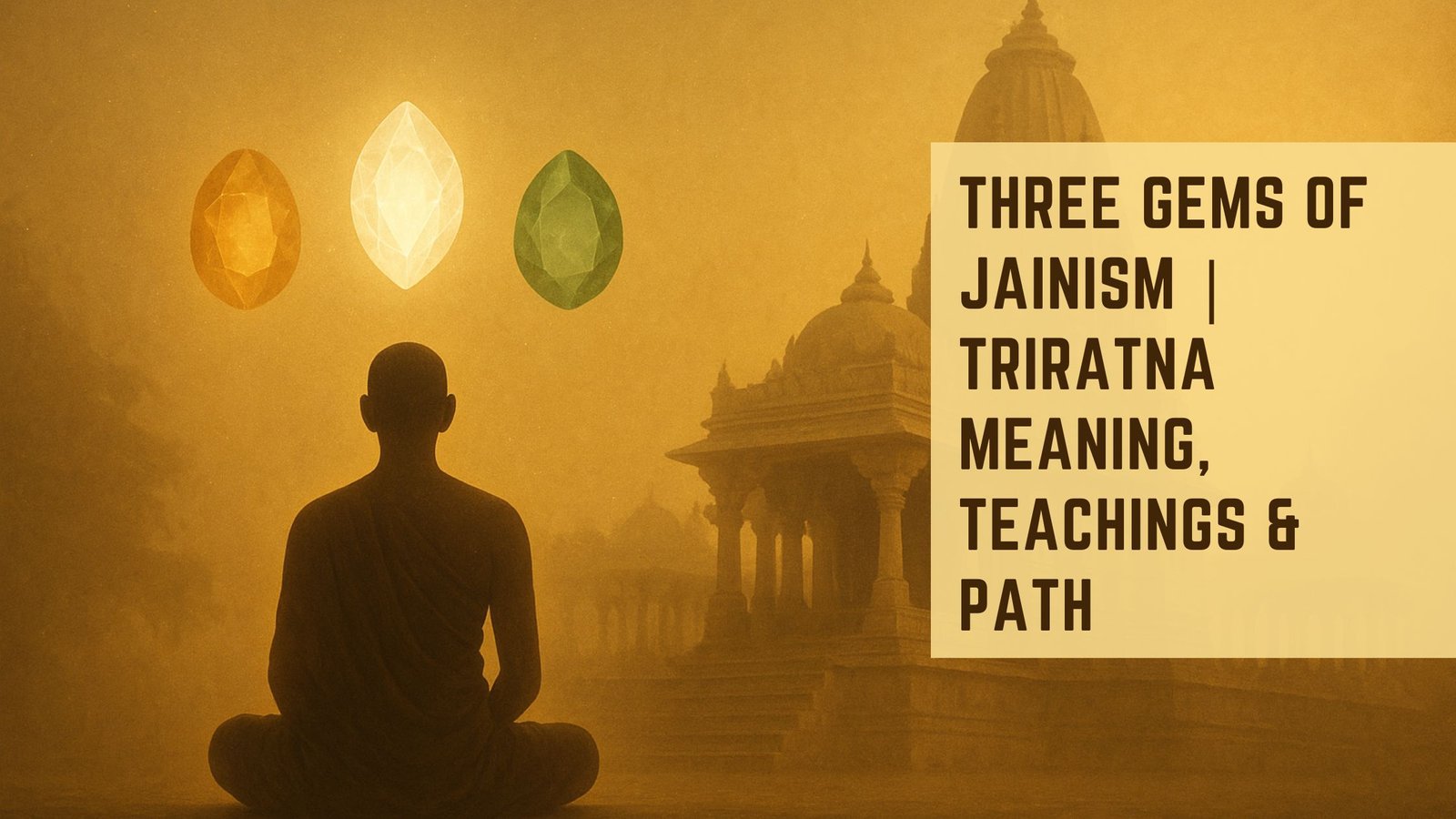
The spiritual philosophy of Jainism stands on a beautiful and disciplined foundation known as the Three Gems of Jainism or the Triratna. These three principles guide the soul toward purity, self-realization, and ultimately liberation (moksha).
In Jain philosophy, life is not a random journey. It is a conscious path shaped by awareness, discipline, and inner transformation. The Three Gems of Jainism are not just theoretical ideas; they are practical tools for daily living, spiritual growth, and ethical conduct.
Table of Contents
What Are the Three Gems of Jainism?
The Three Gems of Jainism are:
- Samyak Darshan – Right Faith
- Samyak Jnana – Right Knowledge
- Samyak Charitra – Right Conduct
These Three Gems of Jainism are collectively called Three Gems of Jainism and form the spiritual ladder toward enlightenment.
“Without right faith, right knowledge is blind; without right conduct, both are powerless.”
Triratna in Jainism: The Spiritual Foundation
Three Gems of Jainism refers to the three jewels that lead an individual toward the purification of the soul and liberation from the cycle of birth and death.
These are not independent stages but interconnected forces:
- Right Faith gives direction.
- Right Knowledge gives clarity.
- Right Conduct gives realization.
Just as a lamp needs oil, wick, and fire to give light, spirituality needs all three gems to illuminate the soul.
1. Samyak Darshan: Right Faith
Right Faith arises when a person develops true belief in reality, in the soul, karma, and the teachings of the Tirthankaras.
It means:
- Faith in the existence of the soul
- Belief in the law of karma
- Trust in the teachings of Jain philosophy
Meaning in Daily Life:
Right Faith is not blind belief. It is rational, thoughtful, and rooted in understanding. It helps a person develop humility, tolerance, and inner peace.
Spiritual Quote:
“True faith is not inherited, it is awakened within.”
2. Samyak Jnana: Right Knowledge
Right Knowledge refers to the correct understanding of the universe, the soul, karma, and reality.
It means:
- Understanding that the soul is eternal
- Knowing the difference between living and non-living
- Recognizing attachment as the root of suffering
Without correct knowledge, faith can lead to superstition. This is why Triratna in Jainism emphasizes knowledge grounded in logic, awareness, and spiritual wisdom.
Informative Insight:
Jain texts identify five types of knowledge:
Sensory, scriptural, telepathic, clairvoyant, and omniscient knowledge.
Quote:
“Knowledge without wisdom binds, but knowledge with awareness liberates.”
3. Samyak Charitra: Right Conduct
Right Conduct is the practical application of faith and knowledge in everyday life.
It includes:
- Non-violence (Ahimsa)
- Truthfulness
- Non-stealing
- Celibacy
- Non-possessiveness
Right Conduct purifies karma and reduces attachment, paving the way for spiritual elevation.
Life Quote:
“Conduct is the mirror of your inner truth.”
Triratna in Jainism and the Path to Liberation
The complete path of Triratna in Jainism is about liberation from the bondage of karma.
Karma in Jainism is not fate — it is a physical substance that binds the soul due to actions and emotions.
When someone follows:
- Pure Faith
- True Knowledge
- Moral Conduct
their karmic layers start dissolving, making the soul lighter and purer.
This is why Triratna in Jainism is not just philosophy but a science of inner transformation.

Practical Lessons from the Three Gems of Jainism
Here are powerful life lessons inspired by the Three Gems:
- Truth is not to be believed blindly but realized consciously.
- Knowledge loses meaning without ethical action.
- Faith is strongest when grounded in understanding.
- Self-discipline is the highest form of power.
- Liberation begins with self-control.
“Walk the path of light, walk with the Three Gems.”
Philosophical Importance of Triratna in Jainism
In Three Gems of Jainism, the soul is trapped because of karma. These three jewels act as tools for breaking that bondage.
They teach:
- Awareness over ignorance
- Discipline over desires
- Detachment over attachment
The soul becomes free not by prayers alone, but by transformation of conduct.
Relevance of Three Gems of Jainism in Modern Life
Even in modern society, where material success dominates life, the Three Gems remain highly relevant:
- Right Faith helps us stay grounded.
- Right Knowledge saves us from misinformation.
- Right Conduct creates ethical leadership.
In an age of stress, greed, and confusion, the values of Three Gems of Jainism offer clarity, balance, and peace. The Three Gems of Jainism hold deep Modern Relevance in today’s world of material distractions and inner conflict.
Spiritual Quotes on the Three Gems
Here are some inspiring quotes:
• “When faith is pure, knowledge becomes divine.”
• “The gems within are more precious than gold outside.”
• “Right conduct is the language of a liberated soul.”
• “The true jewel is not worn but lived.”
Symbolism of the Three Gems
The Three Jewels are symbolized by:
- Three dots above the Jain swastika
- Or a triple-pointed crown in Jain iconography
They represent unity between belief, wisdom, and action.
Difference Between Jain and Buddhist Triratna
Many confuse Jain Triratna with Buddhist Three Jewels. However:
| Jain Triratna | Buddhist Triratna |
|---|---|
| Right Faith, Knowledge, Conduct | Buddha, Dhamma, Sangha |
| Focus on self-effort | Focus on the enlightened teacher |
| Path of soul purification | Path of enlightenment through teaching |
Spiritual Discipline Through Triratna in Jainism
Three Gems of Jainism is not only a philosophical concept but a strict system of self-discipline. When a follower understands and practices Three Gems of Jainism, their lifestyle naturally becomes pure, non-violent, and focused on self-control. The awareness developed through Three Gems of Jainism removes ignorance and ego, which are the main causes of suffering. By applying Three Gems of Jainism in daily life, one learns to detach from material illusions and turn inward. In reality, Three Gems of Jainism transforms ordinary life into a spiritual journey of self-purification and conscious living.
Triratna in Jainism and the Science of Karma
According to Jain philosophy, karma is a physical substance that binds the soul, and only Three Gems of Jainism has the power to destroy it. Without practicing Three Gems of Jainism, liberation is impossible because karma continues to accumulate through wrong belief and wrong actions. Through right faith, right knowledge, and right conduct, the soul weakens karmic bondage, which is the core purpose of Three Gems of Jainism. Every soul seeking freedom must pass through the disciplined path shown by Three Gems of Jainism, as it is the only true method for karmic purification and spiritual evolution.
Modern Relevance of Triratna in Jainism in Daily Life
In today’s world of stress, anxiety, and moral confusion, Three Gems of Jainism offers a crystal-clear spiritual framework for balanced living. By following Three Gems of Jainism, individuals develop ethical decision-making, emotional control, and inner stability. The principles of Three Gems of Jainism guide toward non-violence, self-restraint, and mindful living, making it highly relevant even in modern society. Even today, implementing Three Gems of Jainism helps people achieve peace, discipline, and clarity in both personal and professional life.
FAQ
1.What is the main purpose of the Three Gems of Jainism?
The purpose is to guide the individual toward liberation by purifying the soul through right belief, knowledge, and action.
2.Why is Triratna in Jainism important?
Because without these three, liberation is impossible. They form the foundation of Jain spiritual practice.
3.Are the Three Gems theoretical or practical?
They are deeply practical. They influence daily life, food habits, decisions, and personal behavior.
4.How many times is Triratna in Jainism mentioned in Jain scriptures?
It is one of the most frequently discussed and foundational doctrines across Jain canonical texts.
5.Can modern people follow the Three Gems?
Yes. Anyone practicing truth, non-violence, and self-awareness is already walking this spiritual path.
Conclusion
The Three Gems of Jainism are not merely religious teachings but a complete way of living. They shape character, refine consciousness, and guide the soul toward its highest potential.
The path of self-realization is not crossed by rituals alone but through awareness, discipline, and purity.
When we truly understand and implement Triratna in Jainism, we move closer to liberation, inner peace, and timeless truth.
“The real jewel is not found in temples but in transformed hearts.”
Explore more spiritual wisdom and ancient teachings at thegita.in.