Love is often misunderstood as a single emotion a spark, a moment, or a connection. But the truth is deeper. Love evolves. It transforms. It challenges. It heals.
Every relationship whether romantic, spiritual, or emotional passes through distinct stages, shaping who we become.
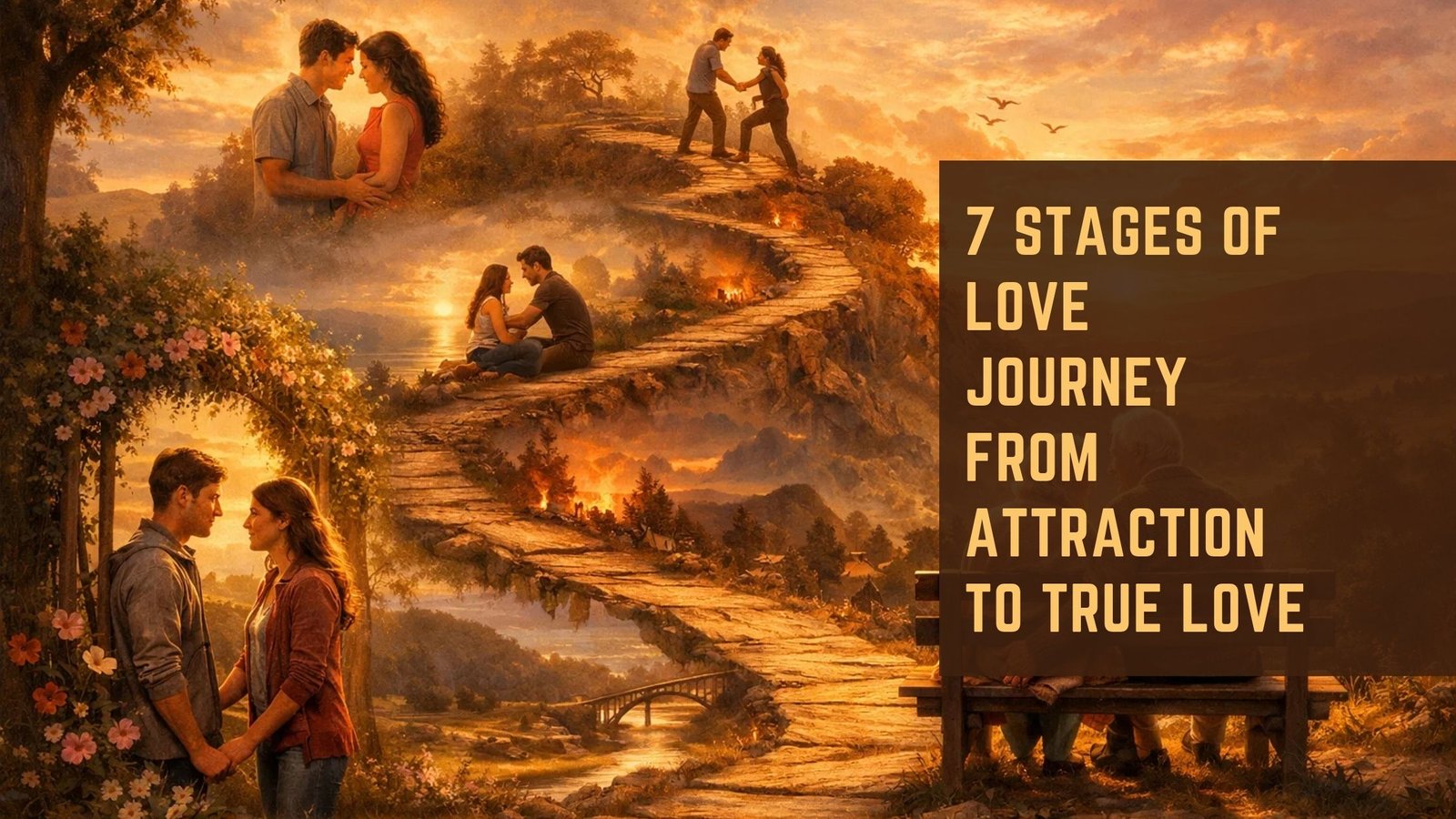
The 7 stages of love are not just phases of relationships; they are reflections of human growth, emotional maturity, and spiritual awakening.
“Love is not what you feel at the beginning, but what you build till the end.”
Table of Contents
Understanding these stages helps you:
- Navigate relationships better
- Avoid emotional confusion
- Grow emotionally and spiritually
- Build deeper, lasting connections
Key Takeaways
- Love is a process, not a moment
- Every stage has lessons, not just emotions
- Challenges in love are part of growth
- True love emerges after patience and understanding
- The final stage of love is peace, not excitement
The 7 Stages of Love Explained
1. Attraction The Beginning of Everything
Attraction is the first spark the moment when your heart notices someone. It is often based on:
- Physical appearance
- Personality
- Energy or vibe
This stage feels magical but is often temporary and surface-level.
Lesson
Attraction is important, but it is not love it is just the beginning.
“Attraction opens the door, but character keeps it open.”
2. Infatuation The Illusion of Perfection
This stage is intense and emotional. You:
- Think about the person constantly
- Ignore their flaws
- Feel emotional highs and lows
It feels like love, but it is often driven by fantasy and imagination.
Lesson
Infatuation teaches you the difference between illusion and reality.
“Infatuation is when you imagine perfection; love is when you accept imperfection.”
3. Love Emotional Connection Begins
Here, real love begins to develop:
- You start understanding each other
- Emotional bonding deepens
- Trust begins to form
This stage is more stable and meaningful than the previous ones.
Lesson
Love is built through understanding, not just feelings.
“Love grows when two hearts choose to understand, not just feel.”
4. Trust The Foundation of True Love
Trust is where love becomes secure:
- You feel safe with the person
- You can be your true self
- There is honesty and transparency
Without trust, love cannot survive.
Lesson
Trust is not given—it is earned and protected.
“Where there is trust, love breathes freely.”
5. Conflict The Test of Love
This is where most relationships struggle:
- Arguments and misunderstandings arise
- Differences become visible
- Ego and expectations clash
Many relationships end here because people mistake conflict as the end of love.
Lesson
Conflict is not the end—it is the refinement of love.
“A relationship that survives conflict becomes unbreakable.”
6. Growth Evolving Together
After conflict comes growth:
- You learn from mistakes
- You become more patient
- You understand each other deeply
This stage transforms love into something mature and meaningful.
Lesson
Love is not about perfection it is about growing together.
“Real love is when two imperfect people refuse to give up on each other.”
7. Commitment The Ultimate Stage of Love
This is the highest stage:
- Love becomes stable and peaceful
- You choose each other every day
- It is no longer about excitement, but presence and loyalty
Lesson
Commitment is the true definition of love.
“Love is not staying because you have to, but because you choose to.”
Quote Table Wisdom About Love
| Language | Quote | Meaning |
|---|---|---|
| English | “Love is a journey, not a destination.” | Love evolves over time |
| Hindi | “सच्चा प्यार समय के साथ गहराता है।” | True love deepens with time |
| Punjabi | “ਸੱਚਾ ਪਿਆਰ ਕਦੇ ਖਤਮ ਨਹੀਂ ਹੁੰਦਾ।” | True love never ends |
| Sanskrit | “प्रेमः अनन्तः अस्ति।” | Love is infinite |
Deep Lessons from the 7 Stages of Love
- Love is not instant it is built slowly
- Emotional pain is part of growth
- True love requires patience and understanding
- Not every attraction leads to real love
- Commitment is more powerful than emotion
Modern Relevance of the 7 Stages of Love
In today’s fast-paced world:
- People confuse attention with love
- Relationships end before reaching deeper stages
- Social media creates unrealistic expectations
Understanding the 7 stages of love helps you:
- Build meaningful relationships
- Avoid emotional confusion
- Develop emotional intelligence
Common Mistakes People Make in Love
- Expecting perfection
- Giving up during conflict
- Confusing infatuation with love
- Avoiding communication
- Not valuing commitment
The Psychology Behind the 7 Stages of Love
Love is not just a poetic feeling—it is deeply rooted in human psychology. Each of the 7 stages of love corresponds to changes in brain chemistry and emotional conditioning. In the early stages like attraction and infatuation, dopamine and serotonin create excitement and obsession. As the relationship progresses into trust and commitment, oxytocin—the “bonding hormone”—takes over, bringing stability and emotional security. This explains why initial passion fades and deeper connection begins. Understanding this psychological shift helps you avoid confusion and accept that real love is not about constant excitement, but about emotional grounding and long-term connection.
Why Most People Fail Before Reaching True Love
Many relationships today break before reaching the final stages because people expect love to remain the same as it was in the beginning. When the excitement of infatuation fades and conflict appears, they assume something is wrong. In reality, this is the most important turning point in the 7 stages of love. People often quit when they should grow. Ego, lack of communication, unrealistic expectations, and fear of vulnerability stop relationships from evolving. True love requires patience, emotional maturity, and the willingness to stay even when things are not perfect.
“Most people don’t lose love; they lose patience during its transformation.”
Spiritual Meaning of the 7 Stages of Love
Beyond emotions and psychology, the 7 stages of love also have a spiritual dimension. Love teaches detachment from ego, acceptance of imperfections, and unconditional giving. It mirrors the journey of the soul from desire to devotion. In many spiritual philosophies, love is seen as a path to self-realization, where the final stage is not just commitment to a person, but alignment with truth and inner peace. When love reaches its highest form, it becomes selfless, calm, and divine—free from fear, control, and expectations.
“When love becomes selfless, it transforms from emotion into enlightenment.”
FAQs
Are the 7 stages of love real?
Yes, they represent emotional and psychological patterns seen in most relationships.
Do all relationships go through these stages?
Most do, but the duration and intensity may vary.
Which stage is the hardest?
The conflict stage is the most challenging because it tests patience and understanding.
Can love skip stages?
No, true love develops gradually through each phase.
What is the final stage of love?
Commitment where love becomes stable, peaceful, and enduring.
Conclusion
The 7 stages of love teach us that love is not just about happiness—it is about growth, patience, and transformation.
From attraction to commitment, every stage has a purpose:
- To teach
- To shape
- To strengthen
In the end, love is not about finding the perfect person it is about becoming the right person.
“The strongest love is not the one that begins quickly, but the one that lasts forever.”
Explore deeper insights on love, life, and spirituality at thegita.in.