What if the oldest knowledge known to humanity was not about power, wealth, or conquest but about truth, harmony, and the inner self?
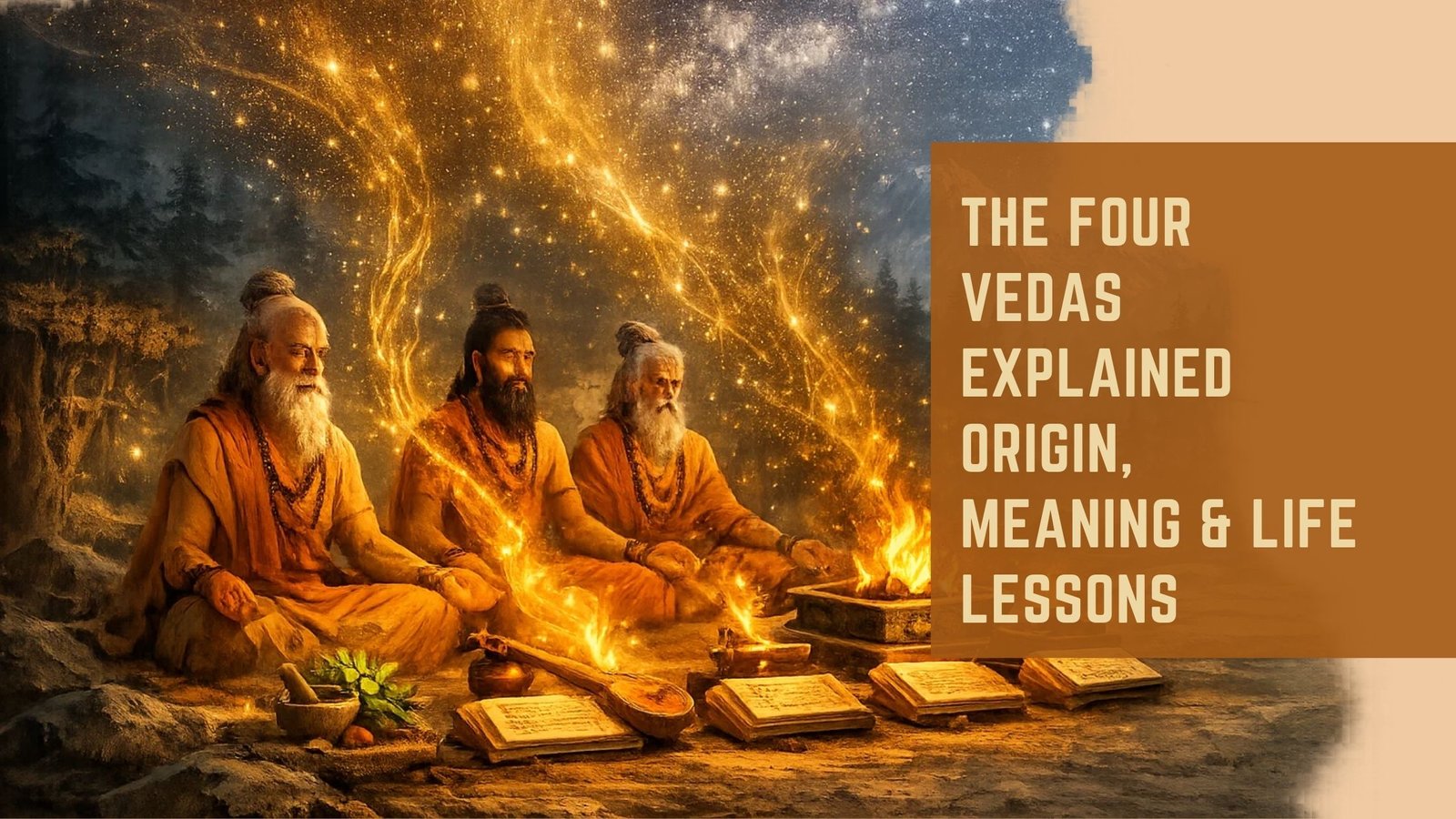
Long before written history, before borders and ideologies, sages sat in silence and heard wisdom. That wisdom became the Vedas not man-made books, but revelations (Śruti), believed to be eternal truths perceived by enlightened seers.
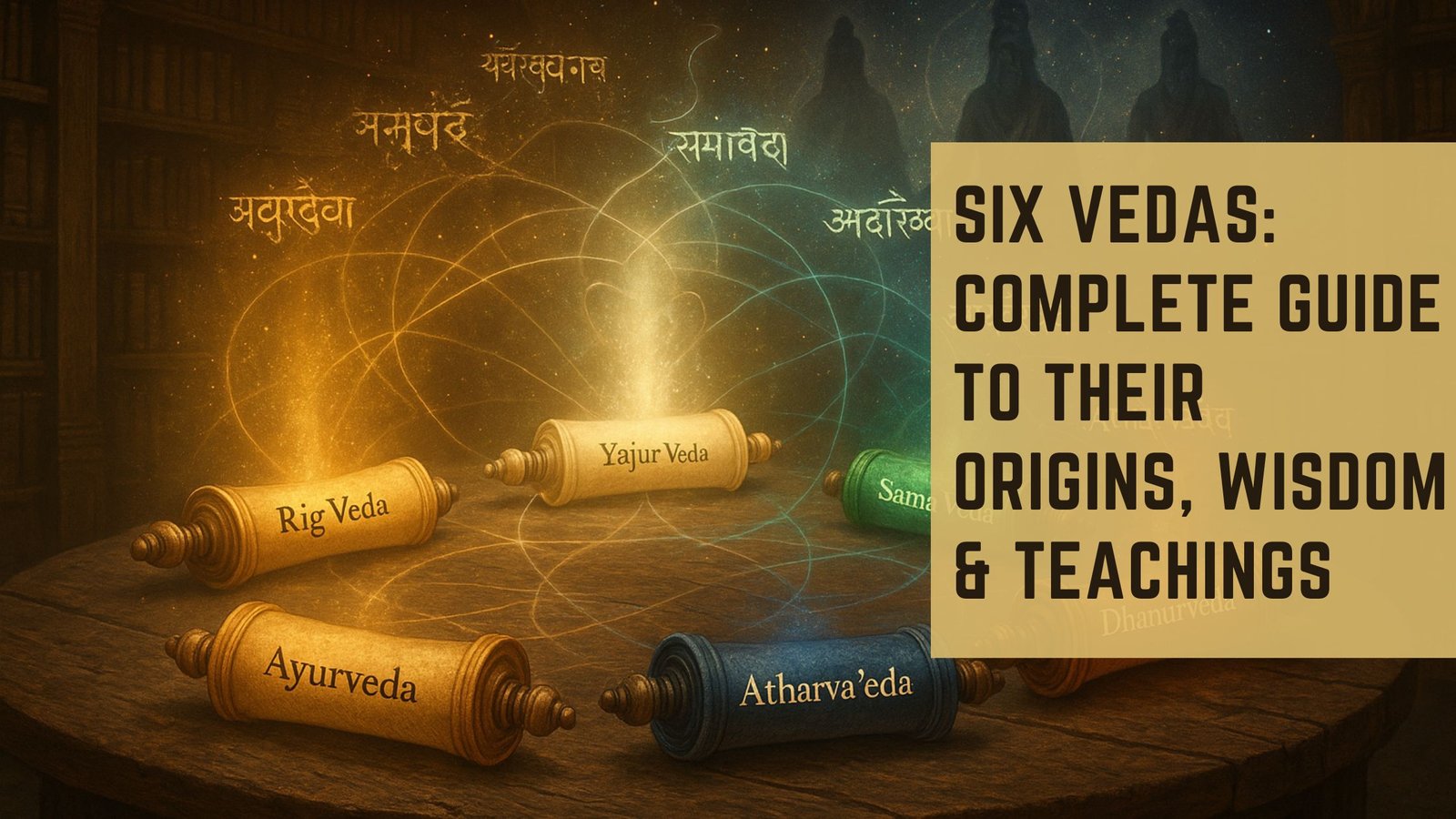
The Four Vedas are not merely religious texts; they are a complete system of knowledge covering spirituality, science, ethics, psychology, music, rituals, health, and cosmic order. Even today, their teachings quietly influence philosophy, yoga, meditation, and the Indian way of life.
Table of Contents
Key Takeaways
- The Vedas are the oldest surviving scriptures in the world
- They consist of four main texts, each with a unique purpose
- The Vedas teach dharma (right living), not blind belief
- They balance ritual, devotion, knowledge, and self-realization
- Their wisdom remains deeply relevant in modern life
What Are the Vedas?
The word Veda comes from the Sanskrit root “Vid”, meaning to know.
Thus, Vedas literally mean “knowledge” specifically, sacred knowledge.
They are traditionally dated between 1500–500 BCE, though many scholars believe their oral tradition is far older.
Core Characteristics of the Vedas
- Apauruṣeya – Not authored by humans
- Śruti – Heard and transmitted orally
- Mantra-based – Preserved through precise chanting
- Universal – Address both worldly and spiritual life
Structure of Each Veda
Each of the Four Vedas contains four layers of wisdom:
- Samhitas – Hymns and mantras
- Brahmanas – Ritual explanations
- Aranyakas – Forest texts (symbolism & meditation)
- Upanishads – Philosophical and spiritual insights

The Four Vedas Explained in Detail
1. Rigveda The Veda of Cosmic Praise
Essence
The Rigveda is the oldest of all Vedas and forms the foundation of Vedic thought. It consists of 1,028 hymns dedicated to natural and cosmic forces.
Key Deities
- Agni (Fire)
- Indra (Energy & Power)
- Varuna (Cosmic Order)
- Soma (Divine Nectar)
Famous Rigvedic Quote
“Ekam sat viprā bahudhā vadanti”
Truth is One, the wise call it by many names.
Life Lessons from Rigveda
- Respect forces of nature
- Seek unity beyond diversity
- Live in harmony with cosmic law (ṛta)
2. Yajurveda The Veda of Sacred Action
Essence
The Yajurveda focuses on rituals, sacrifices, and ethical actions. It provides practical guidance for performing sacred duties.
Two Major Branches
- Shukla (White) Yajurveda
- Krishna (Black) Yajurveda
Powerful Quote
“Karmaṇye vādhikāras te”
You have the right to action, not to the fruits.
Life Lessons from Yajurveda
- Action with discipline leads to harmony
- Duty (karma) purifies the mind
- Rituals symbolize inner transformation
3. Samaveda The Veda of Divine Music
Essence
The Samaveda transforms Rigvedic hymns into melodic chants. It is the foundation of Indian classical music.
Unique Feature
- Emphasis on sound vibration
- Mantras meant to be sung, not spoken
Samavedic Insight
“Nāda Brahma”
The universe itself is sound.
Life Lessons from Samaveda
- Sound influences consciousness
- Music is a spiritual practice
- Harmony begins within
4. Atharvaveda The Veda of Everyday Life
Essence
The Atharvaveda addresses human concerns health, fear, love, peace, and social harmony.
Key Topics
- Healing & Ayurveda
- Mental peace
- Social ethics
- Household life
Atharvavedic Quote
“Let us live together, think together, and grow together.”
Life Lessons from Atharvaveda
- Spirituality must serve life
- Peace begins in the mind
- Society thrives on collective harmony
The Four Vedas at a Glance
| Veda | Core Focus | Unique Contribution |
|---|---|---|
| Rigveda | Cosmic hymns | Philosophy & unity |
| Yajurveda | Ritual action | Discipline & duty |
| Samaveda | Musical chants | Sound & devotion |
| Atharvaveda | Daily life | Healing & ethics |
Philosophical Depth From Ritual to Realization
While the early Vedas emphasize rituals, their deeper layers the Upanishads ask profound questions:
- Who am I?
- What is reality?
- What is liberation (moksha)?
This journey transforms external worship into inner awakening.
Modern Relevance of the Four Vedas
Even today, Vedic wisdom influences:
- Yoga & Meditation
- Ayurveda & holistic health
- Environmental ethics
- Mindfulness & self-awareness
The Vedas teach balance, not renunciation of life.
The Four Vedas as the Foundation of Sanatan Wisdom
The Four Vedas form the very backbone of Sanatan Dharma, shaping not only religious practices but the entire worldview of ancient Indian civilization. They present a holistic vision where the universe is seen as an interconnected whole nature, humanity, and the divine moving in harmony. Through hymns, rituals, melodies, and reflections on everyday life, the Four Vedas establish the principles of dharma (righteous living), ṛta (cosmic order), and balance between material and spiritual pursuits. Rather than separating worldly duties from spiritual growth, the Four Vedas teach that both must coexist for a meaningful and fulfilled life.
The Four Vedas and the Journey of Human Consciousness
One of the most profound aspects of the Four Vedas is their gradual elevation of human consciousness. They begin with prayers to external forces fire, wind, rain, and the sun but slowly guide the seeker inward toward self-knowledge and realization. This evolution from ritual (karma), to devotion (bhakti), and finally to wisdom (jnana) reflects the natural spiritual journey of humanity. The Four Vedas acknowledge human fears, desires, and struggles, yet gently point toward inner peace, discipline, and ultimate liberation (moksha). Their teachings remind us that spiritual growth is not sudden it is a patient unfolding of awareness.
Why the Four Vedas Still Matter in the Modern World
In today’s fast-paced and restless world, the Four Vedas offer timeless guidance rooted in balance, mindfulness, and responsibility. Their emphasis on harmony with nature speaks directly to modern environmental concerns, while their focus on mental discipline and ethical action aligns with contemporary ideas of well-being and self-awareness. The Four Vedas do not reject progress; instead, they caution against progress without wisdom. By encouraging conscious action, inner reflection, and collective harmony, the Four Vedas remain a powerful compass for individuals seeking clarity, purpose, and spiritual grounding in modern life.
Frequently Asked Questions
Are the Vedas religious or philosophical?
They are both ritualistic on the surface, philosophical at their core.
Who wrote the Vedas?
They are considered divinely revealed, not authored by humans.
Can non-Hindus read the Vedas?
Yes. The Vedas are universal wisdom, open to all seekers.
Which Veda is most important?
All four are equally important, forming a complete system.
Conclusion
The Four Vedas are not relics of the past they are living wisdom. They remind humanity that progress without consciousness leads to imbalance, and knowledge without compassion is incomplete.
In an age of noise, the Vedas invite us back to listening to nature, to truth, and to the quiet voice within.
“From ignorance, lead me to truth.
From darkness, lead me to light.
From death, lead me to immortality.”
If the ancient wisdom of the Vedas moved you, continue your path toward truth and inner peace at thegita.in.