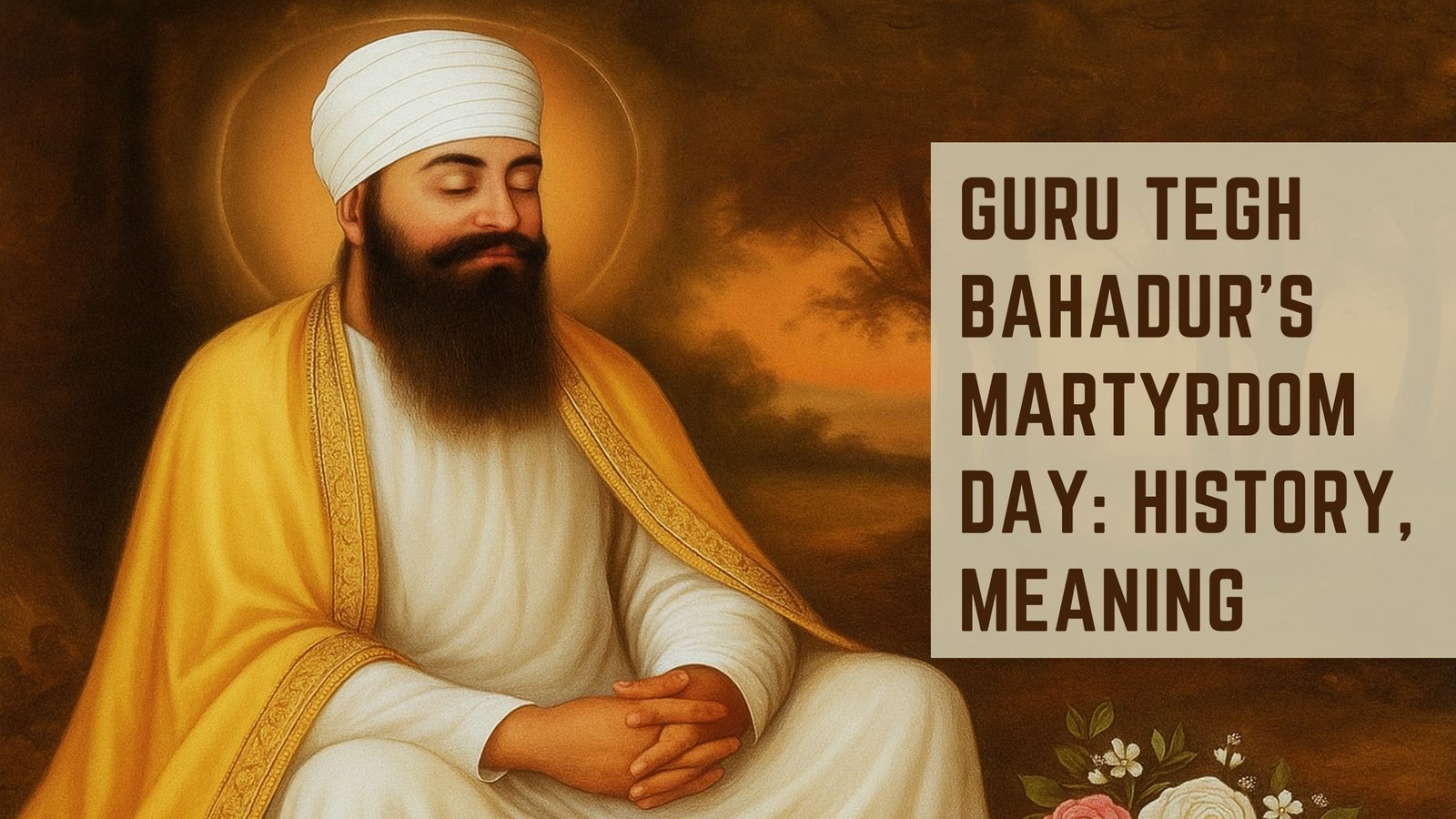
Guru Tegh Bahadur’s Martyrdom Day stands as one of the most powerful chapters in Indian and Sikh history. It marks the ultimate sacrifice of the Ninth Sikh Guru, who gave his life to protect the right of people to follow their own faith and conscience. His martyrdom was not only a religious event; it became a universal symbol of freedom of belief, courage, and humanity.
This day is observed every year on 24 November, when Guru Tegh Bahadur Ji was executed in 1675 by order of the Mughal emperor Aurangzeb in Delhi. His sacrifice is remembered with deep reverence across Sikh, Hindu, and global spiritual communities.
Table of Contents
Historical Background of Guru Tegh Bahadur Ji
Guru Tegh Bahadur Ji was born on 1 April 1621 in Amritsar. He was the youngest son of Guru Hargobind Sahib Ji, the sixth Sikh Guru. From childhood, he showed a deep inclination towards meditation, spirituality, and service.
He became the Ninth Guru in 1664 after Guru Har Krishan Ji. His life was marked by humility, simplicity, spiritual depth, and strong resistance against religious oppression.
During the reign of Aurangzeb, forced religious conversions were taking place, especially targeting the Kashmiri Pandits, who were being persecuted and ordered to convert to Islam. When they approached Guru Tegh Bahadur Ji for protection, he responded with courage and compassion.
Why Guru Tegh Bahadur Ji Was Martyred
Aurangzeb wanted Guru Tegh Bahadur Ji to either convert to Islam or stop supporting Kashmiri Pandits. Guru Ji refused both options.
He knew his decision would lead to death, but his commitment to religious freedom was greater than his love for life.
He traveled to Delhi along with his companions Bhai Mati Das Ji, Bhai Sati Das Ji, and Bhai Dayala Ji. All three were tortured and executed in brutal ways before his eyes, yet Guru Ji remained calm and resolute.
Finally, Guru Tegh Bahadur Ji was publicly beheaded at Chandni Chowk, Delhi, on 24 November 1675.
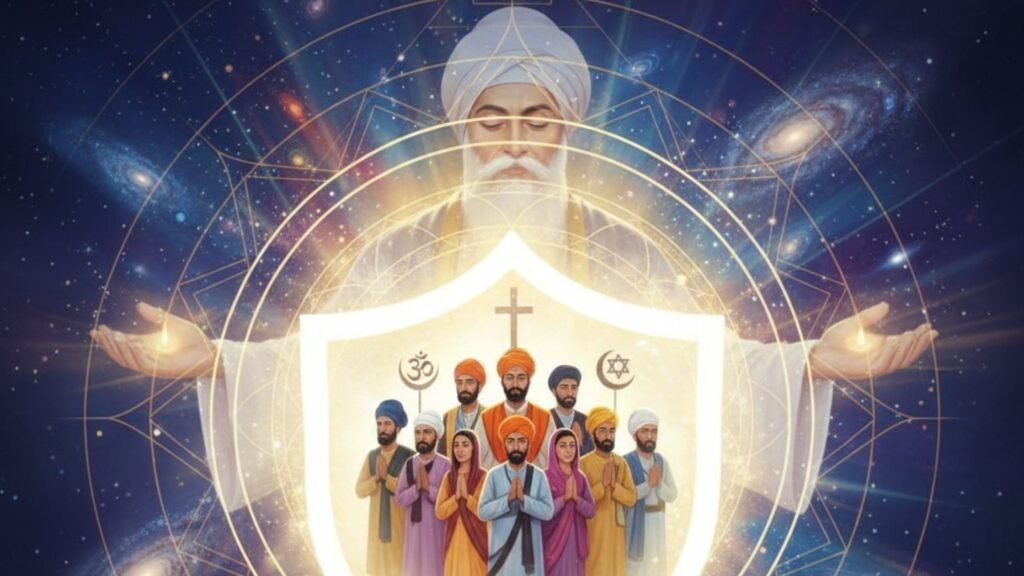
This sacrifice established him eternally as the Hind Ki Chadar – the Shield of India.
Significance of Guru Tegh Bahadur’s Martyrdom Day
Guru Tegh Bahadur’s Martyrdom Day is not just about remembrance; it is about awakening moral courage in society.
It signifies:
- Defense of freedom of belief
- Protection of human rights
- Victory of conscience over tyranny
- Spiritual courage in the face of injustice
- Unity beyond religious boundaries
His martyrdom is also remembered as the Guru Tegh Bahadur’s Martyrdom Day, which reflects his divine role in shaping Sikh history and Indian civilization.
The Guru Tegh Bahadur’s Martyrdom Day is observed through prayers, kirtans, Nagar Kirtans, and spiritual gatherings worldwide.
Role in Interfaith Harmony
Guru Tegh Bahadur Ji sacrificed his life not for his own community alone, but for people of another faith. This makes his martyrdom one of the most significant events in global interfaith history.
The Guru Tegh Bahadur’s Martyrdom Day teaches humanity that truth and justice rise above religious divisions.
His stand proves that true spirituality means standing up for others even when it costs your life.
Spiritual and Philosophical Teachings
Guru Tegh Bahadur Ji’s bani (verses) are included in the Guru Granth Sahib. His teachings emphasize:
- Detachment from materialism
- Fearlessness in the face of death
- Devotion to God
- Compassion for humanity
- Inner peace amid suffering
He taught that life without standing for truth is meaningless.
His martyrdom became the ultimate message that faith must never be forced, and freedom of conscience is sacred.
Powerful Quotes by Guru Tegh Bahadur Ji
Here are some timeless quotes and teachings:
“Jo nar dukh mein dukh nahi maane, sukh saneh ar bhai nahi jaake, kanchan maati maane.”
(One who remains steady in suffering and joy alike, unaffected by fear or attachment, becomes truly liberated.)
“Re man aiso kar sanyasa, ban se sadan sabai kar samajho, man hi mahiya basa.”
(O mind, live like a renunciate even while being a householder, for the Divine resides within you.)
“Fear not those who threaten the body, for the soul belongs only to the Divine.”
These teachings are remembered especially on the Guru Tegh Bahadur’s Martyrdom Day, inspiring millions to walk the path of truth.
Life Lessons from Guru Tegh Bahadur’s Sacrifice
- Stand for Dharma even when alone
His life shows that truth doesn’t depend on majority support. - Protect others’ freedom
The Guru Tegh Bahadur’s Martyrdom Day reminds us that real courage lies in defending someone else’s rights. - Fearlessness in the face of death
Death for truth is not defeat; it is victory. - Spiritual detachment
He showed that material life is temporary, but values are eternal. - Unity of humanity
He sacrificed not only for Sikhs but for all humanity.
Guru Tegh Bahadur Ji’s sacrifice gives us timeless life lessons of courage, compassion, and truth.
How Guru Tegh Bahadur’s Martyrdom Day Is Observed
On Guru Tegh Bahadur’s Martyrdom Day, Sikhs and spiritual communities observe:
- Special prayers in Gurudwaras
- Kirtan and recitation of Gurbani
- Processions (Nagar Kirtans)
- Spiritual discourses on his life
- Free community meals (Langar)
- Educational seminars on his teachings
This day reminds the world of the eternal flame of courage that cannot be extinguished.
Historical Impact on Sikhism and India
His martyrdom shaped Sikh identity forever.
After his execution, his son Guru Gobind Singh Ji later founded the Khalsa Panth in 1699, strengthening the Sikh community and its mission of protecting truth and justice.
The Guru Tegh Bahadur’s Martyrdom Day also influenced India’s broader history by becoming an early symbol of resistance against religious oppression.
Relevance in Modern Times
In today’s world of conflict, intolerance, and ideological struggles, the message of Guru Tegh Bahadur Ji is more relevant than ever.
The Guru Tegh Bahadur’s Martyrdom Day teaches:
- Religious tolerance
- Peaceful resistance
- Moral courage in society
- Respect for diversity
- Defense of human rights
His sacrifice is not just a memory; it is a living philosophy.
FAQs
1.Why is Guru Tegh Bahadur called “Hind Ki Chadar”?
He earned this title because he protected Indian society and religious freedom, shielding it from forced conversions, like a protective blanket.
2.When is Guru Tegh Bahadur’s Martyrdom Day observed?
It is observed every year on 24 November.
3.What was the main reason for his martyrdom?
He sacrificed his life to protect Kashmir Pandits and defend the right to religious freedom.
4.How does the Martyrdom Day of Sikh Ninth Guru inspire youth today?
It teaches young people to stand for truth, protect justice, and stay fearless in times of difficulty.
5.Where did the martyrdom take place?
He was executed at Chandni Chowk, Delhi, where Sis Ganj Gurudwara stands today.
Conclusion
Guru Tegh Bahadur’s Martyrdom Day is not merely a historical event; it is a reminder of the highest form of moral courage.
The Guru Tegh Bahadur’s Martyrdom Day continues to inspire humanity to stand against injustice, protect freedom, and walk the path of truth without fear.
His life shows that physical death cannot kill spiritual legacy. His sacrifice has become an undying flame in the heart of India and the conscience of the world.
Even today, his teachings echo across generations:
Truth may be challenged, but it never dies.
Faith may be tested, but it never breaks.
Sacrifice may end a life, but it begins a legacy.
“Explore the eternal legacy of Guru Tegh Bahadur Ji at thegita.in – where history meets spiritual wisdom.”