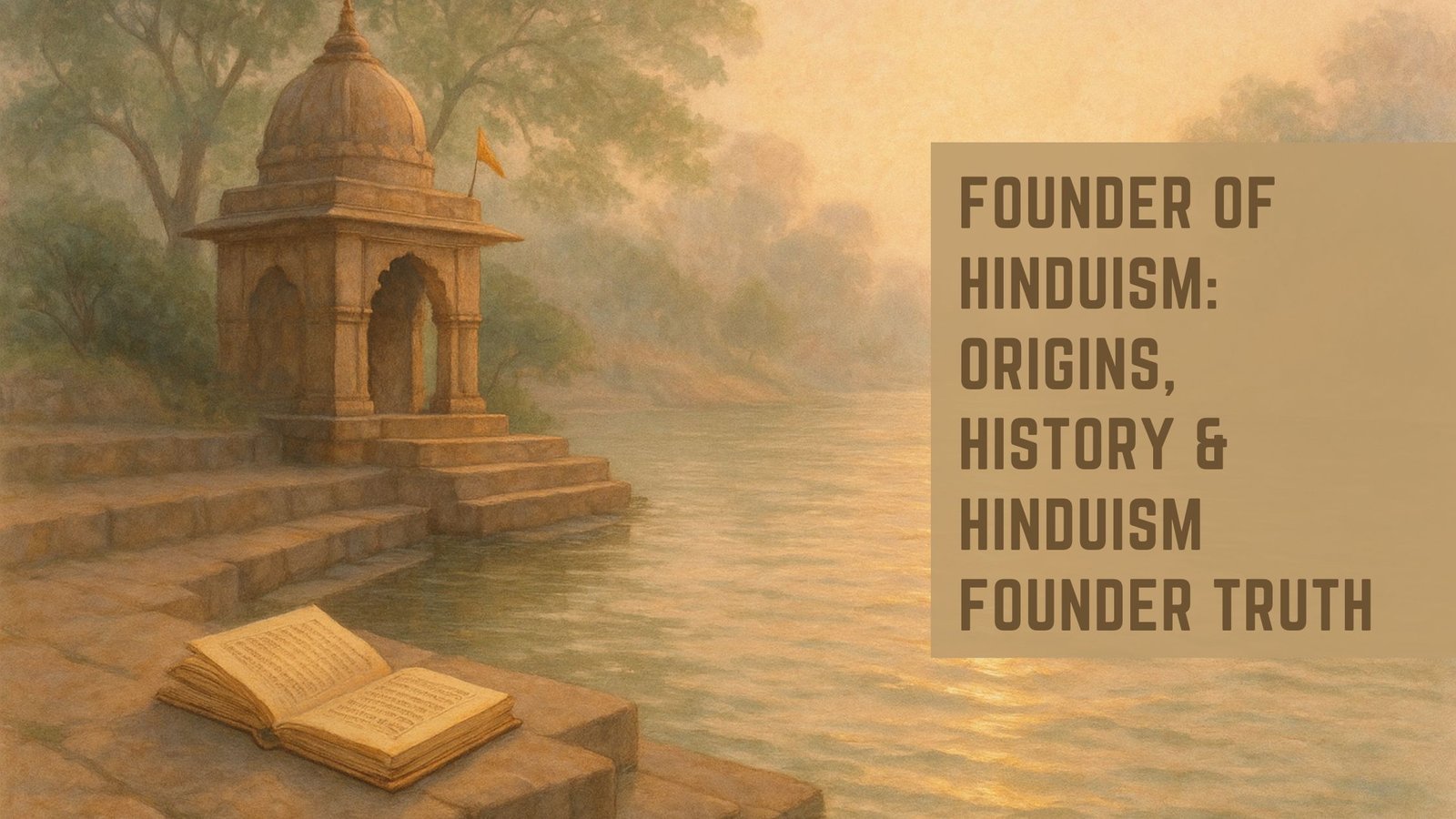
Hinduism is one of the world’s oldest surviving spiritual traditions—older than all organized religions that exist today. When people try to understand who the founder of Hinduism is, they often assume that every religion must have a single leader, prophet, or creator. But Hinduism stands apart because it was not founded by one person, one book, or one event. Instead, it evolved over thousands of years through sages, rishis, and spiritual explorers.
This blog uncovers the complete Hinduism founder truth, the real meaning behind its origin, and why Hindu dharma remains timeless (Sanatan). With spiritual quotes, deep lessons, and detailed explanations, you will discover why Hinduism has no founder—only seekers.
Table of Contents
Why Do People Search for the Founder of Hinduism?
In the modern world, people are used to religions having identifiable founders—like Jesus Christ for Christianity, Prophet Muhammad for Islam, or Guru Nanak Dev Ji for Sikhism.
Naturally, the question arises:
“Who founded Hinduism?”
To answer this, we need to explore the Founder of Hinduism, which reveals something extraordinary:
Hinduism was not founded. It emerged naturally.
A timeless line from the Rigveda states:
“Truth is one; the wise express it in many ways.”
Why Hinduism Has No Single Founder
Unlike religions that began with one teacher or one historical event, Hinduism grew from a vast collective wisdom:
1. It evolved from the Indus-Saraswati Civilization
Archaeological records show spiritual practices, symbols like the Shiva Pashupati seal, fire altars (yajnas), and meditation positions dating back 7,000+ years.
2. It was shaped by thousands of Rishis
Rishis such as Vyasa, Vasishta, Atri, Gautama, Kapila, Yajnavalkya, and countless others received divine knowledge through deep meditation.
3. Knowledge was “revealed,” not created
The Vedas are known as Shruti (heard or revealed), meaning they were not written by any human.
4. Dharma evolved gradually
As society changed, Smriti texts like Manusmriti, Ramayana, Mahabharata, and the Puranas expanded the understanding of life, ethics, and morality.
This is why the Founder of Hinduism emphasizes that no one person can be called its creator—it is the spiritual evolution of humanity.
The Real Hinduism Founder Truth
To understand the Founder of Hinduism, we must first understand the meaning of Sanatan Dharma.
Sanatan = Eternal
Sanatan Dharma means the eternal way of life—without beginning or end.
This indicates no founding date and no founder.
Key Points Behind the Truth
• Hinduism is apauruṣeya — not made by any man
• Knowledge in scriptures is cosmic, universal
• Teachings emerged from inner experience, not invention
• It is open, fluid, and continuously evolving
A powerful verse from the Yajurveda says:
“Let noble thoughts come to us from all directions.”
This reflects that Hinduism grew from the wisdom of humanity, not from the authority of a founder.
Roots of Hinduism
1. Pre-Vedic Period (7000–3000 BCE)
• Indus-Saraswati culture
• Fire worship (Agni)
• Water rituals
• Meditation postures
• Mother Goddess worship
2. Vedic Age (2500–500 BCE)
• Composition of the four Vedas
• Rituals, yajnas, mantra science
• Hymns on nature, existence, and cosmic order
• Development of Upanishads – pure philosophy
3. Classical Age (500 BCE – 500 CE)
• Ramayana, Mahabharata, Bhagavad Gita
• Rise of Yoga, Sankhya, Vedanta, Mimamsa
• Temples, pilgrimages, festivals
• Dharma explained in detail
4. Medieval to Modern Age
• Saints like Adi Shankaracharya, Ramanuja, Kabir, Guru Ravidas, Chaitanya Mahaprabhu
• Bhakti Movement
• Spread of devotional literature
This timeline shows the Hinduism founder truth clearly:
It is not the result of one lifetime but thousands of years of spiritual evolution.
Wisdom of Ancient Sages The True Architects of Hinduism
Rishis did not claim ownership
They simply shared what they realized through tapas (austerity) and dhyana (meditation).
Key contributors include:
• Rishi Vyasa – compiler of Vedas and author of Mahabharata
• Valmiki – author of Ramayana
• Patanjali – creator of Yoga Sutras
• Kapila – founder of Sankhya philosophy
• Yajnavalkya – Upanishadic master
Yet none of them are called the “founder.”
A beautiful Sanskrit quote summarizes this truth:
“Āchārya devo bhava — The teacher is God.”
But no teacher claimed the title of founder.
Core Teachings That Make Hinduism Eternal
1. Concept of Atman and Brahman
The soul is divine and eternal.
2. Law of Karma
Our actions shape our destiny.
3. Rebirth (Punarjanma)
Life is a continuous journey.
4. Dharma
Live with righteousness, truth, and duty.
5. Moksha
Liberation is the purpose of human life.
These teachings also reinforce the Founder of Hinduism — universal laws cannot have an inventor.
Quotes Expressing the Depth of Hinduism
English
• “Hinduism is not a religion, it is a way of life.”
• “The truth is eternal, and eternal truth needs no founder.”
Hindi
• “सनातन धर्म की जड़ें अनादि हैं, इसका कोई आरंभ नहीं।”
• “धर्म खोजा नहीं जाता, अनुभव किया जाता है।”
Sanskrit
• “Ekam sat vipra bahudha vadanti.” – Truth is one; wise men call it by many names.
• “Na karmana na prajaya dhanena tyāgenaike amrutattvam ānashu.”
Life Lessons from the Founder of Hinduism
1. Truth cannot be owned
If a religion has no founder, it belongs to everyone.
2. Spirituality is a personal journey
You do not follow a leader—you explore your own inner self.
3. Diversity is divine
Hinduism allows multiple paths, gods, and practices.
4. Knowledge is limitless
There is no single book or authority in Sanatan Dharma.
5. Humanity is one
Everyone is free to seek their path to the Divine.
Modern Relevance of the Founder of Hinduism
In a world seeking freedom, identity, and spiritual meaning, Hinduism offers:
• Openness — multiple paths, no compulsion
• Scientific temperament — meditation, yoga, energy systems
• Universal acceptance — “Vasudhaiva Kutumbakam” (The world is one family)
• Inclusivity — No founder means no boundaries
This makes the Founder of Hinduism extremely relevant in the modern era. The greatest Life Lesson from the Hinduism founder truth is that real wisdom belongs to everyone, not to a single person.
FAQs
1.Who is the founder of Hinduism?
There is no founder. Hinduism evolved over thousands of years through sages and ancient cultures.
2.Why does Hinduism have no founder?
Because it is Sanatan (eternal) and grew naturally from collective spiritual wisdom.
3.What is Sanatan Dharma?
Sanatan Dharma means eternal truth or eternal way of living.
4.Which is the oldest scripture in Hinduism?
The Rigveda is one of the world’s oldest texts.
5.Is Hinduism the oldest religion in the world?
Yes, based on archaeological and textual evidence, Hinduism predates all organized religions.
Conclusion
The search for the founder of Hinduism leads to a profound realization:
Hinduism is not a creation but a discovery — an awakening of eternal truths.
TheFounder of Hinduism teaches us that the Divine is not limited to one person, one book, or one time. It is infinite, timeless, and available to anyone willing to seek.
Hinduism lives because it flows…
Hinduism survives because it adapts…
Hinduism inspires because it is eternal.
It has no founder because Truth needs no founder. Explore more such spiritual wisdom at:thegita.in.