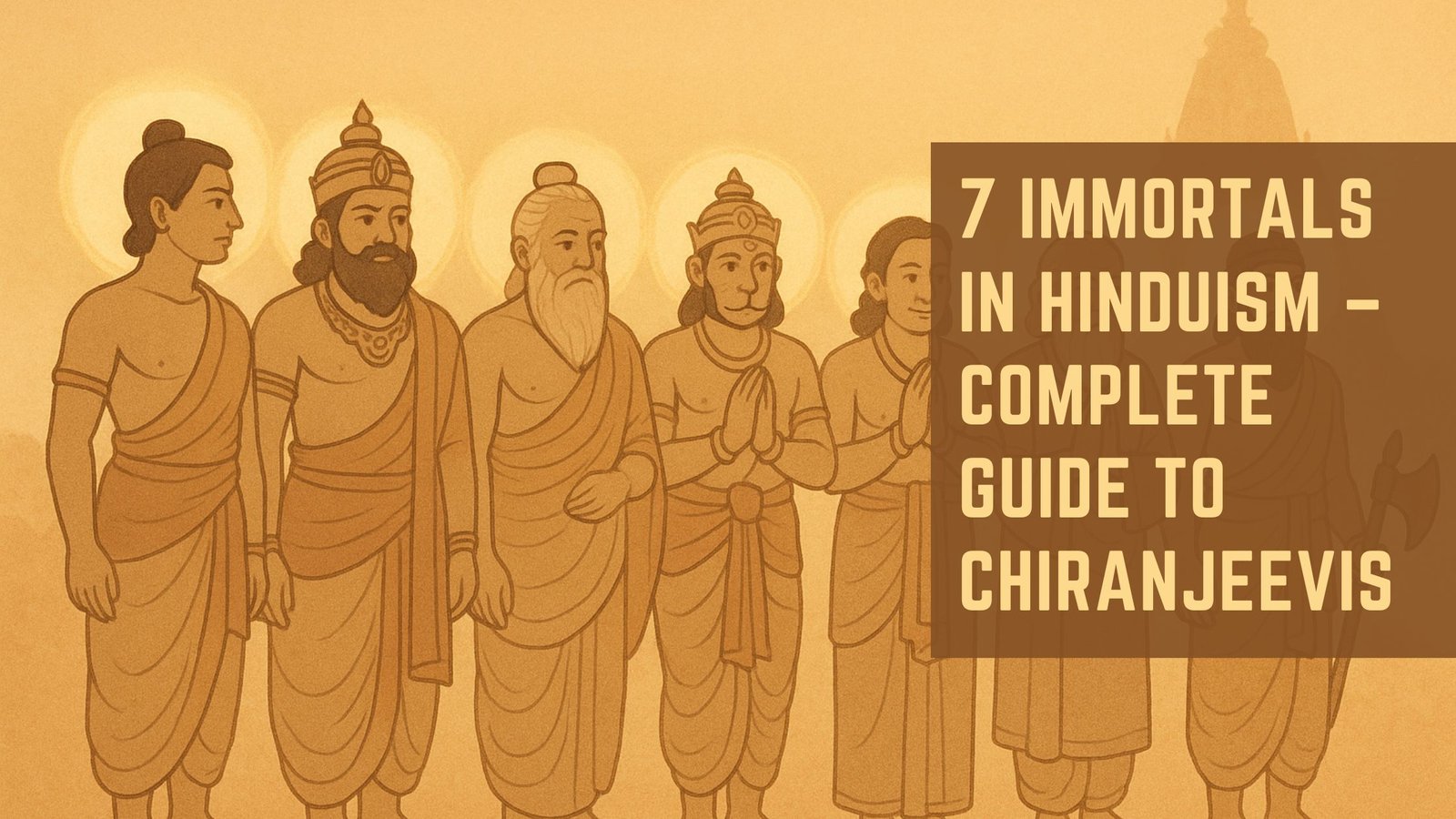
In Hindu philosophy, death is not the end, but a transformation. Yet, there are certain divine beings who are believed to be free from death itself. These are known as Chiranjeevis — the immortals of Sanatan Dharma. The concept of Chiranjeevi in Hinduism reflects not just physical immortality, but spiritual continuity, divine mission, and eternal service to righteousness.
The 7 Immortals in Hinduism are legendary figures gifted (or cursed) with immortality until the end of the Kali Yuga. Their lives teach us profound lessons on karma, devotion, courage, and responsibility.
Table of Contents
What Does Chiranjeevi Mean?
The word Chiranjeevi comes from Sanskrit:
- Chiram – Long / eternal
- Jeevi – Living being
Thus, a Chiranjeevi is someone who lives for an extremely long or infinite time.
The concept of Chiranjeevi in Hinduism is not about escaping death, but fulfilling an ongoing cosmic duty. The essence of the 7 immortals in Hinduism lies in their timeless service to dharma.
The Seven Immortals (Chiranjeevis) in Hinduism
The traditional list of the 7 Immortals in Hinduism includes these divine or semi-divine beings:
- Ashwatthama
- Mahabali
- Vyasa
- Hanuman
- Vibhishana
- Kripacharya
- Parashurama
Each of them represents a unique path of dharma, devotion, strength, knowledge, or karma.
1. Ashwatthama — The Immortal Warrior with a Curse
Ashwatthama, the son of Guru Dronacharya, abandoned righteousness in anger and unknowingly earned a curse from Lord Krishna.
Instead of death, he was cursed with immortality and endless suffering.
Life Lesson:
“Anger is a fire that burns its own container before anyone else.”
Ashwatthama represents how power without control leads to destruction.
2. King Mahabali — The Symbol of Humility and Sacrifice
Mahabali was a noble demon king blessed by Lord Vishnu in the form of Vamana avatar. Despite losing his kingdom, he remains immortal and will return at the end of Kali Yuga.
Spiritual Meaning:
Ego can be surrender, not just pride.
His immortality is a reward for his selflessness and truth.
3. Maharishi Vyasa — The Eternal Sage of Knowledge
Vyasa, the compiler of the Vedas and author of the Mahabharata, received immortality for preserving divine wisdom for humanity.
He is a living symbol of knowledge beyond time.
Vyasa represents Chiranjeevi in Hinduism as the preserver of sacred texts.
Quote:
“Truth never dies, only those who stop seeking it do.”
4. Lord Hanuman — The Immortal Devotee
Hanuman Ji is one of the most celebrated Chiranjeevis in all of Sanatan Dharma. He is believed to be alive even today, guiding sincere devotees.
His immortality is a blessing from Lord Rama.
Hanuman embodies the true essence of Chiranjeevi in Hinduism — eternal devotion.
Quote:
“Where Ram resides, there Hanuman breathes.”
5. Vibhishana — The Righteous One among Demons
Brother of Ravana, Vibhishana chose dharma over blood. Lord Rama granted him immortality for his unwavering loyalty toward justice.
Lesson:
Choosing truth over family pride is the highest sacrifice.
This aspect makes him a pillar of Chiranjeevi in Hinduism.
6. Kripacharya — The Eternal Teacher
Kripacharya was the royal guru of the Kuru dynasty. He was granted immortality to preserve future dynasties through wisdom.
He represents: Discipline, memory of history, and dharmic guidance.
7. Parashurama — The Immortal Warrior Avatar
Parashurama, the 6th avatar of Vishnu, was granted immortality and is believed to appear again as the guru of Kalki.
He maintains the balance between justice and destruction.
Parashurama stands as a fierce embodiment of Chiranjeevi in Hinduism.
Quote:
“When injustice crosses limits, divinity wears a warrior’s form.”
Spiritual Interpretation of Immortality
Immortality in Hinduism does not always mean physical life; it signifies:
• Eternal impact
• Timeless wisdom
• Continuous spiritual presence
• Cosmic responsibility
The concept of Chiranjeevi in Hinduism teaches us that life is not judged by length, but by purpose.
7 Immortals at a Glance
| Chiranjeevi | Source of Immortality | Divine Role |
|---|---|---|
| Ashwatthama | Curse | Consequences of Adharma |
| Mahabali | Blessing | Humility & Sacrifice |
| Vyasa | Divine Gift | Knowledge Preserver |
| Hanuman | Blessing | Devotion & Strength |
| Vibhishana | Blessing | Righteous Leadership |
| Kripacharya | Blessing | Education & Tradition |
| Parashurama | Divine Purpose | Protector of Dharma |
Modern Life Lessons from the 7 Immortals
• Devotion over doubt (Hanuman)
• Dharma over relations (Vibhishana)
• Knowledge as eternal wealth (Vyasa)
• Humility is true power (Mahabali)
• Anger destroys legacy (Ashwatthama)
• Discipline preserves culture (Kripacharya)
• Strength must serve justice (Parashurama)
Ancient Shloka on Immortals
“अश्वत्थामा बलिर्व्यासो हनूमांश्च विभीषण:।
कृपः परशुरामश्च सप्तैते चिरजीविन:”
Meaning: Ashwatthama, Bali, Vyasa, Hanuman, Vibhishana, Kripa and Parashurama are known as the seven immortals.
This verse confirms the cultural foundation of Chiranjeevi in Hinduism.
Why Are These Immortals Needed in Kali Yuga?
They are spiritual guardians watching over humanity’s moral direction.
They remind us that dharma never dies — it only awaits awakening.

Spiritual Power of the 7 Immortals in Hinduism
The 7 immortals in Hinduism are not just mythological characters; they are living symbols of dharma, duty, and divine continuity. Each of the 7 immortals in Hinduism carries a specific role in preserving balance during the Kali Yuga. From Hanuman’s undying devotion to Parashurama’s eternal mission of justice, the impact of these Chiranjeevis goes far beyond ancient scriptures. The concept of immortality through Chiranjeevi in Hinduism reflects that when a soul is dedicated to truth and righteousness, time itself becomes powerless. The presence of the 7 immortals in Hinduism teaches that divine service never ends; it only transforms across yugas.
Philosophical Meaning of Chiranjeevi in Hinduism
The spiritual depth of Chiranjeevi in Hinduism goes beyond physical immortality and enters the realm of eternal purpose. The idea of Chiranjeevi in Hinduism suggests that when one’s life merges with dharma, their existence becomes timeless. The 7 immortals in Hinduism symbolize this eternal alignment with cosmic duty, where life continues not for personal gain but for universal balance. Through the teachings of the 7 immortals in Hinduism, we understand that true immortality is achieved when one sacrifices ego and lives for a divine cause. This is why the concept of Chiranjeevi in Hinduism remains one of the most powerful and spiritually significant beliefs in Sanatan Dharma.
Role of the 7 Immortals in Hinduism in Kali Yuga
The 7 immortals in Hinduism play a silent but powerful role in guiding humanity through the moral decline of Kali Yuga. According to scriptures, the 7 immortals in Hinduism remain present on Earth, not to rule, but to observe, protect dharma, and inspire spiritual seekers. Through the divine concept of Chiranjeevi in Hinduism, these beings serve as living bridges between ancient wisdom and modern humanity. The teachings and spiritual presence of the 7 immortals in Hinduism remind us that dharma never truly disappears; it only awaits revival through awareness and devotion. The influence of Chiranjeevi in Hinduism therefore becomes a source of hope in an age filled with confusion, conflict, and spiritual decline.
Why Chiranjeevi in Hinduism Still Matters Today
In the modern world, where faith often struggles under materialism, the idea of Chiranjeevi in Hinduism holds deep relevance. The 7 immortals in Hinduism represent values that humanity urgently needs today — truth, self-control, devotion, courage, and moral strength. By understanding the stories of the 7 immortals in Hinduism, we do not just learn mythology; we receive ethical guidance for daily life. The philosophy of Chiranjeevi in Hinduism teaches that true immortality is not about escaping death, but about creating an impact so powerful that one’s consciousness continues to guide future generations. Even today, the spiritual awareness spread by the 7 immortals in Hinduism continues to awaken seekers walking on the path of dharma.
FAQs
Q1. Are the 7 immortals still alive today?
According to Hindu belief, yes. They exist in subtle forms to guide humanity.
Q2. Why is Ashwatthama immortal despite his sins?
His immortality is punishment, not a reward. It teaches that consequences never escape time.
Q3. Why is Hanuman the most worshipped Chiranjeevi?
Because his immortality is linked with devotion, protection, and present spiritual guidance.
Q4. What is the difference between immortality in Hinduism and Western concepts?
Hindu immortality is spiritual duty, while Western ideas focus mostly on physical life extension.
Q5. Is the idea of Chiranjeevi symbolic or literal?
It is both philosophical and metaphysical — representing eternal role and living presence.
Conclusion
The 7 Immortals in Hinduism do not represent escape from death — they embody responsibility beyond death.
The idea of 7 Immortals in Hinduism teaches us that one becomes eternal not by avoiding mortality, but by living in alignment with truth, dharma, and divine purpose.
Their stories continue to protect us, guide civilizations, and remind humanity that righteousness never goes extinct.
“Those who live for truth never die — they only change form.”
To explore more spiritual knowledge and deep insights from Sanatan Dharma, visit our website — thegita.in.