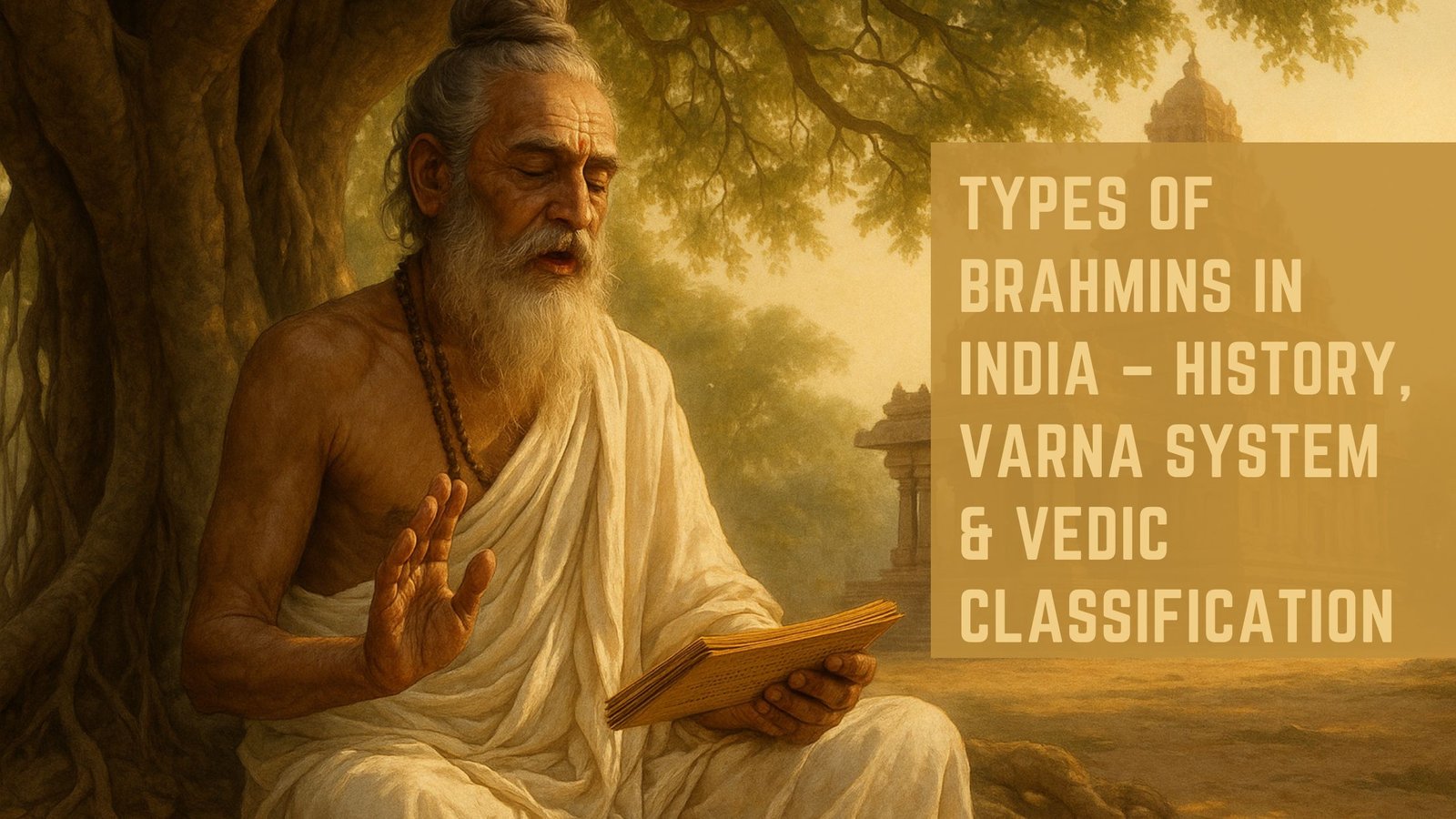
The word Brahmin comes from Brahma – the ultimate reality, the supreme consciousness. Traditionally, Brahmins are associated with knowledge, wisdom, spiritual practices, and the preservation of sacred scriptures. However, over time, different communities, traditions, and lineages emerged, leading to a wide and diverse Classification of Brahmins across India.
This blog explores the Types of Brahmins, not as a matter of hierarchy, but as a historical, cultural, and spiritual understanding based on Vedic literature, regional evolution, and the teachings of the Bhagavad Gita.
“Brahmana is not one who is born so, but one who lives in Brahman (Supreme Knowledge).”
Table of Contents
Meaning of Brahmin According to Bhagavad Gita
In the Bhagavad Gita (18.42), Lord Krishna defines the qualities of a true Brahmin:
शमो दमस्तपः शौचं क्षान्तिरार्जवमेव च।
ज्ञानं विज्ञानमास्तिक्यं ब्रह्मकर्म स्वभावजम्॥
Meaning:
Peacefulness, self-control, austerity, purity, tolerance, honesty, wisdom, knowledge, and faith in God – these are the natural qualities of a Brahmin.
Here, Krishna emphasizes that Brahminhood is based on qualities and actions, not merely birth. This philosophy also deeply influences the traditional types of brahmins.
Historical Origins of Brahmins
The origins of Brahmins trace back to the Vedic period. They were custodians of:
- Rigveda
- Samaveda
- Yajurveda
- Atharvaveda
Each Brahmin family originally specialized in the study and recitation of a particular Veda, which became one basis for the early types of brahmins.
Over centuries, migration, regional kingdoms, language changes, and cultural evolution gave rise to multiple Brahmin communities across India.
Classification of Brahmins Based on Vedas
One major Classification of Brahmins is based on the Vedas they follow:
1. Rigvedi Brahmins
Followers and preservers of the Rigveda.
Mainly found among: Saraswat, Goud, Deshastha Brahmins.
2. Yajurvedi Brahmins
Divided into:
- Shukla Yajurveda followers (e.g., Iyers)
- Krishna Yajurveda followers (e.g., Maharashtra Deshastha)
3. Samvedi Brahmins
Specialize in musical and chanting traditions of the Samaveda.
4. Atharvavedi Brahmins
Focus on rituals, household ceremonies, and philosophical interpretations based on Atharvaveda.
This Vedic division forms the backbone of the traditional types of brahmins.
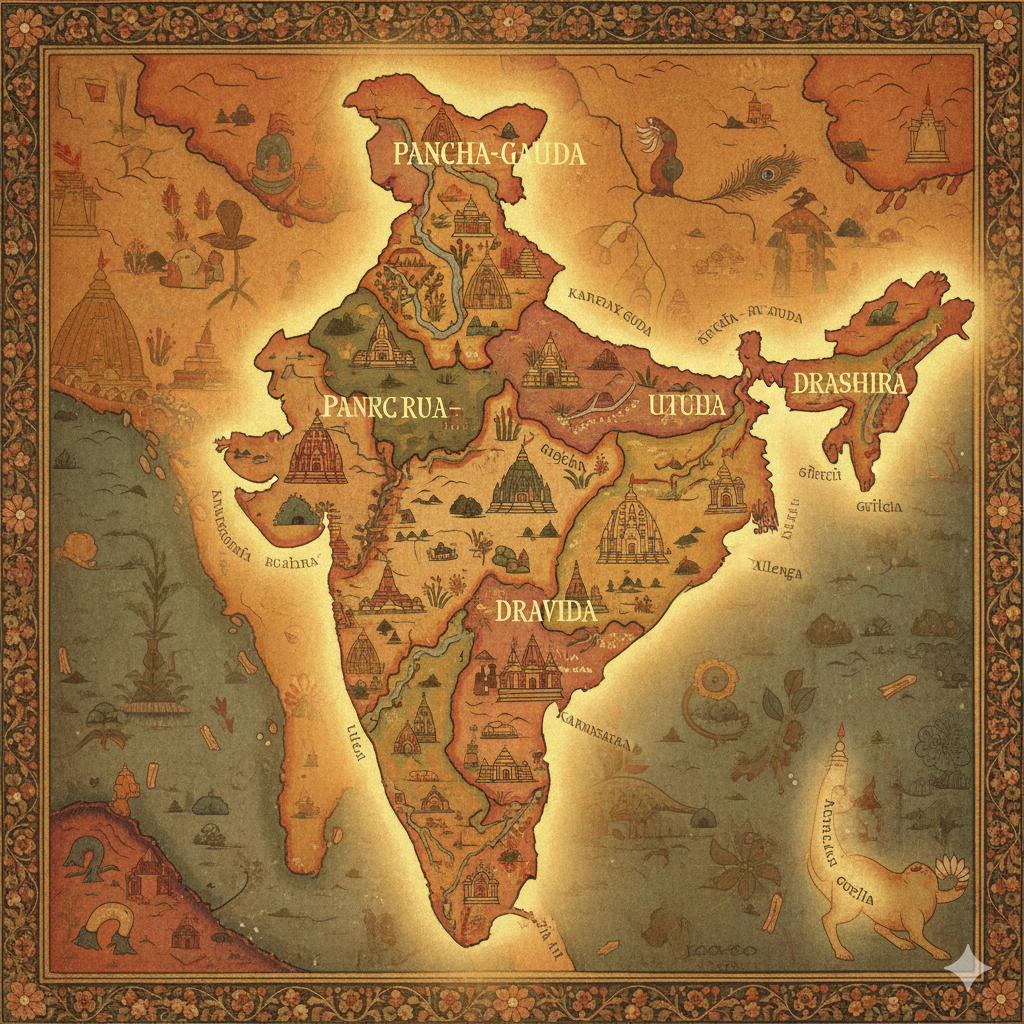
Classification of Brahmins Based on Pancha-Gauda & Pancha-Dravida
Another ancient system of types of brahmins divides them geographically:
Pancha-Gauda (North India Brahmins):
- Saraswat
- Gaur
- Kanyakubja
- Maithil
- Utkal
Pancha-Dravida (South India Brahmins):
- Dravida
- Niyogi
- Karnata
- Gurjara
- Maharashtra
These groups evolved due to migration patterns and regional traditions.
Regional Types of Brahmins in India
1. Saraswat Brahmins
Origin: Saraswati River region
Found mainly in: Goa, Maharashtra, Karnataka, Kashmir
Known for: Vedic scholarship and temple traditions.
2. Maithil Brahmins
Origin: Mithila region (Bihar)
Known for: Deep ritual knowledge and Sanskrit scholarship.
3. Gaur Brahmins
Origin: North India (Rajasthan, Haryana)
Associated historically with royal courts and priesthood.
4. Iyer Brahmins
Found in Tamil Nadu
Followers of Shukla Yajurveda
Highly involved in temple rituals.
5. Iyengar Brahmins
Vaishnavite Brahmin community
Followers of Ramanujacharya
Focused on Bhakti and Vishishtadvaita philosophy.
6. Deshastha Brahmins
Found in Maharashtra and Karnataka
Subgroups: Deshastha Rigvedi, Deshastha Yajurvedi.
7. Konkani Brahmins
Originally Saraswat
Migrated due to political and religious changes.
All these branches fall within the broader types of brahmins that developed through history and migration.
Classification of Brahmins Based on Gotra System
Gotra represents the ancient sage lineage a Brahmin belongs to. Major Gotras include:
- Bharadwaj
- Kashyap
- Vashishtha
- Vishwamitra
- Jamadagni
- Gautam
- Atri
Gotra classification determines:
- Marriage traditions
- Ritual procedures
- Spiritual lineages
Thus, Gotra is another essential dimension in the larger types of brahmins.
Philosophical View: Brahmin as a Role, Not Birth
Bhagavad Gita removes rigid birth-based definitions and emphasizes action and nature.
“A true Brahmin is one who sees the same divine soul in all beings.”
– Bhagavad Gita 5.18
This teaching serves as a spiritual lesson for society:
Spiritual Lesson
True Brahminhood is achieved through:
- Knowledge
- Compassion
- Discipline
- Service
- Humility
Not simply through lineage.
Modern Relevance of Brahmin Classification
In modern society:
- Many Brahmins are part of education, research, administration, and spirituality.
- Social mobility has blurred rigid caste boundaries.
- The teachings of Gita promote equality beyond birth.
Instead of dividing society, the Classification of Brahmins should be understood as a historical and cultural mapping, not superiority.
Quote
“The one who conquers the mind is a true Brahmin, not the one who carries the title.”
Cultural Contributions of Brahmin Communities
Brahmins have significantly contributed to:
- Preservation of Sanskrit
- Development of Indian philosophy
- Temple traditions
- Classical music and dance
- Yoga and Dharma philosophy
Their role has been more about knowledge transmission than power.
Important Facts About Brahmins
- Not all Brahmins do priestly work.
- Many pursue science, arts, administration, and modern professions.
- Brahmin identity evolved over centuries based on lifestyle, region, and duties.
- The Classification of Brahmins varies across texts and traditions.
Role of Brahmins in Preserving Vedic Knowledge
For thousands of years, Brahmins have played a crucial role in safeguarding India’s spiritual heritage. They were the primary keepers of the Vedas, Upanishads, Puranas, and Smritis, passing sacred knowledge orally from one generation to the next through the Guru–Shishya tradition. This system ensured the accurate pronunciation of mantras, preservation of complex philosophical ideas, and continuity of rituals across centuries. Without this knowledge lineage, much of India’s ancient wisdom might have been lost to time.
Social Responsibility and Ethical Duties of Brahmins
According to Dharma Shastras, the social duty of Brahmins was not limited only to performing rituals. They were also expected to act as moral philosophers, advisors to kings, and teachers to society. Their primary responsibility was to guide society using spiritual wisdom, truth, and ethical conduct. A true Brahmin was expected to live a life of simplicity, self-discipline, and service, acting as a moral light for the community, rather than a figure of social dominance.
Misconceptions Around Brahmin Identity in Modern Times
In modern society, many misconceptions exist regarding Brahmin identity. While some view it only as a hereditary caste label, its true philosophical meaning lies in living according to Brahminical virtues like knowledge, compassion, humility, and purity of thought. The misuse of caste identity for societal division has weakened the original spiritual purpose of Varna Dharma. The Bhagavad Gita clearly reminds us that qualities and actions define one’s role, not birth alone.
Types of Brahmins Based on Lifestyle and Occupation
Throughout history, the Types of Brahmins were not only distinguished by Vedic school or region but also by their lifestyle and professional roles. Some Types of Brahmins dedicated their lives to temple worship, while other Types of Brahmins worked as royal advisors, astrologers, teachers, or scholars. There were also Types of Brahmins involved in agriculture, administration, and even modern professions like law and science. This socio-professional evolution shows that the Types of Brahmins adapted with time while still carrying forward their core values of knowledge, discipline, and Dharma. Understanding these Types of Brahmins helps us see them not as a rigid caste, but as a dynamic knowledge community shaped by time and duty.
Types of Brahmins in Ancient vs Modern India
In ancient India, the Types of Brahmins were largely centered around spiritual duties such as Yajnas, Vedic teaching, and philosophical discourse. However, in modern India, the Types of Brahmins have expanded into diverse fields like technology, education, medicine, politics, and arts. While earlier Types of Brahmins were primarily associated with temples and Gurukuls, today’s Types of Brahmins contribute to society through innovation, leadership, and social service. This transformation of Types of Brahmins reflects how Dharma evolves with time while maintaining its spiritual foundation.
FAQ
Q1. What is the original meaning of Brahmin?
A Brahmin is traditionally one who seeks and spreads supreme knowledge (Brahma Jnana).
Q2. How many types of Brahmins are there in India?
There is no fixed number. The Classification of Brahmins depends on region, Veda, gotra, and tradition.
Q3. Is the Brahmin classification based on caste or duty?
Spiritually, it is based on duty and qualities, not just caste by birth.
Q4. Are Iyer and Iyengar Brahmins different?
Yes. Iyers follow Smarta tradition, while Iyengars follow Vishishtadvaita Vaishnavism.
Q5. Does Bhagavad Gita support birth-based caste?
No. It clearly states Varna is based on guna (qualities) and karma (actions).
Conclusion
The Types of Brahmins and the traditional Classification of Brahmins are deeply rooted in India’s Vedic, cultural, and historical evolution. But according to true spiritual understanding, Brahminhood is not limited to birth.
It is a journey of:
- Knowledge
- Self-discipline
- Compassion
- Truth
- Spiritual realization
As the Bhagavad Gita teaches us, true identity lies not in caste but in consciousness and conduct.
“A true Brahmin is reflected not in lineage but in light, not in name but in nature.”
Your blog on this topic can guide readers to understand history without promoting division — and instead, inspire spiritual unity. Don’t just read history — understand its spiritual essence.
Join thousands of seekers exploring Dharma, Karma, and consciousness through authentic Gita teachings. Start your journey today: thegita.in.