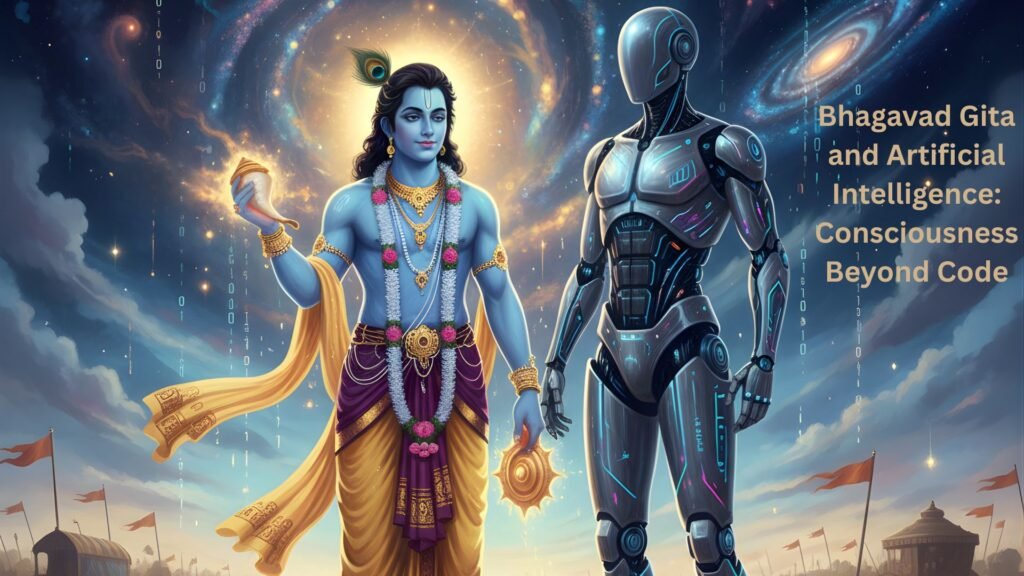
In today’s rapidly evolving digital age, the intersection of the Gita and Artificial Intelligence opens a profound dialogue between timeless wisdom and technological innovation. Artificial Intelligence (AI) is teaching machines to “think,” “learn,” and “decide,” but the Bhagavad Gita invites humanity to look deeper — beyond code, logic, and data — into the essence of Consciousness itself.
While AI operates through algorithms, the Gita explores the depth of awareness — the witness within. The teachings of Lord Krishna to Arjuna are not just about war or duty; they explore self-awareness, detachment, and ego transcendence — insights that can guide how humanity shapes and governs the future of Gita and Artificial Intelligence in the modern era.
“नैव किंचित्करोमीत्येव योऽन्येते मन्यते कविः।”
— Bhagavad Gita 5.8
(The wise see themselves as non-doers even while acting, knowing that consciousness alone observes all.)
Table of Contents
🌸 Life Lessons: Gita’s Teachings for the Age of Artificial Intelligence
🌸 1. Awareness vs. Intelligence
Artificial Intelligence mimics the form of intelligence but lacks awareness. In the Consciousness in Bhagavad Gita, Lord Krishna explains the difference between the body, mind, and Atman (Self). The Atman is pure awareness — the eternal observer that perceives all but remains untouched.
AI can process vast data and predict outcomes, but it cannot experience subjective awareness. The Gita and Artificial Intelligence relationship reminds us that awareness is not programmed — it is realized.
“अविनाशि तु तद्विद्धि येन सर्वमिदं ततम्।”
— Bhagavad Gita 2.17
(Know that which pervades the entire body is indestructible; no one can destroy that imperishable Self.)
Just as Krishna teaches that consciousness is eternal, we understand that no AI, however advanced, can imitate the eternal, witnessing Self.
🌸 2. Ego and the Illusion of Control
Modern AI ethics warn against human pride — the illusion that we can “control” creation. The Gita teaches that ego (Ahamkara) binds us to delusion. The harmony between the Gita and Artificial Intelligence reminds us that technology, without humility, becomes dangerous.
When developers build machines in their own image, they risk amplifying human flaws. The Gita’s wisdom teaches humility and surrender of ego as the foundation of all ethical progress.
“अहंकारं बलं दर्पं कामं क्रोधं परिग्रहम्।”
— Bhagavad Gita 16.18
(Ego, power, arrogance, desire, and anger — these are the qualities that bind the soul.)
The antidote — both for individuals and for innovators — lies in awareness and detachment from pride.
🌸 3. Detachment and Ethical Creation
The Bhagavad Gita teaches Nishkama Karma — action without attachment to results. In the realm of Gita and Artificial Intelligence, this principle translates into developing technology with ethics, compassion, and accountability.
When AI is created with detachment — without greed or dominance — it becomes a tool of service, not control.
“कर्मण्येवाधिकारस्ते मा फलेषु कदाचन।”
— Bhagavad Gita 2.47
(You have the right to perform your actions, but not to the fruits thereof.)
This eternal wisdom of the Gita and Artificial Intelligence reveals that true innovation is guided by responsibility, not reward.
🌸 Modern Relevance: Gita’s Vision for AI Ethics
The concept of Consciousness in Bhagavad Gita offers a deeper lens to examine AI ethics. When machines act, who holds moral responsibility — the programmer, the user, or the system? Here, the Gita and Artificial Intelligence together offer a spiritual framework to find balance.
Just as Arjuna was torn between duty and morality, we now face choices between innovation and integrity. Lord Krishna’s guidance — to act with awareness and compassion — forms the foundation of a mindful AI-driven world.
AI ethics inspired by the Gita can emphasize:
- Transparency: Understanding cause and effect in algorithms.
- Compassionate Design: Building AI that uplifts rather than exploits.
- Responsibility: Creating mindfully, not recklessly.
“When technology meets awareness, intelligence becomes compassion.”
— Inspired by the Gita’s spirit of conscious creation.
In this balance between Gita and Artificial Intelligence, machines compute, but humans remain conscious. Awareness becomes the light that ensures code never overshadows the soul that creates it.
🌸 Verse Explanation: Consciousness Beyond Code
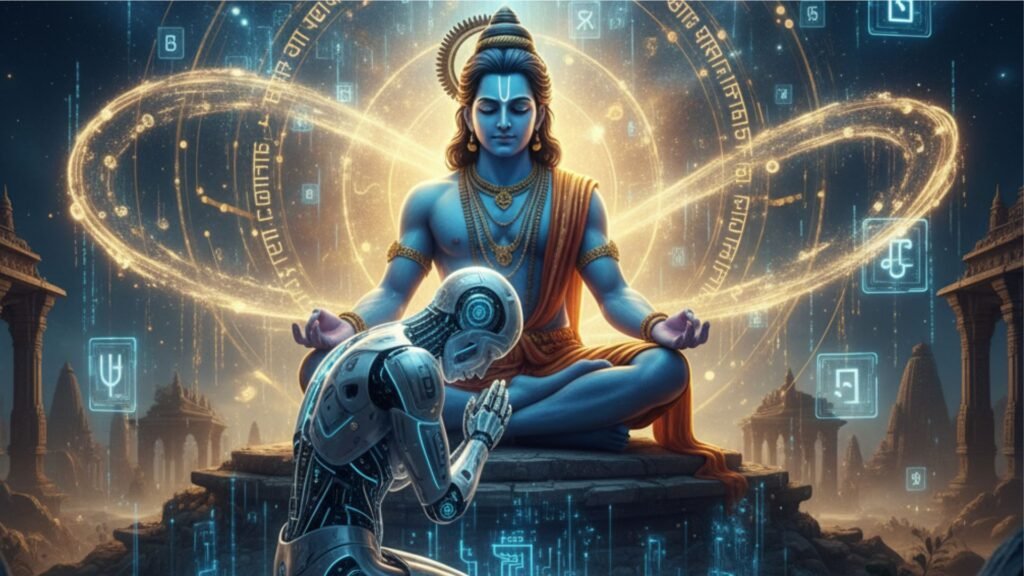
The Gita views Chaitanya (consciousness) as infinite, eternal, and divine — something no code can replicate. AI can simulate thought but not feel awareness.
“उद्धरेदात्मनाऽऽत्मानं नात्मानमवसादयेत्।”
— Bhagavad Gita 6.5
(Let man lift himself by his own self; let him not degrade himself. The Self is both friend and foe.)
This verse reflects that true consciousness arises from within — not from design or data. AI operates externally; the Self operates eternally. The Consciousness in Bhagavad Gita reminds us that intelligence is not just calculation — it is realization.
🌸 Inspirational Quotes
“Artificial Intelligence may calculate the world, but only awareness can comprehend it.”
“The Gita teaches that intelligence without consciousness is like a lamp without light.”
“AI may evolve through data; consciousness evolves through self-realization.”
“Krishna’s wisdom reminds humanity — you are not the program, you are the Programmer.”
🌸 FAQs: Gita and Artificial Intelligence
1. How does the Gita relate to Artificial Intelligence?
The Gita and Artificial Intelligence share a common quest — understanding intelligence and awareness. The Gita teaches that true intelligence arises from consciousness, while AI replicates logic without awareness.
2. What is the meaning of Consciousness in Bhagavad Gita?
The Consciousness in Bhagavad Gita refers to the eternal Self (Atman) that observes all actions without attachment. It is beyond birth, death, and programming — unlike artificial systems.
3. Can AI ever achieve consciousness like humans?
According to the Gita, consciousness is divine and self-illumined. Machines may process data but cannot realize awareness. AI can simulate intelligence, not consciousness
4. What lessons from the Gita can guide AI ethics?
The Gita’s teachings on detachment, humility, and Nishkama Karma (selfless action) can guide ethical AI creation — ensuring technology serves humanity rather than controls it.
5. How can the Gita help balance technology and spirituality?
The Gita reminds us that awareness and compassion must guide every innovation. It helps balance outer progress (AI) with inner evolution (Consciousness).
🌸 Conclusion: The Future of Consciousness
The union of Gita and Artificial Intelligence reminds us that while machines may think, only humans can be aware. The Consciousness in Bhagavad Gita teaches that true intelligence flows from awareness, not from code. As technology advances, let us ensure compassion remains at its core.
“When consciousness guides creation, intelligence becomes divine.”
Let us apply Krishna’s wisdom — to act without ego, innovate with purpose, and remain detached from pride. Before awakening machines, let us awaken the Self within.
✨ Explore more timeless insights on TheGita.in — where ancient wisdom meets the modern world.